| Piú votate - THE LUNAR EXPLORER ARCHIVES |

vo1_00437-00.jpgSunrise over Mars (Extremely Enhanced Natural Colors; credits for the additional process. and color.: Dr Paolo C. Fienga - Lunexit Team)67 visiteDal bellissimo Sito di Keith Laney (http://keithlaney.net/) - che Vi suggeriamo di andare a visitare - un'immagine conosciuta, "datata" (siamo ai tempi del Viking Orbiter 2), ma pur sempre affascinante: nuvole stratiformi (o nebbie?!?) di ghiaccio d'acqua che assumono, grazie ai raggi del Sole che sta appena sorgendo, riflessi celesti, azzurrini e verdi.
Una splendida immagine: e non si può dire nulla di più.MareKromium
(9 voti)
|
|

Cydonia_Mensae-The_Face-060.gifAs Time Goes By... (1)117 visiteDue bellissimi GIF-Movies per vedere come la "Face on Mars" sia (sostanzialmente!) cambiata negli ultimi 25 anni.
Molti sostenitori della natura artificiale della "Face" dicono che la NASA ha truccato le carte - rectius: le immagini - perchè un qualcosa che rimane inalterato (o quasi) per milioni e milioni di anni non può deteriorarsi improvvisamente.
Giusto.
Ma chi può dire con certezza assoluta che la collinetta che noi chiamiamo "Face" è DAVVERO rimasta INALTERATA per milioni e milioni di anni?
Che dire se, invece, la "Face" è stata tale solo per un breve intervallo di tempo?
In altre parole: e se provassimo a cambiare i termini del discorso per una volta - così, tanto per non fare sempre i "Complottisti" - e dicessimo che la "Face" (FORSE!) non è altro che una collinetta la quale ha mutato e muta continuamente d'aspetto a causa del concorso di svariate cause (i.a.: le condizioni meteorologiche di Marte) e noi, grazie all'occhio del Viking Orbiter One, in un istante della sua "vita" (fatta, ripetiamo, di continui e costanti cambiamenti), l'abbiamo vista "simile" ad un volto umanoide il quale, ovviamente, è durato (o meglio: si è mostrato a noi come tale) solo per un breve periodo di tempo?
Perchè no?!? Pensateci sopra...
MareKromium
(9 voti)
|
|
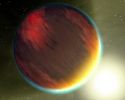
HD189733b-PIA09200.jpgJust like Jupiter...69 visiteThis artist's concept shows a cloudy Jupiter-like planet that orbits very close to its fiery hot star. NASA's Spitzer Space Telescope was recently used to capture spectra, or molecular fingerprints, of two "hot Jupiter" worlds like the one depicted here. This is the first time a spectrum has ever been obtained for an exoplanet, or a planet beyond our solar system.
The ground-breaking observations were made with Spitzer's spectrograph, which pries apart infrared light into its basic wavelengths, revealing the "fingerprints" of molecules imprinted inside. Spitzer studied two planets, HD 209458b and HD 189733b, both of which were found, surprisingly, to have no water in the tops of their atmospheres. The results suggest that the hot planets are socked in with dry, high clouds, which are obscuring water that lies underneath. In addition, HD209458b showed hints of silicates, suggesting that the high clouds on that planet contain very fine sand-like particles.
Capturing the spectra from the two hot-Jupiter planets was no easy feat. The planets cannot be distinguished from their stars and instead appear to telescopes as single blurs of light. One way to get around this is through what is known as the secondary eclipse technique. In this method, changes in the total light from a so-called transiting planet system are measured as a planet is eclipsed by its star, vanishing from our Earthly point of view. The dip in observed light can then be attributed to the planet alone.
This technique, first used by Spitzer in 2005 to directly detect the light from an exoplanet, currently only works at infrared wavelengths, where the differences in brightness between the planet and star are less, and the planet's light is easier to pick out. For example, if the experiment had been done in visible light, the total light from the system would appear to be unchanged, even as the planet disappeared from view.
To capture spectra of the planets, Spitzer observed their secondary eclipses with its spectrograph. It took a spectrum of a star together with its planet, then, as the planet disappeared from view, a spectrum of just the star. By subtracting the spectrum of the star from the spectrum of the star and planet together, astronomers were able to determine the spectrum of the planet itself.
Neither of the parent stars for HD 209458b or HD 189733b can be seen with the naked eye. HD 209458b is located about 153 light-years away in the constellation Pegasus, while HD 189733b is about 62 light-years away in the constellation Vulpecula. Both planets zip around their stars in very tight orbits; HD 209458b circles once every 3.5 days, while HD 189733b orbits once every 2.2 days.
Of the approximately 200 known exoplanets, there are 12 besides HD 209458b and HD 189733b whose orbits are inclined in such a way that, from our point of view, they pass in front of their stars. At least three of these transiting exoplanets are bright enough to follow in the footsteps of HD 209458b and HD 189733 and reveal their infrared spectra to Spitzer. Astronomers hope to use Spitzer's spectrograph in the future to study HD 209458b and HD 189733b again in much greater detail, and to examine some of the other candidates for the first time.
(9 voti)
|
|

Aeolian_Features-Windstreaks-V20036001.jpgWindstreaks, Pseudo-Windstreaks and Surface Striations (3 - False Colors)63 visitenessun commentoMareKromium
(9 voti)
|
|

NGC-1313.jpgNCG 1313 - Barred Spiral67 visite"...You have no idea how much nastier would be if I was not a Catholic.
Without "Supernatural Aid" I would hardly be a human being..."
Evelyn Waugh (1903 - 1966) - replying to Nancy Mitford who rebuked her for cruelty
(9 voti)
|
|

M-016-PIA09107.jpgM 16 - The "Eagle Nebula"67 visiteThis majestic view taken by NASA's Spitzer Space Telescope tells an untold story of life and death in the Eagle Nebula, an industrious star-making factory located 7000 L.Y. away in the Serpens constellation. The image shows the region's entire network of turbulent clouds and newborn stars in infrared light.
The color green denotes cooler towers and fields of dust, including the three famous space pillars, dubbed the "Pillars of Creation," which were photographed by NASA's Hubble Space Telescope in 1995 (see inset).
But it is the color red that speaks of the drama taking place in this region. Red represents hotter dust thought to have been warmed by the explosion of a massive star about 8,000 to 9,000 years ago. Since light from the Eagle nebula takes 7000 years to reach us, this "supernova" explosion would have appeared as an oddly bright star in our skies about 1000 to 2000 years ago.
According to astronomers' estimations, the explosion's blast wave would have spread outward and toppled the three pillars about 6,000 years ago (which means we wouldn't witness the destruction for another 1,000 years or so). The blast wave would have crumbled the mighty towers, exposing newborn stars that were buried inside, and triggering the birth of new ones.
The pillars of the Eagle nebula were originally sculpted by radiation and wind from about 20 or so massive stars hidden from view in the upper left portion of the image. The radiation and wind blew dust away, carving out a hollow cavity (center) and leaving only the densest nuggets of dust and gas (tops of pillars) flanked by columns of lighter dust that lie in shadow (base of pillars). This sculpting process led to the creation of a second generation of stars inside the pillars.
If a star did blow up in this region, it is probably located among the other massive stars in the upper left portion of the image. Its blast wave might have already caused a third generation of stars to spring from the wreckage of the busted pillars.
This image is a composite of infrared light detected by Spitzer's infrared array camera and multiband imaging photometer. Blue is 4.5-micron light; green is 8-micron light; and red is 24-micron light.
(9 voti)
|
|

M-016-PIA09108.jpgThe many colors of the Eagle69 visiteThis set of images from NASA's Spitzer Space Telescope shows the Eagle Nebula in different hues of infrared light. Each view tells a different tale. The left picture shows lots of stars and dusty structures with clarity. Dusty molecules found on Earth called polycyclic aromatic hydrocarbons produce most of the red; gas is green and stars are blue.
The middle view is packed with drama, because it tells astronomers that a star in this region violently erupted, or went supernova, heating surrounding dust (orange). This view also reveals that the hot dust is shell shaped, another indication that a star exploded.
The final picture highlights the contrast between the hot, supernova-heated dust (green) and the cooler dust making up the region's dusty star-forming clouds and towers (red, blue and purple).
The left image is a composite of infrared light with the following wavelengths: 3.6 microns (blue); 4.5 microns (green); 5.8 microns (orange); and 8 microns (red). The right image includes longer infrared wavelengths, and is a composite of light of 4.5 to 8.0 microns (blue); 24 microns (green); and 70 microns (red). The middle image is made up solely of 24-micron light.
(9 voti)
|
|

as08-14-2485.jpgAS 08-14-2485 - What a Moon!79 visitenessun commentoMareKromium
(9 voti)
|
|
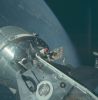
AS09-20-3061.jpgAS 09-20-3061 - Let's go take a (Space) Walk!...65 visite
(9 voti)
|
|

as07-06-1697-00.jpgAS 07-06-1697 - Beautiful Mother Earth n. 176 visitenessun commento
(9 voti)
|
|
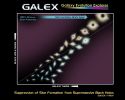
Black Hole-PIA08697_fig1.jpgBlack Holes72 visiteThis diagram illustrates research from NASA's Galaxy Evolution Explorer showing that black holes -- once they reach a critical size -- can put the brakes on new star formation in elliptical galaxies.
In this graph, galaxies and their supermassive black holes are indicated by the drawings (the black circle at the center of each galaxy represents the black hole). The relative masses of the galaxies and their black holes are reflected in the sizes of the drawings. Blue indicates that the galaxy has new stars, while red means the galaxy does not have any detectable new stars.
The Galaxy Evolution Explorer observed the following trend: the biggest galaxies and black holes (shown in upper right corner) are more likely to have no observable star formation (red) than the smaller galaxies with smaller black holes. This is evidence that black holes can create environments unsuitable for stellar birth.
The white line in the diagram illustrates that, for any galaxy no matter what the mass, its black hole must reach a critical size before it can shut down star formation.
(9 voti)
|
|
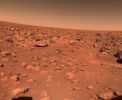
vl2_p17686.jpgRed Planet, Orange Planet... - Frame Viking Lander 2 n. p1768658 visitenessun commento
(9 voti)
|
|
| 3218 immagini su 269 pagina(e) |
 |
|
|
|
|
22 | |
|
|
|
|





