| |

| Piú votate - THE LUNAR EXPLORER ARCHIVES |

OPP-SOL1167-PIA09694-1.jpgWhat if...79 visitenessun commentoMareKromium
(10 voti)
|
|

AlienWorld-PIA09228.jpgTwin Suns' Sunset72 visiteOur solitary sunsets here on Earth might not be all that common in the grand scheme of things. New observations from NASA's Spitzer Space Telescope have revealed that mature planetary systems -- dusty disks of asteroids, comets and possibly planets -- are more frequent around close-knit twin, or binary, stars than single stars like our sun. That means sunsets like the one portrayed in this artist's photo concept, and more famously in the movie "Star Wars," might be quite commonplace in the universe.
Binary and multiple-star systems are about twice as abundant as single-star systems in our galaxy, and, in theory, other galaxies. In a typical binary system, two stars of roughly similar masses twirl around each other like pair-figure skaters. In some systems, the two stars are very far apart and barely interact with each other. In other cases, the stellar twins are intricately linked, whipping around each other quickly due to the force of gravity.
Astronomers have discovered dozens of planets that orbit around a single member of a very wide stellar duo. Sunsets from these worlds would look like our own, and the second sun would just look like a bright star in the night sky.
But do planets exist in the tighter systems, where two suns would dip below a planet's horizon one by one? Unveiling planets in these systems is tricky, so astronomers used Spitzer to look for disks of swirling planetary debris instead. These disks are made of asteroids, comets and possibly planets. The rocky material in them bangs together and kicks up dust that Spitzer's infrared eyes can see. Our own solar system is swaddled in a similar type of disk.
Surprisingly, Spitzer found more debris disks around the tightest binaries it studied (about 20 stars) than in a comparable sample of single stars. About 60 percent of the tight binaries had disks, while the single stars only had about 20 percent. These snug binary systems are as close or closer than just three times the distance between Earth and the sun. And the disks in these systems were found to circumnavigate both members of the star pair, rather than just one.
Though follow-up studies are needed, the results could mean that planet formation is more common around extra-tight binary stars than single stars. Since these types of systems would experience double sunsets, the artistic view portrayed here might not be fiction.
The original sunset photo used in this artist's concept was taken by Robert Hurt of the Spitzer Science Center at the California Institute of Technology, Pasadena, Calif.
(10 voti)
|
|

HD-209458b-00.jpgExtra-Solar Planet HD-209458b (1)68 visiteThe powerful vision of NASA's HST has allowed astronomers to study for the first time the layer-cake structure of the atmosphere of a planet orbiting another star. HST discovered a dense upper layer of hot Hydrogen gas where the super-hot planet's atmosphere is bleeding off into space.
The planet, designated HD 209458b, is unlike any world in our Solar System. It orbits so close to its star and gets so hot that its gas is streaming into space, making the planet appear to have a comet-like tail. This new research reveals the layer in the planet's upper atmosphere where the gas becomes so heated it escapes, like steam rising from a boiler.
"The layer we studied is actually a transition zone where the temperature skyrockets from about 1340 deg. Fahrenheit (1000 Kelvin) to about 25.540 degrees (15.000 Kelvin), which is hotter than the Sun " said Gilda Ballester of the University of Arizona in Tucson, leader of the research team.
"With this detection we see the details of how a planet loses its atmosphere."
The findings by Ballester, David K. Sing of the University of Arizona and the Institut d'Astrophysique de Paris, and Floyd Herbert of the University of Arizona will appear Feb. 1 in a letter to the journal Nature.
The Hubble data show how intense ultraviolet radiation from the host star heats the gas in the upper atmosphere, inflating the atmosphere like a balloon. The gas is so hot that it moves very fast and escapes the planet's gravitational pull at a rate of 10,000 tons a second, more than three times the rate of water flowing over Niagara Falls. The planet, however, will not wither away any time soon. Astronomers estimate its lifetime is more than 5 billion years.
The scorched planet is a big puffy version of Jupiter. In fact, it is called a "hot Jupiter," a large gaseous planet orbiting very close to its parent star. Jupiter might even look like HD 209458b if it were close to the Sun, Ballester said.
The planet completes an orbit around its star every 3.5 days. It orbits 4.7 million miles from its host, 20 times closer than the Earth is to the Sun. By comparison, Mercury, the closest planet to our Sun, is 10 times farther away from the Sun than HD 209458b is from its star. Unlike HD 209458b, Mercury is a small ball of iron with a rocky crust.
(10 voti)
|
|

Aeolian_Features-Windstreaks-V18214014.jpgWindstreaks, Pseudo-Windstreaks and Surface Striations (2 - False Colors)62 visiteI "Windstreaks" presentano caratteristiche visibili che li rendono agevolmente riconoscibili. Essi si dipartono da rilievi superficiali (anche modesti) quali bordi di crateri - rims -, picchi centrali di crateri di medio/grandi dimensioni - peaks -, colline - hills -, fratture superficiali "a scalino" - step-like cracks - ed anche macigni erratici ed ejecta - erratic and ejecta boulders.
Le superfici di questi rilievi, opponendosi al vento, creano, alle spalle dei rilievi medesimi, almeno 3 diverse tipologie di terreni (diciamo 3 diverse aree):
1) Area di minimo disturbo - è l'area più protetta, proprio a ridosso della porzione sottovento del rilievo e, di regola, ha un colore più chiaro rispetto al resto del paesaggio e la forma di un triangolo isoscele;
2) Area con massimo disturbo - segna la fine del cono di protezione costituito dal rilievo opposto al vento e l'inizio della superficie direttamente battuta dal vento; ha una forma - di regola - lineare e si caratterizza per il fatto di avere un colorito più scuro ripetto al resto del paesaggio;
3) Area di transizione - ha una forma arcuata, conica o anche semi-circolare e definisce la fine della "regione di influenza" del rilievo sui venti che battono la superficie su cui esso sorge.
I Windstreaks, ovviamente, possono configurarsi in maniera diversa rispetto alle tre tipologie che abbiamo descritto qui di sopra, ad esempio, allorchè i venti battono da diverse direzioni in tempi diversi, ora cancellando le aree (1) ed ora confondendo le aree (2) e (3), ma il dato di fatto che a noi preme sottolineare è che, comunque sia, l'azione del vento sui rilievi (piccoli, medi o grandi che sìano) produce un "Windstreak" il quale, almeno inizialmente, configura ("disegna", se volete...) il suolo determinando le tre aree che abbiamo definito.
Ora, a Vostro parere, i segni del "battere" del vento su una superficie ed i segni che il "muoversi" di corpi spinti dal vento sulla medesima superficie producono, sono "visivamente" uguali?
Le tracce lasciate dal vento che, trasportando sabbie e polveri, batte e "ripulisce" una superficie e le tracce lasciate, sempre su una superficie, da un vento che trasporta "fumi in emissione da camini vulcanici", sono "visivamente" uguali?
Possono esserlo?
Noi non abbiamo intenzione - per tanti motivi - di metterci a riscrivere tutta la "storia" (geologica ed atmosferica) di Marte riclassificandone tutti i fenomeni però, se avete seguito i nostri ragionamenti sino a questo punto, sarete d'accordo con noi nel dire che, forse, non tutto quello che "sembra essere qualcosa" poi si rivela essere realmente "quel qualcosa".
Ricordate? Non tutti i crateri, forse, derivano da impatti; non tutte le dune derivano da accumuli di sabbie e polveri trasportate dai venti e, quindi (e sempre "forse"), non tutti i Windstreaks sono il prodotto delle medesime azioni.
O meglio: che si tratti, a proposito dei Windstreaks, di eventi sempre legati ad azioni eoliche, siamo tutti d'accordo; ma che queste azioni eoliche, alla fine, vadano ad esprimere sempre le medesime caratteristiche "a prescindere"...A noi pare una forzatura.
Ed ora: che parlino le immagini e, con esse, i Vostri occhi, le Vostre competenze e, certamente, le Vostre sensazioni e supposizioni.
Buon Lavoro!MareKromium
(10 voti)
|
|
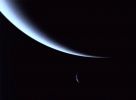
vg2_p34761.jpg...Fare Forward, Voyager!... (natural colors - elab. Lunexit)74 visitenessun commentoMareKromium
(10 voti)
|
|

MorningLights.jpgMorning Lights...102 visiteNel quadro delle innumerevoli opinioni sulle apparenze di Marte (ovvero sul come un occhio umano vedrebbe il Panorama Marziano "da" Marte), ci piace inserire questa nuova elaborazione ottenuta dai nostri due (bravissimi) Tecnici dell'Immagine: luci del mattino (un "cupo" e nebbioso mattino) sull'ormai lontano Endurance Crater.
Assunzioni di partenza: elevata O.A., cielo parzialmente coperto da nuvole stratiformi poste ad altezze comprese fra i 3 ed i 5 Km, luminosità di base del Sole - che è ancora bassissimo sull'orizzonte - pari ad 1/3-1/4 della luminosità media di un'alba terrestre, colore dominante di base e di fondo: arancio/marrone.
(10 voti)
|
|
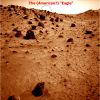
The_American_Eagle-SOL1041-2N218780428EFFAS81P0700R0M1.jpgImagination: the American Eagle - Sol 104175 visiteDue frames dedicati alla "umana capacità" di compiere associazioni logiche basate sull'esperienza (in questo caso visiva) e, conseguentemente, di vedere "cose che hanno un senso umano e compiuto" (ad es.: profili, facce, sentinelle e manufatti vari) laddove c'è solo la Natura e la nostra - a volte sfrenata - Immaginazione...
(10 voti)
|
|

OPP-SOL1016-1N218384221EFF7700P0635L0M1.jpgFantasy: green-algae all over Meridiani?123 visiteFrame a colori elaborati fantasiosamente, sulla base di un suggerimento del nostro Caro Amico e Socio, Lorenzo Leone: e se fosse proprio questo lo spettacolo che vedremmo realmente, oggi, "while walking on Mars"?!?...MareKromium
(10 voti)
|
|

P-BalleSpaziali-CUN-00.jpgIs this a U.F.O.?!? (1)353 visiteNel Sito del Centro Ufologico Nazionale "CUN Italia Network" (http://www.cun-italia.net/index.htm) c'è una Sezione - fra le tante - che è dedicata agli "UFO fotografati da Astronauti" (http://www.cun-italia.net/astronauti/astronauti.htm) e, alla pagina 1 di 2 - se non è stata di recente modificata -, troverete, inter alia, anche questa curiosa ed intrigante immagine di un presunto UFO.
Che dire? Quando le immagini Apollo-NASA non vengono corredate del loro seriale identificativo, rintracciare un qualsiasi frame diventa un'opera improba ma, ancora una volta, il nostro Dr Gianluigi Barca, consultando con enorme pazienza l'Apollo Image Atlas, è riuscito a trovare il frame controverso in questione: è un frame Apollo 12 e lo andremo a visionare nel quadro che segue...
(10 voti)
|
|

AS09-19-2968.jpgAS 09-19-2968 - Mother Earth79 visite
(10 voti)
|
|

vg2_p34761.jpgThe Eternity beyond Neptune and Triton (natural colors - elab. NASA)61 visitenessun commento
(10 voti)
|
|

vl2_22e169_old.jpgAntenna Mast - Frame Viking Lander 2 n. 22e169 (Natural Colors; credits: NASA/JPL)62 visitenessun commento
(10 voti)
|
|
| 3218 immagini su 269 pagina(e) |
|
|
|
|
|
16 | |
|
|
|
|
|
|





