| Piú votate |

Phobos_from_Mgs-011.jpgMartian Limb and Phobos (Natural Colors; credits: NASA/MGS/MSSS)134 visiteUna spettacolare veduta del bordo ("limb") di Marte e della sua luna "misteriosa", Phobos, la quale costituisce anche uno degli oggetti più "bui" dell'intero Sistema Solare. Ecco il commento originale a questa immagine:
"Phobos is one of the darkest objects in the Solar System. Thus, 4 wide angle images were obtained to make the picture of Phobos over the martian limb: a pair of red and blue wide angle images was acquired for the limb and a pair of separate images were required to see Phobos. The wide angle images illustrate the fact that Phobos is mostly colorless (dark gray); the faint orange/red hue in the wide angle picture is a combination of slight differences in the focal lengths of the blue and red cameras and the orange/red illumination provided by reflection of sunlight off Mars. To a person standing on Phobos, the Red Planet would fill most of the sky". 
(11 voti)
|
|
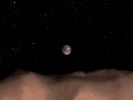
Toutatis.jpgEarth from the asteroid "Toutatis"86 visiteOn September 29, 2004, the Earth came within 1 million miles of the asteroid Toutatis - the closest predicted approach of our fair planet to a sizable asteroid or comet in this century. Coming within 1 million miles (or about 4 times the Earth-Moon distance), Earth would appear to be nearly the size of the full moon in the asteroid's sky, as suggested in this illustration. In Earth's sky, Toutatis appeared only as a faint object rapidly moving against a background of stars. Also known as Earth-Crossing Asteroid (ECA) 4179, Toutatis is in an eccentric 4 year orbit which moves it from the asteroid belt between Mars and Jupiter to just inside Earth's orbit. When the Earth passed near it in 1992 Toutatis was imaged by radar and seen to be 2 irregularly shaped lumps, perhaps joined by a narrow neck. This bizarre object is about 3 Km wide, 5,5 Km long and is tumbling through space. Studies of Toutatis and other ECA's help reveal connections between the Solar System's meteorites main-belt asteroids and comets.
(11 voti)
|
|

Sun - Coronal holes.jpgCoronal "Holes"62 visiteCaption NASA originale:"The ominous, dark shapes haunting the left side of the Sun are coronal holes - low density regions extending above the surface where the solar magnetic field opens freely into interplanetary space. Studied extensively from space since the 1960s in ultraviolet and x-ray light, coronal holes are known to be the source of the high-speed solar wind, atoms and electrons which flow outward along the open magnetic field lines. During periods of low activity, coronal holes typically cover regions just above the Sun's poles. These coronal holes, however, have just moved into view near the Sun's equator, and particles escaping them have already caused notable aurora here on Earth. Coronal holes like this one may last for a few solar rotations before the magnetic fields shift and change configurations. Shown in false-color, this picture of the Sun on March 9, 2003, was made in extreme ultraviolet light by the EIT instrument on board the space-based SOHO observatory".
(11 voti)
|
|

Sun & Comet (dtl-mgnf).jpgA comet approaching the Sun (from SOHO) - detail mgnf60 visiteCaption NASA originale:"Based on their similar orbits, as first worked out by 19th century German astronomer Heinrich Kreutz, all "sungrazers" are believed to originate from a single large "parent comet" which broke up during a perihelion passage perhaps 2.000 years ago. Over time, pieces have continued to split off producing a family of smaller comets which seem to travel in the same orbit".
(11 voti)
|
|

ZZ-The Blair Cuspids Area(un)-iv_090_h1.jpgThe "Blair Cuspids' Area" (unedited)142 visiteFu un certo Dr William BLAIR - un antropologo che lavorava alla Boeing (la Società produttrice del Lunar Orbiter) - che rimase particolarmente colpito da queste "anomalie" e dedicò ad esse un profondo studio il quale ancora oggi mantiene, al pari delle "cuspidi", un grande fascino ed interesse. Il Dr Blair si era infatti convinto, osservando l'immagine ripresa dal Lunar Orbiter, che simili strutture rispondevano, in termini geometrici, ad una sorta di "trama" che ricordava - per certi versi - i tracciati...
(11 voti)
|
|
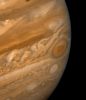
Jupiter-V2-LAFT-PIA01370_modest.jpgLate afternoon on Jupiter...59 visiteCaption NASA originale:"This color composite made from Voyager 2 narrow-angle camera frames shows the Great Red Spot during the late Jovian afternoon. North of the Red Spot lies a curious darker section of the South Equatorial Belt (SEB), the belt in which the Red Spot is located. A bright eruption of material passing from the SEB northward into the diffuse equatorial clouds has been observed on all occasions when this feature passes north of the Red Spot. The remnants of one such eruption are apparent in this photograph".
(11 voti)
|
|

Jupiter_s limb-Gal-PIA00896_modest.jpgJupiter's limb, from Galileo71 visiteCaption NASA originale:"North is at the top. The images are projected on a sphere, with features being foreshortened towards the north. The planetary limb runs along the right edge of the mosaic. Cloud patterns appear foreshortened as they approach the limb. The smallest resolved features are tens of kilometers in size. These images were taken on April 3, 1997, at a range of 1.4 MKM by the Solid State Imaging system (CCD) on NASA's Galileo spacecraft".
(11 voti)
|
|

Jupiter-V1-PIA01324_modest.jpgCrescent Jupiter (from Voyager 1)59 visiteCaption NASA originale:"This crescent view of Jupiter was taken by Voyager 1 on March 24, 1979. This image was taken through three color filters and recombined to produce the color image. This photo was assembled from three black and white negatives by the Image Processing Lab at Jet Propulsion Laboratory".
(11 voti)
|
|

Jupiter-HW-PIA00360_modest.jpgHigh Winds on Jupiter (from appx. 4.000.000 Km)61 visiteCaption NASA originale:"A high resolution image of the Jovian mid-latitudes taken by Voyager 1 on March 2, 1979, shows distinctly differing characteristics of the planet's meteorology. The well defined pale orange line running from southwest to northeast (North is at the top) marks the high speed north temperate current with wind speeds of about 120 meters p/s. These high winds produce a cleaner flow pattern in the surrounding clouds whose average lifetime is of about 2 years".
(11 voti)
|
|
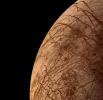
Europa-V2-PIA00459.jpgEuropa from Voyager 2 - the closest approach65 visiteCaption NASA originale:"This color image of the Jovian moon Europa was acquired by Voyager 2 during its close encounter on Monday morning, July 9, 1979. Europa, the size of our Moon, is thought to have a crust of ice perhaps 100 kilometers thick which overlies the silicate crust. The complex array of streaks indicate that the crust has been fractured and filled by materials from the interior. The lack of relief, any visible mountains or craters, on its bright limb is consistent with a thick ice crust hypothesis".
(11 voti)
|
|
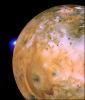
Io-Plumes from Loki-V1-PIA00010_modest.jpgLoki's eruption on Io (the "Plume")67 visiteUn'informazione importante per chi volesse provare a calcolare le dimensioni effettive della "piuma vulcanica" (conoscendo, ovviamente, le dimensioni di Io): l'immagine è stata scattata da (circa) 490.000 Km.
Original caption:"Voyager 1 image of Io showing active plume of Loki on limb. Heart-shaped feature southeast of Loki consists of fallout deposits from active plume Pele. The images that make up this mosaic were taken from an average distance of approximately 490.000 Km (about 340.000 miles)".
(11 voti)
|
|

Io-Eruptions-PIA00293.jpgContinuous eruptions on Io66 visiteThis image, taken by NASA's Galileo spacecraft, shows a new blue-colored volcanic plume extending about 100 kilometers (about 60 miles) into space from Jupiter's moon Io (see inset at lower left). The blue color of the plume is consistent with the presence of sulfur dioxide gas and 'snow' condensing from the gas as the plume expands and cools. Galileo images have also shown that the Ra Patera plume glows in the dark, perhaps due to the fluorescence of sulfur and oxygen ions created by the breaking apart of sulfur dioxide molecules by energetic particles in the Jovian magnetosphere. The images at right show a comparison of changes seen near the volcano Ra Patera since the Voyager spacecraft flybys of 1979 (windows at right show Voyager image at top and Galileo image at bottom). This eruptive plume is an example of a new type of volcanic activity discovered during Voyager's flyby in 1979, believed to be geyser-like eruptions driven by sulfur dioxide or sulfur gas erupting and freezing in Io's extremely tenuous atmosphere. Volcanic eruptions on Earth cannot throw materials to such high altitudes. Ra Patera is the site of dramatic surface changes. An area around the volcano of about 40,000 square kilometers, area about the size of New Jersey, has been covered by new volcanic deposits. The image was taken in late June 28, 1996 from a distance of 972,000 kilometers (604,000 miles).
(11 voti)
|
|
| 25332 immagini su 2111 pagina(e) |
 |
|
|
|
|
98 | |
|
|
|
|





