| Piú votate |

12-Davy Crater Chain.jpgThe "Davy Crater Chain" from Lunar Orbiter 4 - A comet impact?109 visiteCaption NASA originale:"Lunar Orbiter 4 image of the Davy Crater Chain on the Moon. The chain stretches from Davy Y at left to the large, bright Davy G (diameter 15 Km). Note the even spacing of the craters. The chain may be the result of secondary impacts, volcanic activity, or an impactor which broke apart shortly before impact, similar to Comet Shoemaker/Levy 9 on Jupiter. North is up (Lunar Orbiter 4, frame 108-H2)".
Location & Time Information
Date/Time (UT): 1967-05-18 T 17:16:51
Distance/Range (km): 2719
Central Latitude/Longitude (deg): -14.26/357.64
(11 voti)
|
|

10-A-Tsiolkovsky Crater.jpgTsiolkovsky Crater on the far-side of the Moon136 visiteCaption NASA originale:"Lunar Orbiter 3 view of Tsiolkovsky crater and the southern zone of the western far side of the Moon. The approximately 240 Km crater at the upper center of the image is located at 20° S, 130° E and exhibits a flat, dark infilled floor and prominent central peak. The circular feature at the very bottom of the image is Planck Crater, at 55° S, 130° E. This image is upside down from the original so that North is up. A high resolution view of the crater is shown in L03-121-H1 (LO 3, frame M-121)".
Location & Time Information
Date/Time (UT): 1967-02-19 T 19:22
Distance/Range (km): 1500
Central Latitude/Longitude (deg): -24.15/126.59
(11 voti)
|
|

OPP-SOL339-B_P2581_L456-B352R1.jpgSkull Rock is an iron-nickel meteorite! - Sol 339 (Approximate True Colors; credits: NASA/JPL-Caltech)98 visiteDunque avevamo visto giusto: Skull Rock sembrava "estranea" al paesaggio Marziano di Meridiani Planum perchè NON è una roccia Marziana! Skull Rock è - a quanto dice la NASA - il frammento di una meteora precipitata su Marte. EccoVi la caption NASA originale:"NASA's Mars Exploration Rover Opportunity has found an iron meteorite on Mars, the first meteorite of any type ever identified on another planet. The pitted, basketball-size object is mostly made of iron and nickel. Readings from spectrometers on the Rover determined that composition. Opportunity used its panoramic camera to take the images used in this approximately true-color composite on Sol 339. This composite combines images taken through the PanCam's 600-nanometer (red), 530-nanometer (green) and 480-nanometer (blue) filters".
(11 voti)
|
|

NGC-0346-4.jpgNGC 346 - Open Star Cluster in the Small Magellan Cloud80 visite"...Corruptissima republica, plurimae leges..."
(Tacito)
"...(quando) lo Stato è oltremodo corrotto, le leggi proliferano (aumentano a dismisura)..."
(11 voti)
|
|

Miranda-PIA00038_modest.jpg"Chevron grooves" on Miranda - HR90 visiteCaption NASA originale:"This image of Miranda, obtained by Voyager 2 on approach, shows an unusual 'chevron' figure and regions of distinctly differing terrain on the Uranian moon. Voyager was 42.000 Km (26.000 miles) away when its narrow-angle camera acquired this clear-filter view. Grooved areas baring light and dark bands, distinct from other areas of mottled terrain, are visible at this resolution of about 600 meters (2.000 feet). The bright V-shaped feature in the grooved areas is the 'chevron' observed in earlier, lower-resolution images. Cutting across the bands are sinuous scarps, probably faults. Superimposed on both types of terrain are many bowl-shaped impact craters less than 5 Km (3 mi) wide. The entire picture spans an area about 220 Km (140 mi) across".
(11 voti)
|
|

Craters-Pollack_Crater-01.jpgThe "White Rock" inside Pollack Crater82 visiteCaption NASA originale:"The layering in White Rock suggests that the material is sediment deposited at some time in the distant past within Pollack Crater. The fact that the material erodes to form steep cliffs suggests that it is hard like rock. Thus, White Rock is interpreted to be an outcrop of sedimentary rock. It is probably a small remnant of a larger body of rock that may have once covered the entire floor of Pollack Crater; this view is supported by the observation that more extensive layered rocks are seen in other craters across the surface of the Red Planet (e.g., the crater at 8°N, 7°W)".
(11 voti)
|
|

Saturn.jpgSaturn in real colors60 visitenessun commento
(11 voti)
|
|

M-042-5.jpgM 42, Syrius, a shooting star and the "Green Head" of Machholz Comet83 visite"...La vita è tutto ciò che ci succede mentre facciamo progetti per il futuro..."
John Lennon
(11 voti)
|
|
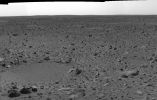
SOL053-PANORAMA-01-ra-2-back-A053R1-PCF-LXTT-00.jpgA very BIG (!) Surface Anomaly from Sol 53 (RAW b/w NASA Original frame)109 visiteGuardate attentamente l'immagine: focalizzate la Vostra attenzione sopra un dettaglio, piccolo ma luminoso, a mezza altezza dell'immagine, leggermente spostato verso la Sn dell'Osservatore. Vi anticipiamo subito che si tratta di un'Anomalia a tutti gli effetti e che, purtroppo, non abbiamo trovato altri frames che la riprendessero meglio o più da vicino. Tuttavia una cosa l'abbiamo notata...
(11 voti)
|
|

Saturn-W00003808.jpgSaturn and Dione80 visitenessun commento
(11 voti)
|
|

A - Uranus.jpgUranus from Voyager 288 visiteUranus Data and Statistics
Discovered by William Herschel
Date of discovery = AD 1781
Mass (kg) = 8.686e+25
Mass (Earth = 1) = 1,4535e+01
Equatorial radius = 25.559 Km
Equatorial radius (Earth = 1) = 4,0074
Mean density (gm/cm^3) = 1,29
Mean distance from the Sun = 2.870.990.000 Km
Mean distance from the Sun (Earth = 1) = 19,1914
Rotational period (hours) = - 17,9
Orbital period (years) = 84,01
Mean orbital velocity = 6,81 Km per second
Tilt of axis = 97,86°
Orbital inclination = 0,774°
Equatorial surface gravity (m/sec^2) = 7,77
Equatorial escape velocity = 21,30 Km per second
Magnitude (Vo) = 5,52
Mean cloud temperature = - 193°C
Atmospheric pressure (bars) = 1,2
Atmospheric composition: Hydrogen 83%; Helium 15%; Methane 2%
(11 voti)
|
|

Japetus-PIA06145_modest.jpgSharp views of Japetus61 visiteIn sequenza, alcune delle migliori immagini di Giapeto ottenute da Cassini e superiori, per qualità e dettaglio, a quelle ottenute dalla Sonda Voyager 2 qualche anno fa. Le immagini a colori visibili sulla Sn dell'Osservatore ed al centro sono state ottenute usando (e combinando) i filtri per l'ultravioletto (a 338 Nnmts), il verde (a 568 Nnmts) e l'infrarosso (a 930 Nnmts); l'immagine a Dx è stata ottenuta riprendendo nel cosiddetto "spettro visibile". Le immagini sono state riprese da una distanza oscillante fra gli 1,1 e gli 1,3 MKMs; Giapeto si caratterizza sia per il gigantesco cratere da impatto visibile nell'emisfero sud (400 Km di diametro), sia per alcune notevoli differenze di albedo fra diverse zone della sua superficie (il che ci fa supporre che esistano aree ricoperte, probabilmente, da vasti depositi di polveri - che sono causa di una bassa riflessione della luce ergo di una bassa albedo - ed altre aree che, forse, sono costituite da rocce o addirittura da depositi di ghiaccio).
(11 voti)
|
|
| 25332 immagini su 2111 pagina(e) |
 |
|
|
|
|
96 | |
|
|
|
|





