| Piú votate |

Neq-Neptune-PIA00057.jpgThe "haze" of Neptune (false colors)56 visiteCaption NASA originale:"This false color photograph of Neptune was made from Voyager 2 images taken through 3 filters: blue, green and a filter that passes light at a wavelength that is absorbed by methane gas. Thus, regions that appear white or bright red are those that reflect sunlight before it passes through a large quantity of methane. The image reveals the presence of a ubiquitous haze that covers Neptune in a semitransparent layer. Near the center of the disk, sunlight passes through the haze and deeper into the atmosphere, where some wavelengths are absorbed by methane gas, causing the center of the image to appear less red. Near the edge of the Planet, the haze scatters sunlight at higher altitude, above most of the methane, causing the bright red edge around the planet. By measuring haze brightness at several wavelengths, scientists are able to estimate the thickness of the haze and its ability to scatter sunlight. The image is among the last full disk photos that Voyager 2 took before beginning its endless journey into interstellar space".
(11 voti)
|
|
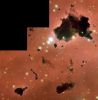
IC_2944-PIA04223.jpgIC 2944 - Thackeray's Globules (HST)82 visite"...I want to go on living even after Death..."
Anne Frank - "Diary" (April 4, 1944)
(11 voti)
|
|

M-002-PIA04926.jpgM 2 - Globular Star Cluster in Aquarius74 visiteCaption NASA originale:"This image of the Globular Cluster Messier 2 (M2) was taken by Galaxy Evolution Explorer on August 20, 2003. This image is a small section of a single All Sky Imaging Survey exposure of only 129 seconds in the constellation Aquarius. This picture is a combination of Galaxy Evolution Explorer images taken with the far ultraviolet (colored blue) and near ultraviolet detectors (colored red). Globular clusters are gravitationally bound systems of hundreds of thousands of stars that orbit in the halos of galaxies. The globular clusters in out Milky Way galaxy contain some of the oldest stars known. M2 lies 33.000 LY from our Sun with stars distributed in a spherical system with a radius of approximately 100 LY".
(11 voti)
|
|

Chasmas-Tithonium_Chasma-2-121-221004-0442-6-co-01.jpgTithonium Chasma - Valles Marineris137 visiteCaption ESA originale:"This image shows the western end of the canyons Tithonium Chasma and Ius Chasma, part of the Valles Marineris canyon system, which are up to 5,5 Km deep.
The image was taken on 26 May 2004 during orbit 442 with a ground resolution of approximately 52 metres per pixel. The displayed region is located at the beginning of the canyon system at about latitude 7° South and longitude 269° East. North is to the left".
(11 voti)
|
|

The Solar Spectrum_noao.jpgThe Solar Spectrum and the "missing colors"...62 visiteDa "NASA - Picture of the Day" del 27 Febbraio 2005:"It is still not known why the Sun's light is missing some colors. Shown above are all the visible colors of the Sun, produced by passing the Sun's light through a prism-like device. The above spectrum was created at the McMath-Pierce Solar Observatory and shows, first off, that although our yellow-appearing Sun emits light of nearly every color, it does indeed appear brightest in yellow-green light. The dark patches in the above spectrum arise from gas at or above the Sun's surface absorbing sunlight emitted below. Since different types of gas absorb different colors of light, it is possible to determine what gasses compose the Sun. Helium, for example, was first discovered in 1870 on a solar spectrum and only later found here on Earth. Today, the majority of spectral absorption lines have been identified - but not all".
(11 voti)
|
|

NGC-2024-00.jpgNGC 2024 - The "Flame" Nebula70 visite"...Dum Romae consulitur, Saguntum expugnatur..."
(Livio)
"...Mentre a Roma si chiacchiera, Sagunto cade..."
(detto per indicare l'inutilità - o peggio - di lunghissime discussioni su problemi che, invece, richiedono decisioni ed azioni rapide)
(11 voti)
|
|

0-The launch of Apollo17-liftoff-noID.jpgThe "Last Launch": Apollo 17139 visiteQuesta immagine del vettore Saturno V che sta per lasciare la rampa di lancio non è un "Farewell": è solo un (triste, ma del tutto temporaneo - speriamo...) "Good-Bye"!
(11 voti)
|
|
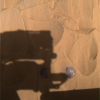
SOL079-Illinois___New_York_Rock-PIA05629.jpgMazatzal: the Illinois & New York areas - Sol 79 (Natural Colors; credits: NASA/JPL-Caltech)175 visiteUn frame in "colori veri" per lo scorcio di una parete rocciosa Marziana che, a livello di sensazione visiva, non ci sembra essere particolarmente interessante.
Possiamo comunque notare due tracce circolari che indicano l'attività delle "spazzole" di cui i Rover sono dotati e che hanno eliminato le polveri arancioni che coprono l'intero Pianeta, così riportandone alla luce i suoi "veri colori".
Ci sembra di vedere, dunque, nella traccia circolare rimasta in luce, un grigio piuttosto brillante (venato di bianco e - forse - con qualche riflesso viola...) il quale potrebbe anche ricordarci le rocce basaltiche e/o il granito.
Ma forse le nostre speculazioni sono del tutto inutili ed i "true colors" di questo frame sono "true" solo nella testa dei Tecnici NASA che lo hanno "tinteggiato"...
(11 voti)
|
|
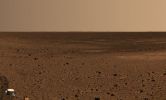
SOL318-325-Husband_Hill-PIA07334_br2-04.jpgColumbia Hills: "Husband Hill's Region" - full 360° panorama (5 - Approximate True Colors; credits: NASA/JPL-Caltech)76 visiteLa pianura attraversata da Spirit per quasi un anno, infine (che vedete molto bene nei sub-frames 1 e 5 di questa carrellata), è stata anch'essa 'piallata ed offuscata'.
Il frame "BIG", se lo andrete a visionare, è altresì deludentissimo per quanto attiene la definizione dei dettagli posti in campo medio e lungo. O meglio: alcuni dettagli (specie quelli posizionati al centro ed alla Dx di chi guarda) sono splendidamente chiari, anche se lontani dal punto di ripresa. Altri, magari decisamente più vicini, sono annebbiati e confusi.
Altre tracce - secondo noi evidenti - di abrasioni e cancellazioni di particolari (riteniamo operate usando un aerografo o qualcosa di simile) nonchè una "nuvola" di puntini luminosi (uno 'spruzzo' fuori bersaglio?!?), sono ben visibili sullo skyline alla Dx di chi guarda.
Last but not least: le colline più lontane (che dovrebbero essere visibili sul filo dell'orizzonte) sembrano disegnate a mano e poi colorate con i "pastelli"...
Il nostro voto all'"Opera"? Un bel 4=!
(11 voti)
|
|

SOL318-325-Husband_Hill-PIA07334_br2-00.jpgColumbia Hills: "Husband Hill's Region" - full 360° panorama (1 - Approximate True Colors; credits: NASA/JPL-Caltech)63 visiteCaption NASA originale:"NASA's Mars Exploration Rover Spirit took this full-circle panorama of the Region near "Husband Hill" (the peak just to the left of center) over the Thanksgiving holiday, before ascending farther. This 360° view combines 243 images taken by Spirit's Panoramic Camera over several Martian Days, (from Sol 318 - Nov. 24, 2004 - to sol 325 - Dec. 2, 2004). It is an approximately true-color rendering generated from images taken through the camera's 750, 530 and 480 nanometer filters. The view is presented here in a cylindrical projection with geometric seam correction".
Abbiamo guardato con attenzione questa immagine e, al di là di qualche piccola valutazione semi-positiva unicamente riferita al suo lato "estetico" - ed a condizione di utlizzare un modestissimo ingrandimento del frame!), i nostri commenti non sono stati affatto positivi.
Vediamo perchè...
(11 voti)
|
|
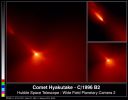
Comets-Comet_Hyakutake-PIA01290_modest.jpgThe "Hyakutake" Comet59 visiteFULL-FIELD VIEW (Left)--->This image is 3340 Km acroos and shows that most of the dust is being produced on the sunward-facing hemisphere of the comet. Also at upper left are 3 small pieces which have broken off the comet and are forming there own tails. Icy regions on the nucleus are activated as they rotate into sunlight, ejecting large amounts of dust in the jets that are faintly visible in this image. Sunlight striking this dust eventually turns it around and "blows" it into the tailward hemisphere. What might be another jet is emanating from the nightside of the nucleus, but this direction might be misleading due to the angle of the jet relative to our line-of-site.
CLOSE-UP OF NUCLEUS (Bottom Right) This expanded view of the near-nucleus region is only 760 Km across. The nucleus is near the center of the frame, but the brightest area is probably the tip of the strongest dust jet rather than the nucleus itself. Presumably, the nucleus surface lies just below this bright jet.
CLOSE-UP OF COMET FRAGMENTS (Top Right) This image shows pieces of the nucleus that apparently broke off and were first detected during ground-based observations on March 24. The Hubble image shows at least three separate objects that are probably made up of coarse-grained dust. Large fragments of the nucleus would not be accelerated into the tail, which appears to be the case in this image.
(11 voti)
|
|

SOU-SOL008-PIA01004.jpgDeflated Airbags and Skyline - Soles 8, 9 and 10 (Natural Colors; credits: NASA/JPL)131 visiteCaption NASA originale:"This is a sub-section of the geometrically improved and color enhanced version of the 360° panorama known as the "Gallery Pan", the first contiguous, uniform panorama taken by the Imager for Mars Pathfinder (IMP) over the course of Soles 8, 9 and 10. Different regions were imaged at different times over the 3 Martian days to acquire consistent lighting and shadow conditions for all areas of the panorama.
The IMP is a stereo imaging system that, in its fully deployed configuration, stands 1,8 mt above the Martian surface and has a resolution of 2 mm at a range of 2 mt. In this geometrically improved version of the panorama, distortion due to a 2,5° tilt in the IMP camera mast has been removed, effectively flattening the horizon. The IMP has color capability provided by 24 selectable filters -- twelve filters per "eye". Its red, green, and blue filters were used to take this image. The color was digitally balanced according to the color transmittance capability of a high-resolution TV at the Jet Propulsion Laboratory (JPL), and is dependent on that device. In this color enhanced version of the panorama, detail in surface features are brought out via changes to saturation and intensity, holding the original hue constant. A threshold was applied to avoid changes to the sky".
(11 voti)
|
|
| 25332 immagini su 2111 pagina(e) |
 |
|
|
|
|
95 | |
|
|
|
|





