| Piú votate |

The Rings-2-PIA07872.jpgThe "Rings": the most spectacular view ever seen!60 visiteSpecially designed Cassini orbits place Earth and Cassini on opposite sides of Saturn's rings, a geometry known as "occultation". Cassini conducted the 1st radio occultation observation of Saturn's Rings on May 3, 2005.
Three simultaneous radio signals of 0,94; 3,6, and 13 cm wavelengths (Ka-, X-, and S-bands) were sent from Cassini through the rings to Earth. The observed change of each signal as Cassini moved behind the Rings provided a profile of the distribution of ring material as a function of distance from Saturn, or an optical depth profile.
This simulated image was constructed from the measured optical depth profiles. It depicts the observed ring structure at about 10 Km in resolution. Color is used to represent information about ring particle sizes in different regions based on the measured effects of the 3 radio signals. Shades of purple, primarily over most of the inner ring (ring B) and the inner portion of the next ring (ring A), indicate regions where there is a lack of particles less than 5 centimeters (about 2 inches) in diameter. Green and blue shades indicate regions where there are particles of sizes smaller than 5 centimeters (2 inches) and 1 centimeter (less than one third of an inch), respectively, primarily in outer ring A and within most of ring C. From other evidence in the radio observations, all ring regions appear to be populated by a broad range of particle size distribution that extends to boulder sizes (several to many meters or yards across). 
(11 voti)
|
|

OPP-SOL027-El_Capitan-xpe_Outcrop_RATplacement_2_blue-B027R1.jpg"El Capitan": an Outcrop inside Eagle Crater - Sol 27142 visiteCaption NASA originale:"This graphic is a planning tool used by Mars Exploration Rover engineers to plot and scheme the perfect location to place the Rock Abrasion Tool on the rock collection dubbed "El Capitan" near Opportunity's landing site. "El Capitan" is located within a larger outcrop nicknamed "Opportunity Ledge. "El Capitan" was named after a mountain in Texas, but on Mars, it is about 10 cm (about 4") high. Scientists are eager to use the Rock Abrasion Tool to peer deeper into the history of the formation of "El Capitan" and the Team will spend multiple Soles taking pre- and post-measurements of the rock targets".
(11 voti)
|
|

ZZ-ZZ-HybridEclypse-Heinsius_Panama_tse2005_1.jpgAn unusual "Hybrid Solar Eclipse" (2)68 visiteDa "NASA - Picture of the Day" del 6 Maggio 2005:"(...) But for Stephan Heinsius, near the end of the shadow track at Penonome Airfield, Panama, the Moon's apparent size had shrunk enough to create an anular eclipse, showing a complete anulus of the Sun's bright disk as a dramatic "Ring of Fire".
(...) How rare is such a Hybrid Eclipse?
Calculations show that during the 21st century just 3,1% (7 out of 224) of Solar Eclipses are hybrid while hybrids comprise about 5% of all Solar Eclipses over the period from 2.000 BC to AD 4.000".
(11 voti)
|
|

ZE-I-Viking2-21a082~0.jpgFrom the "Viking Archive" - Viking 2: surroundings217 visiteIl luogo di discesa del Viking Lander 2 ci mostrò un panorama anch'esso simile ad un deserto roccioso terrestre, sebbene leggermente più ricco di rocce del panorama mostratoci dal Viking 1 e meno "ondeggiante" (insomma, più liscio e senza rilievi di sorta). Le immagini ci mostrano poca sabbia e meno polvere attorno al Lander, ma la sorpresa (se così si può dire) fu costituita dalla presenza di piccoli crepacci (canali?) larghi sino ad 1 metro e profondi 8/10 cm, presenti un pò ovunque.
La configurazione particolarmente liscia del suolo attorno al Lander fece pensare che le rocce fossero poggiate su uno strato di sedimento duro e piatto. E che dire del cielo?!?
La maggior parte delle immagini Viking mostrava un cielo vagamente rosato, forse a causa delle polveri rossastre in (perenne?) sospensione, ma non mancarono casi in cui il cielo Marziano apparve di un tenue celeste.
Colpa di errori nella elaborazione dei dati?
Forse, ma la sapete una cosa davvero strana e su cui pochissimi Ricercatori...
(11 voti)
|
|
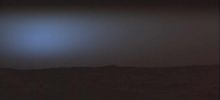
ZE-I-Viking1-12f010.jpgFrom the "Viking Archive" - Viking 1: Sunset139 visiteComposizione a colori dei Viking Lander frames n. 12f010.red, 12f010.grn, and 12f010.blu.
Come potete vedere, negli istanti che seguono la scomparsa del Sole dietro l'orizzonte Marziano, il cielo di Marte appare di un colore "blu-scuro" piuttosto cupo, decisamente intenso e, apparentemente, "soffocato" da una incombente oscurità.
Si tratta di un ennesimo effetto collaterale del cosiddetto "dimming"? Forse, ma anche questa istantanea entra nella galleria dei "frames belli ma discutibili", specialmente se la mettiamo a confronto con altre immagini similari (cioè relative a tramonti Marziani), riprese sempre a colori veri o quasi/veri, ed ottenute dalle Sonde Soujourner/Pathfinder e Spirit (le troverete pubblicate nella Sezione "Mars in Colors").
Guardate, fate i confronti e poi provate a dare qualche risposta agli interrogativi che inevitabilmente emergeranno.
(11 voti)
|
|
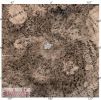
007-Mars_South_Pole.jpgThe South Polar Region of Mars108 visitenessun commento
(11 voti)
|
|

006-Mars_Topography.jpgMars Global Map: Topography103 visitenessun commento
(11 voti)
|
|

012-Thermal_Inertia.jpgMars Global Map: Thermal Inertia100 visitenessun commento
(11 voti)
|
|

NGC-3324-1.jpgNGC 3324 - The "Key-Hole Nebula"77 visite"L'oggettiva carenza di informazioni disponibili può comportare la fine di qualsiasi Ricerca.
D'altra parte, la possibile fine di qualsiasi Ricerca diviene certezza allorchè le informazioni disponibili sono oggettivamente troppe"
"Prima Legge della Ricerca"
(11 voti)
|
|

NGC-1316-01.jpgNGC 1316 - Elliptical Galaxy79 visite"...L'ora più buia è quella che annuncia la fine della notte..."
(anonimo)
(11 voti)
|
|

Venusian_Clouds-IR-PIA00124.jpgLow altitude Venusian clouds (false colors)98 visiteThis false-color image is a near-infrared map of lower-level clouds on the night side of Venus, obtained by the Near Infrared Mapping Spectrometer aboard the Galileo spacecraft as it approached the planet's night side on February 10, 1990. Bright slivers of sunlit high clouds are visible above and below the dark, glowing hemisphere. The spacecraft is about 100.000 Km above the planet. An infrared wavelength of 2,3 microns (about 3 times the longest wavelength visible to the human eye) was used. The map shows the turbulent, cloudy middle atmosphere some 50-55 Km above the surface, 10-16 Km below the visible cloudtops. The red color represents the radiant heat from the lower atmosphere (about 400° Fahrenheit) shining through the sulfuric acid clouds, which appear as much as 10 times darker than the bright gaps between clouds. This cloud layer is at about -30° Fahrenheit, at a pressure about 1/2 Earth's surface atmospheric pressure. Near the equator, the clouds appear fluffy and blocky; farther north, they are stretched out into East-West filaments by winds estimated at more than 150 mph, while the poles are capped by thick clouds at this altitude.
(11 voti)
|
|

Neq-Neptune-PIA00051.jpgNeptune in false colors57 visiteCaption NASA originale:"In this false color image of Neptune, objects that are deep in the atmosphere are blue, while those at higher altitudes are white. The image was taken by Voyager 2's wide-angle camera through an orange filter and two different methane filters. Light at methane wavelengths is mostly absorbed in the deeper atmosphere. The bright, white feature is a high altitude cloud just south of the Great Dark Spot. The hard, sharp inner boundary within the bright cloud is an artifact of computer processing on Earth. Other, smaller clouds associated with the Great Dark Spot are white or pink, and are also at high altitudes. Neptune's limb looks reddish because Voyager 2 is viewing it tangentially, and the sunlight is scattered back to space before it can be absorbed by the methane. A long, narrow band of high altitude clouds near the top of the image is located at 25° north latitude and faint hazes mark the equator and polar regions".
(11 voti)
|
|
| 25332 immagini su 2111 pagina(e) |
 |
|
|
|
|
94 | |
|
|
|
|





