| Piú votate |

Solar Eclypse 2006-tse2006_ayiomamitis_f.jpgThe "Diamond Ring"59 visiteDa "NASA - Picture of the Day" del 30 Marzo 2006:"The track of totality for the first solar eclipse of 2006 began early yesterday on the East coast of Brazil and ended half a world away at sunset in Western Mongolia. In between, the shadow of the Moon crossed the Atlantic Ocean, Northern Africa, central Asia and so came for a moment to the small Greek island of Kastelorizo in the Eastern Aegean.
Astronomer Anthony Ayiomamitis reports that the islanders and many eclipse-watching visitors were indeed treated to an inspiring display of the beautiful Solar Corona as totality lasted about 3 minutes.
As the total phase of the eclipse ended, he was able to capture this striking "Diamond Ring" image. In it, the first rays of sunlight shining through edge-on lunar valleys create the fleeting appearance of glistening diamonds set in a bright ring around the Moon's silhouette".
(11 voti)
|
|
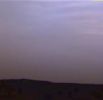
SOU-SOL015.jpgClouds... - Sol 1573 visiteThese clouds from Sol 15 have a new look: as water ice clouds cover the sky, the sky takes on a more bluish cast. This is because small particles (perhaps 1/10th the size of the Martian dust, or 1/1000th the thickness of a human hair) are bright in blue light, but almost invisible in red light. Thus, scientists expect that the ice particles in the clouds are very small. The clouds were imaged by the Imager for Mars Pathfinder (IMP).
(11 voti)
|
|

Comets-Comet_Pojmanski-4.jpgThe "Pojmanski" Comet (HR)66 visiteComet Pojmanski flew by planet Earth last weekend (March 4/5, 2006) on a surprise trip through the Inner Solar System. (...)
Pojmanski ultimately showed off a long tail, but also presented some lovely green-blue hues as gas molecules in its tenuous coma and tail fluoresced in the sunlight. Astronomers Adam Block and Jay GaBany recorded this colorful HR view on March 3rd, 2006, in the darkness just before twilight. The picture spans about two full moons on the sky. Comet Pojmanski (C/2006 A1) is outward bound and fading now, still visible in binoculars for northern hemisphere observers.
(11 voti)
|
|

ALANBEAN-FANTASY.jpg"Buddies" forever98 visitePete Conrad, Dick Gordon and I were assigned by head astronaut Deke Slayton as the backup crew for Apollo 9. This was super news because this meant we would fly three missions subsequent and make one of the first Moon landings.
The most experienced astronaut was designated commander, in charge of all aspects of the mission including flying the lunar module. Prudent thinking suggested that the next most experienced crew member be assigned to take care of the command module since it had a heat shield and was our only way back home. This left the least experienced to accompany the commander. Pete Conrad had flown two Gemini flights, the second with Dick Gordon as his crew mate. I had not flown at all.
During training, Pete and I frequently practiced our lunar surface activities such as emplacing experiments, gathering rock samples, or making observations. We were excited. We were going to have the ultimative adventure someone in our profession could experience. But while we did, Dick Gordon would be orbiting 60 miles above us. We often fantasized Dick joining us on the Moon for all the fun, but we could never really find a way. But now I'm an artist and in my paintings I can have it my way. Now, at last, our best friend has come the last 60 miles.
One last story. Dick was the more experienced astronaut, yet I got the prize assignment. In the three years of training preceding our mission, he never once said: "It's not fair, I wish I could walk on the Moon too." I do not have his unwavering discipline or strength of character.
(11 voti)
|
|

Chamaeleon.jpgSpace Chamaleon77 visite"...Pereant qui crastina curant..."
(Virgilio)
"...(E) che vadano in rovina coloro che pensano (soltanto) al domani..."
(11 voti)
|
|
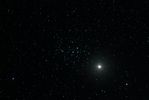
M 44 and Saturn.jpgM 44 and Saturn64 visite"...Silent Leges inter arma..."
(Cicerone)
"...In tempo di guerra - o, comunque, "nel corso di brutti tempi" - le Leggi (da intendersi nel senso più ampio di "principii, ordine e voce della ragione") tacciono..."
(11 voti)
|
|

A-Venus.gifThe Phases of Venus (2) - GIF111 visiteCaption originale:"Venus goes through phases. Just like our Moon, Venus can appear as full as a disk or as a thin as a crescent. Venus, frequently the brightest object in the post-Sunset or pre-Sunrise Sky, appears so small, however, that it usually requires binoculars or a small telescope to clearly see its current phase. The above time-lapse sequence, however, was taken over the course of many months and shows not only how Venus changes phase but how it's apparent angular size also changes. In the middle negative image, Venus is in a new phase, the same phase that occurred during its rare partial eclipse of the Sun in 2004".
(11 voti)
|
|

Moon and Companions~2.jpgHappy New Year from the Moon and Venus75 visiteDa "NASA - Picture of the Day" del 4 Gennaio 2006:"Fading sunlight, a young crescent Moon, and brilliant Venus shared the Western Sky in this view of 2005's final sunset from the top of Mount Haleakala, on Maui, Hawaii. Also known as the Sacred House of the Sun, Haleakala, is Maui's dormant volcano.
At 10.000 feet, the Summit is an ideal site for astronomical observatories, and this scene also features the silhouette of the Northern Hemisphere Faulkes Telescope. It can be of particular interest to students the fact that the Faulkes Telescope (a 2-meter diameter instrument, dedicated to astronomy education), can be remotely operated over the internet.
The Project is a joint effort between the Dill Faulkes Educational Trust and the University of Hawaii - Institute for Astronomy (...)".
(11 voti)
|
|

NGC-4261.jpgNGC 4261 - The "Living Core" of an active Galaxy60 visite"...Incidit in Scyllam, cupiens vitare Charybdim..."
(antico proverbio)
"...Si infranse contro Scilla, cercando di evitare Cariddi..."
ossìa: per evitare alla propria nave di soccombere nel vortice Cariddi, la portò ad infrangersi sullo scoglio Scilla. Detto per indicare l'inevitabilità del Fato e/o l'inevitabilità di un male (oggi diremmo: "al proprio Destino non si può sfuggire").
(11 voti)
|
|

M31-G1.jpgGlobular Cluster M31-G158 visite"...Malitia ipsa maximam partem veneni sui bibit..."
(Seneca)
"...La malvagità si nutre del suo stesso veleno..."
(11 voti)
|
|

59-Luna 13 - Q-Detail 2~0.JPGLunik 13: Oceanus Procellarum (6) - The Anomaly338 visiteCome è stato notato dalla Redazione di Lunar Explorer Italia, tra il frame panoramico (sub-frame 1) che riprende le 2 Singolarità e l'ingrandimento della Singolarità Maggiore (forse un'autentica Anomalìa di superficie), è successo qualcosa. O meglio: c'è una leggera, ma importante, differenza. Sul primo quadrante di questo "boulder" (per ora consideriamolo tale), appaiono due ombre, simili alle lancette di un orologio.
Ebbene queste 2 ombre descrivono un angolo: un angolo che nel sub-frame 1 è più AMPIO rispetto a quanto invece appare nel detail mgnf (frame 5 della nostra sequenza).
E non è tutto. Nel frame 5 (e cioè il detail mgnf del boulder):
a) la luminosità della superficie Lunare appare sostanzialmente diversa e
b) la stessa ombra del boulder (come proiettata sulla superficie della Luna) si è radicalmente modificata rispetto a quanto si vede nel frame 1.
Come spiegare una simile incongruenza? Probabilmente (anzi: sicuramente) i due dettagli accedono a due frames diversi, ottenuti ad una certa distanza di tempo l'uno dall'altro e, come la NASA stessa ci rammenta, a "different Sun angles".
Già. Ma ne siamo proprio sicuri?
Insomma: Luna 13 è rimasta operativa – al massimo – per 5 o 6 giorni terrestri (è arrivata il 24 Dicembre 1966 ed ha smesso di funzionare – sembra... – il giorno 29 o il 30) e, a nostro parere, questo intervallo di tempo è decisamente troppo breve (in rapporto alla durata del giorno Lunare) per consentirci di apprezzare, attraverso le poche immagini inviate e ricevute, una simile variazione di luminosità dell’ambiente e di lunghezza delle ombre.
Oltretutto, le fotografie ottenute da Luna 13 (sulla base dei dati che siamo riusciti – con fatica – a raccogliere) vennero tutte scattate nelle prime 36 (o forse anche meno) ore di operatività della Sonda (nota: il tempo necessario per la successiva trasmissione delle immagini a Terra è irrilevante ai nostri fini) e, dunque, in un arco di tempo, ribadiamo, veramente troppo breve per poter riscontrare delle differenze di contesto così nette.
Conclusioni? Allo stato nessuna, ovviamente.
Il lavoro dell’Amico Fabio Italiano è stato notevole e l’attenzione mostrata dalla nostra Staff, anche.
Le risposte...Le risposte, forse, arriveranno in futuro.
Forse.
(11 voti)
|
|

Venusian_Surface-Venera_13-03.jpgVenus from Venera 13 (detail mgnf)129 visiteSpettacolare dettaglio di un frame originale Venera 13 il quale ci mostra, molto vicino al Lander, delle rocce che - ad occhio - sembrano essere di natura basaltica (ergo avere un'origine vulcanica).
Molto intrigante il dettaglio, visibile in alto a Sx e proprio a ridosso della linea dell'orizzonte, di un rilievo immerso nella nebbia. Si direbbe una modesta collina dal profilo smussato (simile alla famosa Husband Hill di Gusev Crater). Un profilo così smussato da farla somigliare ad una sorta di "cupola".
Una splendida elaborazione, davvero.
(11 voti)
|
|
| 25332 immagini su 2111 pagina(e) |
 |
|
|
|
|
90 | |
|
|
|
|





