| Piú votate |
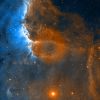
Pelican Nebula.jpgThe "Pelican Nebula" - IC 507080 visite"Dopo la Dissonanza Cognitiva, di cui abbiamo già parlato, vediamo ora il fenomeno conosciuto come "Deriva Cognitiva". Esso si verifica allorchè la percezione di un evento - di qualunque natura - viene modificata dal concorso di fattori esterni alla capacità cognitiva individuale dell'agente i quali, però, sono abbastanza potenti da modificare (o, se preferite, da far "derivare") il valore della sua effettiva percezione. Un esempio: io vedo un gatto attraversare la strada e percepisco questo evento per quello che è. Subito dopo, una moltitudine di persone (oppure pochi individui, ma autorevoli), dice che la strada, in realtà, è stata attraversata da un serpente. Io rimuovo dalla mia percezione il gatto e lo sostituisco con il serpente. Questo fenomeno viene oggi impiegato su larga scala per ottenere Derive Cognitive di massa su eventi i quali, se correttamente percepiti ed interpretati, comprometterebbero le basi dell'attuale Ordine Mondiale".
P.C. Floegers - "Conversations"
(12 voti)
|
|

MOON HALO.jpgMoon halo with planets and stars157 visiteUna bellissima - ancorchè amatoriale - immagine delle Luna con il suo caratteristico "alone" (che, si dice, essere portatore di maltempo) ed un congruo quantitativo di oggetti celesti (tra cui Giove e Saturno) che la circondano.
(12 voti)
|
|

M-024-1.jpgM 24 - A "Nebular" Region near the Center of the Galaxy73 visite"...Il Cammino che percorri, per quanto arduo possa essere o sembrare, prima o poi ti condurrà alle Stelle: non porti, dunque, domanda alcuna: percorrilo!..."
P.C. Floegers - "In the Paradox"
(12 voti)
|
|
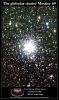
M-069-1.jpgM 69 - Globular Star Cluster68 visite"A volte, quando guardiamo una Creatura che reputiamo essere a noi inferiore - magari per la posizione che occupa nella Scala Evolutiva, per esempio, o anche per la posizione in cui si trova in quella che chiamiamo "Gerarchia Sociale" -, ci scopriamo a chiederci "a che cosa serva", effettivamente, quella Creatura Inferiore e perchè, a quali scopi, Essa sia stata creata.
Io mi domando che effetto possa fare, a quella Creatura, sentirsi valutata in questi termini da esseri che, per semplice crudeltà, egoismo, vanagloria o cupidigia o lussuria o per altre similari motivazioni, non esitano a passare sopra i loro simili, calpestandone la Dignità, mutilandone la Speranza e poi, spesso, carpendone anche la Vita..."
P.C. Floegers - "Conversations"
(12 voti)
|
|

Landing on Mars.jpgLanding on Mars142 visiteA livello di curiosità Vi suggeriamo, se volete vedere una ricostruzione davvero molto credibile di un futuro "landing on Mars" (a base di paracadute prima ed airbags poi), la sequenza della discesa della capsula di emergenza con 5 astronauti a bordo che viene presentata nel discreto Sci-Fi Movie "Red Planet".
(12 voti)
|
|
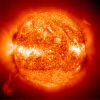
Sun-prom1743_eit_big.jpgAnother "Solar Prominence" from Soho84 visiteCaption NASA originale:"This large prominence is significant not only for its size, but also for its shape. The picture was taken early in the year 2000 by the Sun-orbiting SOHO satellite. Although large prominences and energetic Coronal Mass Ejections (CMEs) are relatively rare, they are occurred more frequently near Solar Maximum, such as the time of peak sunspot and solar activity in the 11 year solar cycle".
(12 voti)
|
|

Io-Sulphur volcanism-PIA03887_modest.jpgPotential Source of Sulphur Flow on Io70 visiteA field of bright lava flows next to a shield volcano could be a source of recent sulfur volcanism on Io, as detected by instruments aboard NASA's Galileo spacecraft.
The mosaic at left combines higher-resolution images (330 meters or about 1080 feet per picture element) taken in October 2001 with lower-resolution color images (1.4 kilometers or 0.9 mile per picture element) taken in July 1999 by Galileo's solid-state imaging camera.
By comparing these images with a map of hot spots taken in February by Galileo's near-infrared mapping spectrometer (lower right), Galileo scientists noted that a new hot spot west of the active volcano Prometheus became bright in February 2000 and dimmed later. This hot spot appears to correspond with the bright flow field just west of a recently discovered shield volcano (see PIA03532), which is the only fresh volcanic material in the area.
The relatively low intensity of the February 2000 hot spot in the infrared data suggests a low-temperature eruption, consistent with sulfur lava rather than silicate lava as found elsewhere on Io and also on Earth. Sulfur lavas are thought to cool to a gray-yellow color on Io, as seen in the new flow field visible in the camera image. This bright flow field could be the best example of active sulfur lava flows deposited on Io during the Galileo mission. At upper right is a global view of Io showing the location of the more-detailed images.
The low temperature of this hot spot differs from many of Io's other active volcanoes, such as Pele, Tvashtar and Prometheus. Intense tidal flexing of Io helps keep the moon's interior molten, at some places producing silicate lavas hotter than any seen on Earth in billions of years. Io has the greatest known diversity of volcanic activity in the solar system.
North is to the top of all these images.
(12 voti)
|
|

Landing on Titan (3).jpgSaturn, through the fog of Titan117 visiteTitan's surface may hold lakes of liquid ethane and methane, sprinkled over a thin veneer of frozen methane and ammonia. Most of the brownish-orange color comes from more heavily processed hydrocarbons present in Titan's atmosphere and on its surface. Artistic license has been used to exaggerate the size of the orbiter, the sharpness of the icy features, the tilt of Saturn's rings, and the visibility of the planet through Titan's atmosphere.
(12 voti)
|
|

M-019-2.jpgM 19 - Globular Star Cluster72 visite"...Qualcuno ha detto - credo un certo Einstein... - che il Futuro, ancorchè irraggiungibile, può essere visto, in qualche modo. Io credo che questa affermazione sia esatta solo in parte: infatti è vero che il Futuro - oggi irraggiungibile - può essere visto in qualche modo, ma...Non è esattamente 'Il Futuro': è solo 'Un Possibile Futuro'!..."
P.C. Floegers - "In the Paradox"
(12 voti)
|
|

OPP-SOL060-Lion_King_Pan-OppSol60-B_P2218_L256-B067R1_br2.jpgLion King Panorama - Sol 60 (Contrast Enhanced True Colors; credits: NASA/JPL-Caltech)90 visiteThis image from the Mars Exploration Rover Opportunity's panoramic camera shows one octant of a larger panoramic image which has not yet been fully processed. The full panorama, dubbed "Lion King" was obtained on sols 58 and 60 of the mission as the rover was perched at the lip of Eagle Crater, majestically looking down into its former home. It is the largest panorama yet obtained by either rover. The octant, which faces directly into the crater, shows features as small as a few millimeters across in the field near the rover arm, to features a few meters across or larger on the horizon.
(12 voti)
|
|

Jupiter-WO-PIA01513_modest.jpgWhite Ovals on Jupiter58 visiteCaption NASA originale:"This photo of Jupiter was taken by Voyager 1 on March 1st, 1979, from a distance of 4.300.000 Km. The region shown is just to the southeast of the Great Red Spot. A small section of the spot can be seen at upper left. One of the 40-year-old white ovals in Jupiter's atmosphere can also be seen at middle left, as well as a wealth of other atmospheric features, including the flow lines in and around the ovals.
The smallest details that can be seen in this photo are about 80 Km across".
(12 voti)
|
|
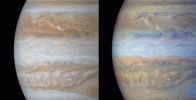
Jupiter-CH-PIA02877_modest.jpgReal Colors and False Colors of Jupiter60 visiteCaption NASA originale:"These color composite frames of the mid-section of Jupiter were of narrow angle images acquired on December 31, 2000, a day after Cassini's closest approach to the planet. The smallest features in these frames are roughly ~ 60 kilometers. The left is natural color, composited to yield the color that Jupiter would have if seen by the naked eye. The right frame is composed of 3 images: two were taken through narrow band filters centered on regions of the spectrum where the gaseous methane in Jupiter's atmosphere absorbs light, and the third was taken in a red continuum region of the spectrum, where Jupiter has no absorptions".
(12 voti)
|
|
| 25332 immagini su 2111 pagina(e) |
 |
|
|
|
|
76 | |
|
|
|
|





