| Piú votate |

Volcanoes-Elysium_Mons.jpgElysium Mons (NASA/JPL/MSSS)69 visitenessun commento
(12 voti)
|
|

00-The Moon.jpgThe Moon73 visiteMoon Facts and Data
Mass (kg) = 7.349e+22
Mass (Earth = 1) = 1.2298e-02
Equatorial radius = 1.737,4 Km
Equatorial radius (Earth = 1) = 2.7241e-01
Mean density (gm/cm^3) = 3.34
Mean distance from Earth = 384.400 Km
Rotational period (days) = 27,32166
Orbital period (days) = 27,32166
Average length of lunar day (days) = 29,53059
Mean orbital velocity (km/sec) = 1,03
Tilt of axis = 1,5424°
Orbital inclination = 5,1454°
Equatorial surface gravity (m/sec^2) = 1,62
Equatorial escape velocity (km/sec) = 2,38
Magnitude (Vo) = -12,74
Mean surface temperature (day) = 107°C
Mean surface temperature (night) = -153°C
Maximum surface temperature = 123°C
Minimum surface temperature = -233°C
(12 voti)
|
|

M-020-3.jpgM 20 - The "Trifid Nebula" - HST and SST89 visite"...Iustitia sine prudentia multum poterit: sine iustitia, nihil prudentia valebit..."
(Cicerone)
"...La Giustizia che difetti di prudenza può fare (comunque) molto: (ma) senza la Giustizia la prudenza non serve a nulla..."
(12 voti)
|
|
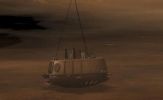
Titan-IMG001293-br500.jpgHuygens is landed on Titan!92 visitenessun commento
(12 voti)
|
|

Miranda-PIA00044_modest.jpgMiranda (super close-up of "Verona Rupes") - HR103 visiteCaption NASA originale:"This HR image of Miranda was acquired by Voyager 2 on Jan. 24, 1986, when the spacecraft was 36.250 Km (22.500 miles) from the Uranian moon. In this clear-filter, narrow-angle image, Miranda displays a dramatically varied surface. Well shown at this resolution of 660 meters (2.160 feet) are numerous ridges and valleys - a topography that was probably produced by compressional tectonics. Cutting across the ridges and valleys are many faults. The largest fault scarp, or cliff, is seen below and right of center; it shows grooves probably made by the contact of the fault blocks as they rubbed against each other (leaving what are known as slickensides). Movement of the down-dropped block is shown by the offset of the ridges. The fault may be 5 Km (3 mi) high, or higher than the walls of the Grand Canyon on Earth. NASA's Voyager 2 probe encountered the planet Uranus and its collection of moons in 1986. The small moon Miranda, with a diameter of 472 km, has a surface made up of a jumble of bizarre geological features. One of the most prominent of these features is an enormous cliff with a vertical relief of about 20 km (12 miles). This cliff, named Verona Rupes, is 10 times higher than the walls of the Grand Canyon on Earth. That this towering cliff is so huge is made even more remarkable by the small size of Miranda itself. The white material exposed in the cliff face is probably mostly water ice".
(12 voti)
|
|
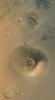
Volcanoes-Ceraunius_and_Uranius-E14-1248-1249_ceraunius50.jpgCeraunius and Uranius (Over-Saturated Natural Colors; credits: NASA/MGS/MSSS)76 visiteCaption NASA originale:"Acquired in March 2002, this Mars Global Surveyor (MGS) Mars Orbiter Camera (MOC) wide angle view shows the martian volcanoes, Ceraunius Tholus (lower) and Uranius Tholus (upper). The presence of impact craters on these volcanoes, particularly on Uranius Tholus; indicates that they are quite ancient and are not active today. The light-toned area on the southeastern face (toward lower right) of Ceraunius Tholus is a remnant of a once more extensive deposit of dust from the global dust storm events that occurred in 2001. The crater at the summit of Ceraunius Tholus is about 25 Km (15,5 mi) across. Sunlight illuminates the scene from the lower left".
(12 voti)
|
|

M-042-95.jpgM 42 - detail mgnf99 visite"...E' difficile resistere alla corrente, e non parlo - ovviamente - della corrente "fisica", quale può essere quella che si sviluppa in un fiume, o nel mare, da qualche parte...Parlo della corrente in un senso più sottile e più subdolo: un flusso di parole, di concetti, di immagini e di stereotipi; un complesso omogeneo di elementi il quale è capace di far deviare non solo il nostro corpo, ma anche - addirittura - la nostra mente, dal percorso che, in difetto di questi elementi combinati (un cocktail letale...), avremmo deciso di seguire. Qualcuno parla di condizionamento di massa attuato con messaggi subliminali o fantascientifici retrosegnali, inseriti nelle frequenze più usate. Io credo, invece, che il meccanismo usato sia molto più semplice e, proprio per questo, molto più efficace e terribile: io credo che lo strumento usato per guidare l'Umanità intera verso un annientamento intellettuale totale ed eseguito su scala planetaria, si chiami "consumismo"..."
P.C. Floegers - "Conversations"
(12 voti)
|
|
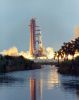
1-APOLLO 13-ap13-KSC-70PC-178.jpg04-11-1970: the launch of Apollo 13204 visiteDue fotogrammi che immortalano la partenza della Missione Apollo più difficile di tutte: era una giornata serena, quell'11 Aprile 1970...
(12 voti)
|
|

Pulsar 3c58.jpg3C58 Pulsar68 visite"There are no such things as facts: only interpretations"
Friedrich Nietzsche
(12 voti)
|
|

OPP-SOL001-0-p150xL_cyl_str2-B0R2.jpgThe very "First Look" at Mars, Meridiani Planum Region (Original NASA/JPL/Opportunity b/w Mosaic)201 visiteNulla di anomalo o di particolare in questo frame (un frame, a ben vedere, neppure bellissimo - qualitativamente parlando...). Nulla di anomalo, a parte il suo valore storico: è la prima "occhiata" di Opportunity al Nuovo Mondo che la accoglieva e che, ad oggi - AD 2005, Maggio, 15 -, la ospita.
(12 voti)
|
|

Dione-PIA06155-1.jpgDione and Saturn in natural colors83 visiteCaption NASA originale:"Cassini captured Dione against the globe of Saturn as it approached the icy moon for its close rendezvous on Dec. 14, 2004. This natural color view shows the moon has strong variations in brightness across its surface, but a remarkable lack of color, compared to the warm hues of Saturn's atmosphere. Several oval-shaped storms are present in the planet's atmosphere, along with ripples and waves in the cloud bands.
The images used to create this view were obtained with the Cassini spacecraft wide-angle camera at a distance of approximately 603.000 Km from Dione through a filter sensitive to wavelengths of ultraviolet light centered at 338 nanometers. The Sun-Dione-spacecraft, or phase, angle is 34°. The image scale is about 32 Km per pixel".
(12 voti)
|
|
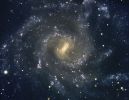
NGC-7424.jpgNGC 7424 - Spiral Galaxy58 visite"...Homo homini Deus est, si suum officium sciat..."
(Erasmo)
"...L'Uomo che conosce il suo dovere (e lo compie) è, per gli altri uomini, un Dio..."
(12 voti)
|
|
| 25332 immagini su 2111 pagina(e) |
 |
|
|
|
|
74 | |
|
|
|
|





