| Piú votate |

ZZ-ZZ-SunFromMaunaKea.jpgThe Sun from Mauna Kea: an alien landscape163 visiteDa "NASA - Picture of the Day" del 4 Luglio 2005:"Typically, views from Mauna Kea are up and dark. That's because the famous dormant volcano in Hawaii is arguably Earth's premier observing platform of the complex and ever changing night sky. However, this daytime view is across and bright. White snow and white clouds seem to blend together to make an alien landscape. Cinder cones from extinct volcanic outbursts dominate the foreground. Scrolling right will reveal structures visually incongruous even here: an armada of the largest optical telescopes on Earth. The observatories seen include Subaru and Keck. In the distance on the far left is Mauna Loa, Earth's largest volcano".
(12 voti)
|
|

TheRings-PIA07522.jpgFour versions of the "F-Ring"60 visiteCaption NASA originale:"This montage of 4 images of Saturn's knotted F-Ring shows different locations around the Ring itself. Even though all the images were taken within a few hours of each other, there is remarkable variation in the structure of the F-Ring at these four locations.
For example, the number of ring strands differs from image to image and in some images, kinks are clearly visible in the F-Ring, while other regions appear more smooth.
Astronomers believe that the structure of Saturn's F-Ring is governed by its shepherding moons, Prometheus and Pandora. The F-Ring's appearance is expected to vary depending on how recently a ring section has encountered each moon and how close the moon came to the ring".
Nota: nel primo quadro (in alto a Sx) c'è qualcosa, posto proprio al di sopra del 'nodo' centrale visibile sull'intreccio più luminoso dell'Anello F, che sembra un 'filamento' o, comunque, un oggetto estraneo all'Anello F stesso, ma reale (NON crediamo che sia un photo-artifact). Cos'è?
(12 voti)
|
|

UFO-1-PIA07250.jpgFar distant galaxies and a UFO in front of the GALEX telescope! (1)83 visiteCaption NASA originale:"Galaxies aren't the only objects filling up the view of NASA's Galaxy Evolution Explorer. Since its launch in 2003, the space telescope (originally designed to observe galaxies across the universe in ultraviolet light) has discovered a festive sky blinking with flaring and erupting stars, as well as streaking asteroids, satellites and space debris. One such streaking object - possibly an Earth-orbiting satellite - can be seen here flying across the telescope's sight.
This probable satellite appears during the last 5' of a 13,5' observation. It looks elongated because each picture frame containing the moving object is 19" long. Faint ghost images on either side of the source are detector artifacts caused by the object's extreme brightness. These 'Bonus Objects' are being collected in to Public Catalogues for other Astronomers to study".
Bonus Objects. Un nuovo modo di classificare gli UFO? Un frame intrigante ed un commento ufficiale asciutto, ma possibilista: qualcosa si muove?!?
(12 voti)
|
|

MOONRISE.jpgMoonrise154 visiteUna delle tante 'immagini artistiche' che ci aiutano a ricordare quanto la Natura sia misteriosa e, nel contempo, assolutamente affascinante ed inesplicabile.
(12 voti)
|
|

NGC-1851-PIA07908_modest.jpgNGC 1851 - Globular Star Cluster in Columba Constellation70 visite"...Fantasy deals with things that are not and cannot be. Science fiction deals with thing that can be and that, some day, will be..."
Frederic Brown (1906 - 1972) - "Angels and Spaceships" (1955)
(12 voti)
|
|

APOLLO 11 AS 11-36-5404 HR.jpgAS 11-36-5404 - The Earth behind the LM (HR)335 visiteUna splendida veduta della Terra che 'occhieggia' accanto al LM, durante la crociera trans-Lunare.
(12 voti)
|
|

ZF-I-Viking2-22a158corr-LF.jpgFrom the "Viking Archive" - Viking 2: antenna, sky and horizon (natural colors; credits: NASA)137 visitenessun commento
(12 voti)
|
|

ZE-I-Viking1-vl1_12b069-1.jpgFrom the "Viking Archive" - Viking 1: horizon and spacecraft159 visiteSe non lo si fosse saputo in anticipo, i dintorni del Viking 1 Lander si sarebbero potuti agevolmente confondere con quelli tipici di un deserto roccioso terrestre. La maggior parte delle immagini ottenute dal Viking Lander 1, infatti, mostravano un paesaggio di colore giallo/bruno, con alcuni tratti di marrone e di arancione, completamente ricoperto da pietre e piccoli comuli di sabbia. Le rocce riprese mostravano una superficie ruvida, con chiari segni di erosione causata (molto probabilmente) da un costante e relativamente violento bombardamento di granuli di sabbia spinti da venti molto forti. Molte rocce evidenziavano, ai loro lati, la presenza di rilievi che oggi chiamiamo "wind-drift" (e che sono l'equivalente, su scala più piccola, dei "wind-streaks").
Le immagini ci mostrarono anche - nei mesi invernali - un sottile strato di brina (d'acqua e NON ghiaccio secco!) che si era formato sul suolo e che resistette per oltre 100 Soles.
(12 voti)
|
|

010-Mars_North_West.jpgThe North-Western Region of Mars111 visitenessun commento
(12 voti)
|
|
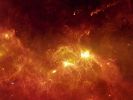
M 42~3.jpgM 42 - In Memory Of IRAS (infrared vision)131 visiteCaption NASA originale:"Do you recognize the constellation Orion? This striking but unfamiliar looking picture of the familiar Orion region of the sky was produced using survey data from the now-defunct InfraRed Astronomical Satellite (IRAS). The above image combines information recorded at three different invisible infrared wavelengths and covers about 30x24° on the sky. Most of Orion's visually impressive stars don't stand out, but bright Betelgeuse does appear as a small bright purplish dot on the lower left. The bright region on the right contains the Great Nebula in Orion, while the bright region just above the image bottom is the Rosette Nebula. Surrounding these regions are a jumble of chaotic glowing gas and dark dust jettisoned by stars forming and exploding over millions of years".
(12 voti)
|
|

M-016-97.jpgM 16 - The "Eagle Nebula"105 visiteConsciousness is a potential technology; we are exquisite machines, nothing less than sentient patterns. As such, there's no convincing technical reason we can't eventually upload ourselves into matrices of our design and choosing. It's extremely likely the phenomenon we call "intelligence" will cease to be strictly biological as we begin to merge with our machines more meaningfully and intimately. Philip K. Dick once wrote that "living and nonliving things are exchanging properties." I suspect that in a few hundred years, separating the animate from the inanimate will probably be an exercise in futility. Ultimately, we have two options: self-mutate by venturing off-planet in minds and bodies of our own design, or succumb to extinction.
(12 voti)
|
|

Image037-54-10075567_C.jpgBlue Flares and the Invisible Crater: Cone Crater (detail mgnf)236 visiteSemmai la questione si complica per la presenza di strane caratteristiche geomorfologiche nella parte Nord-Ovest e di una curiosa “rampa” che si intravede nell'area meridionale del Cratere e che non era visibile neppure nelle altre fotografie planimetriche.
La cosa comunque non deve avere sconvolto gli Astronauti, visto che non l’hanno né descritta, né fotografata in alcuna circostanza (anche se la scelta per l’allunaggio di quest’area nella zona settentrionale di Fra Mauro non deve essere stata proprio accidentale...).
(12 voti)
|
|
| 25332 immagini su 2111 pagina(e) |
 |
|
|
|
|
72 | |
|
|
|
|





