| Piú votate |

Voyagers-Heliosphere5b.JPGThe Voyagers at the "Final Frontier"80 visiteThe twin Voyager 1 and 2 spacecrafts continue exploring where nothing from Earth has flown before. In the 25th year after their 1977 launches, they each are much farther away from Earth and the Sun than Pluto is and approaching the boundary region - the heliopause - where the Sun's dominance of the environment ends and Interstellar Space begins. Voyager 1, more than twice as distant as Pluto, is farther from Earth than any other human-made object and speeding outward at more than 17 Km per second (38.000 miles per hour). Both spacecraft are still sending scientific information about their surroundings through the Deep Space Network (DSN).
The primary mission was the exploration of Jupiter and Saturn.
After making a string of discoveries there - such as active volcanoes on Jupiter's moon Io and intricacies of Saturn's rings - the mission was extended. Voyager 2 went on to explore Uranus and Neptune, and is still the only spacecraft to have visited those outer Planets. The adventurers' current mission, the Voyager Interstellar Mission (VIM), will explore the outermost edge of the Sun's domain. And beyond.

(12 voti)
|
|
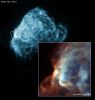
Puppis-A.jpgShockwaves in "Puppis-A"58 visite"...Ma io, che sono povero, ho solo i miei sogni.
E quei sogni, adesso, li ho distesi ai tuoi piedi: cammina con leggerezza, dunque, poichè cammini sui miei sogni..."
Yeats - "Poesie"
(12 voti)
|
|

Aeolian_Features-DD_Tracks-PIA02185-1.jpgDeep Dust Devil Tracks between Brashear and Ross Crater (Original NASA/JPL/ASU b/w Frame)63 visiteCaption originale:"Dust Devil activity in this region between Brashear and Ross Craters is very common.
Large areas full of DD tracks surround the South Polar Region of Mars.
Image information: VIS instrument;
Latitude: - 55,2° North;
Longitude: 244,2° East;
Resolution: 17 meter/pixel.
(12 voti)
|
|

Soviet-LTP-Map1.jpgThe Moon over Moscow...96 visiteI suoi occhi erano chiari e belli
Brillanti, come le notti di Luna piena
E le sue labbra, amaramente dolci
Come uno spicchio di arancio verde
Come una lacrima caduta nello zucchero ...
Le sue mani erano fresche e sicure
Mi stringevano, ma senza farmi male
E la sua pelle, così liscia e calda
Come la sabbia di un vicino deserto
Come le onde di un prossimo mare ...
Quante menzogne, per salvare i ricordi
La voglia di partire e di cercarla
Sapendo che è laggiù, da qualche parte
E lei non sa che io le penso ancora
Ed io non so che lei è andata via ...
Ed è bello pensare a quello che accade
Quando tutto sembra definito, ecco
Il Destino ci viene incontro
E ci prende per mano, leggermente
E ci accompagna, laggiù, dove vorremmo andare ...
Ed è bello pensare a quello che accade
Quando tutto sembra ormai deciso, ecco
Il Destino ci viene incontro
E ci prende per mano, leggermente
E ci porta via, laggiù, dove dobbiamo tornare...
Paolo C. Fienga – “Poesie”
(12 voti)
|
|

Large Magellanic Cloud.jpgSome elements inside the "Large Magellanic Cloud"57 visite"...E sì come lucciuole ke se movano leggiere nella notte, così kelle parvule scintille stavano a palpitare nella calante Luna: e non vi fu omo, aut donna, aut infante, aut contadino, aut religioso, aut viandante, ke postea d'aver levato l'occhi allo cielo, non provasse maraviglia et timore..."
Cronache Medioevali (Autore anonimo - datazione approssimativa: AD 1190-1200)
(12 voti)
|
|

G29-38-PIA03652-1.jpgSpace debris around White Dwarf G29-38141 visite"...Quae Fato manent, quamvis significata, non vitantur..."
(Tacito)
"...Gli eventi scritti nel Destino, anche se si riesce ad intravederli, non si possono evitare..."
(12 voti)
|
|
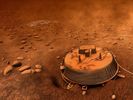
Titan-IMG001958-br500.jpgHuygens' Landing Site87 visiteThis is an artist's interpretation of the area surrounding the Huygens Landing Site, based on images and data returned on Jan. 14, 2005.
On January 14, 2005, the European Space Agency's (ESA) Huygens Probe reached the upper layer of Titan's atmosphere and landed on the surface after a parachute descent 2 hours and 28 minutes later.
As part of the joint NASA/ESA/ASI mission to Saturn and its Moons, the Huygens Probe was sent from the Cassini spacecraft to explore Titan, Saturn's largest moon. Titan's organic chemistry may be like that of the primitive Earth around 4000 MY ago, and it may hold clues about how life began on our Planet.
Nota: permetteteci un piccolo commento su questo "grande successo". Di dati significativi sull'ambiente di Titano (p.e.: temperature medie nel ciclo giorno/notte; presenza o meno di venti; presenza o meno di polveri in sospensione; componenti primari dell'atmosfera a varie altitudini etc.), ad oggi, non ci pare ne sìano emersi. A parte qualche "sembra" e qualche "si sta ancora studiando" non c'è ancora nulla di solido su cui lavorare (o almeno speculare). E questo per non dire delle fotografie di Titano al suolo: dovevano dirci tanto. Alla fine, quelle poche (ed orrende) immagini ricevute non ci hanno detto assolutamente niente.
La "Discesa dell'Europa su Titano" (come si scrisse in tono trionfalistico un anno fa - per poi dimenticare tutto in 24 ore...) fu dunque vera gloria?
Ai posteri l'ardua sentenza...
(12 voti)
|
|
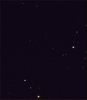
KappaCrucis.jpgThe "Jewel Box" (alias Kappa Crucis)61 visiteThis image of part of the Jewel Box, an open star cluster, was acquired by the HiRISE camera, an instrument on the Mars Reconnaissance Orbiter, on December 14, 2005 as part of a calibration sequence while en route to the Red Planet. The Jewel Box was so named by Sir John Herschel because of the variety of star colors in the cluster, including the large red giant star seen near the bottom of this image. The Jewel Box, also called Kappa Crucis, is about 10 MY old, so it is much younger than our Sun which is about 4.600 MY old. This cluster lies about 7.500 LY away, so the light we see today left the stars in the Neolithic Ages of Earth, when farming was first being practiced by our ancestors.
HiRISE can image in three colors, green, red, and near-infrared, so the colors are not exactly as we see them with our eyes.
The Jewel Box cluster lies in the Crux constellation, also called the Southern Cross, the most compact constellation in the sky.
(12 voti)
|
|
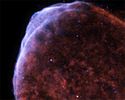
SN-1006.jpgSN 1006: Supernova Remnant in X-Rays72 visite"...Circuit Fatum, et si quid diu praeteriit repetit; quaedam rarius sollicitat, saepius quaedam, nihil immune esse et innoxium sinit..."
(Seneca)
"...Il Destino si muove intorno a noi e se, talvolta, qualcosa riesce a sfuggirgli, (nel tempo) la riafferra; esso è causa di eventi che accadono di frequente, come di eventi rari e, comunque, nulla e nessuno può restare indifferente al suo tocco o (addirittura) sfuggirgli..."
(12 voti)
|
|

IC-2118-1.jpgIC 2118 - The "Witch Head" Nebula63 visite"...Ira quae tegitur nocet; Professa perdunt odia vindictae locum..."
(Seneca)
"...La rabbia repressa fa male, (ma) l'odio che si manifesta fa svanire le trame della vendetta..."
(12 voti)
|
|

M-016-95.jpgM 16 - Stellar "Eggs" Emerge from Molecular Cloud (the "Evaporating Globules" of M 16)78 visite"...Sine Cerere et Libero, friget Venus..."
(Terenzio)
"...Senza cibo nè vino, anche il desiderio (d'amore) si raffredda..."
(12 voti)
|
|

Cone Nebula.jpgDeep inside "the Cone"...73 visite"...Felis amat pisces, sed aquas intrare recusat..."
(anonimo)
"...il gatto, sebbene ami il pesce, non vuole entrare in acqua (a prenderlo)..."
Detto per indicare coloro che amano qualcosa in maniera particolare, ma non vogliono fare la fatica di conquistarsela.
(12 voti)
|
|
| 25332 immagini su 2111 pagina(e) |
 |
|
|
|
|
69 | |
|
|
|
|





