| Piú votate |
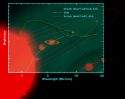
Graph-PIA07336.jpgA Brown-Dwarf's planetary system and the Solar System131 visiteThis artist's conception shows the relative size of a hypothetical brown dwarf-planetary system (below) compared to our own solar system. A brown dwarf is a cool or "failed" star, which lacks the mass to ignite and shine like our Sun. NASA's SST set its infrared eyes on an extraordinarily low-mass brown dwarf called OTS 44 and found a swirling disc of planet-building dust. At only 15 times the mass of Jupiter, OTS 44 is the smallest known brown dwarf to host a planet-forming, or protoplanetary, disc.
Astronomers believe that this unusual system will eventually spawn planets. If so, they speculate that OTS 44's disc has enough mass to make one small gas giant and a few Earth-sized rocky planets. Examples of these possible planets are depicted at the bottom of this picture, circling a low-mass brown dwarf. Above, the bodies of our own Solar System have been drawn to the same scale. In each system, the terrestrial planets have been enlarged and the distances between them and their parent bodies scaled down.
(13 voti)
|
|
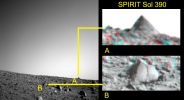
SOL390-4-Pyramid-3MD.jpgThe "Pyramid" - detail mgnf157 visiteUn'elaborazione davvero fantastica (e tridimensionale) della - per ora ignorata dalla NASA - "piccola piramide" di Cumberland Ridge. Un grazie di cuore al Dr Alessio Feltri per lo splendido lavoro fatto ed una domanda ai Lettori: secondo Voi, di che cosa si tratta?
E' forse una roccia simile a quella indicata dalla lettera "B", ma vista da un angolo visuale diverso (il quale ci dà l'impressione di una perfetta squadratura che, in realtà, non esiste...), oppure siamo effettivamente davanti ad una roccia squadrata e l'angolo visuale di ripresa è irrilevante?
(13 voti)
|
|

O-Mariner9-71-PIA02989_modest.jpgSouth Polar Cap from Mariner 9 and 7135 visiteCaption NASA originale:"This mosaic of Mariner 9 frames (top), taken during the first orbit, shows the remnants of the South Polar Cap of Mars dimly through the great dust storm. Mariner 7 photographed the same area in August, 1969 (bottom) at which time the entire region was covered with dry ice. The strange quasilinear features of 1969 have been replaced by a number of bright curved appendages never before seen on Mars and, at this time, unexplained. Mariner 9 was the 1st spacecraft to orbit another planet. The spacecraft was designed to continue the atmospheric studies - begun by Mariners 6 and 7 - and to map over 70% of the Martian surface from the lowest altitude (1500 Km [approx. 900 miles]) and at the highest resolutions (1 Km per pixel to 100 meters per pixel) of any previous Mars mission".
Eccezionale, semplicemente: Mariner 9 venne lanciato il 30 Maggio 1971 ed arrivò a destinazione il 14 Novembre dello stesso anno.
(13 voti)
|
|

SOL015-Adirondack-PIA05220_modest.jpgAdirondack - Sol 15 (Approximate True Colors; credits: NASA/JPL-Caltech)220 visiteCaption NASA:"This image shows the Mars Exploration Rover Spirit's "hand," or the tip of the instrument deployment device, poised in front of the rock nicknamed Adirondack, the rover's first science target since developing communication problems over two weeks ago. In preparation for grinding into Adirondack, Spirit cleaned off a portion of the rock's surface with a stainless steel brush located on its Rock Abrasion Tool (RAT). The image was taken by the Rover's Panoramic Camera - or PanCam, for short".
Nota Lunexit: ancora una delle primissime immagini a colori provenienti da Spirit la quale è stata ripresa all'inizio del suo viaggio verso le Columbia Hills. Noi abbiamo notato, in particolare, il colorito "arancio-vivo" delle sabbie dell'Area di Gusaev Crater: un colorito "autentico" - a detta della NASA - il quale, tuttavia, "sbiadirà" progressivamente e senza nessuna apparente ragione. Insomma: i colori di Marte, nei primi giorni di Spirit (ed Opportunity), erano più "vivaci" (e se non ci credete, controllate pure le immagini); con il tempo (e le sempre più sofisticate tecnologie utilizzate...) si sono attenuati, sino a diventare - oggi - così "anonimi" da lasciare perplessi.
Anzi, non sono soltanto anonimi: sono, a nostro modesto parere, totalmente (o quasi) falsi.
(13 voti)
|
|

V-838_Mon-03.jpgV-838 Monocerotis: a young "Binary System"68 visite"...Animo cupienti nihil satis festinatur..."
(Sallustio)
"...Nulla viene conseguito abbastanza in fretta per colui che desidera con tutto sè stesso..."
(13 voti)
|
|

BH-BlackHoles-swarm_cxc_labelf.jpgBlack-Hole Systems or Neutron Star Systems near the center of the Milky Way?130 visiteDa "NASA - Astronomy Picture of the Day" del 28 Gennaio 2005:"Monitoring a region around the center of our Galaxy, astronomers have indeed found evidence for a surprisingly large number of variable x-ray sources - likely Black Holes or Neutron Stars in binary star systems - swarming around the Milky Way's own central supermassive Black Hole. Chandra Observatory combined x-ray image data from their monitoring program is shown above, with four variable sources circled and labeled A-D. While four sources may not make a swarm, these all lie within only 3 LY of the central supermassive Black Hole known as Sagittarius A* (the bright source just above C). Their detection implies that a much larger concentration of Black Hole systems is present. Repeated gravitational interactions with other stars are thought to cause the Black Hole systems to spiral inward, toward the Galactic Center Region".
(13 voti)
|
|

M-087-2.jpgM 87 - Energetic Jet in X-ray, Radio and Optical66 visite"...Oderint, dum metuant..."
Cicerone
"...Che mi odino, purchè mi temano..."
(13 voti)
|
|
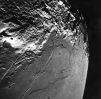
P-APOLLO 17 AS 17-M-R27-0953.jpgAPOLLO 17 AS 17-M-R27-0953 - What a view!152 visiteUna vista davvero eccezionale, da un'altezza di circa 280 Km: sul margine superiore della fotografia, una formazione montuosa che ricorda tantissimo la "cordigliera delle Ande" e poi, simili a graffiti, i letti lasciati da antichi fiumi di lava (Sn) ed alcune increspature di una pianura che potrebbero risalire al tempo in cui la Luna iniziò a raffreddarsi e, nel farlo, a "raggrinzire" leggermente (Sn ed al centro, verso il basso). Piccoli crateri isolati costellano il margine inferiore ed il lato Dx del frame.
(13 voti)
|
|

Galactic Center - X-ray.jpgThe Milky Way - Galaxy center in X-ray126 visite"...Bellum ita suscipiatur ut nihil aliud nisi pax quaesita videatur..."
(Cicerone)
"...Ogni guerra deve essere iniziata facendo sì che non appaia null'altro se non il desiderio di pace..."
(13 voti)
|
|

M-094-1.jpgM 94 - Spiral Galaxy62 visite"...I vampiri?!? I vampiri, in un certo senso, direi che mi ricordano - in chiave allegorica - le più ancestrali paure degli uomini. Quali?
Il buio, per esempio (e soprattutto!); e poi anche il silenzio, il mistero e l'ignoto: le grandi caratteristiche della Notte.
E la paura della Notte, in fondo, riassume in sè tutte le paure!
E così, al pari della Notte, anche i vampiri svaniscono e, vinti, si dissolvono, alle prime luci dell'alba..."
P.C. Floegers - "Conversations"
(13 voti)
|
|

Sunrise from Space.jpgSunrise from space...86 visiteCaption NASA originale:"Sunrise seen from low Earth orbit by the shuttle astronauts can be very dramatic indeed. In this view, the Sun is just visible peaking over towering anvil-shaped storm clouds whose silhouetted tops mark the upper boundary of the troposphere, the lowest layer of planet Earth's atmosphere. Sunlight filtering through suspended dust causes this dense layer of air to appear red. In contrast, the blue stripe marks the stratosphere, the tenuous upper atmosphere, which preferentially scatters blue light".
(13 voti)
|
|

EROS-PIA02905-0.jpgEros (the BIG Pseudo-Anomaly)143 visiteThis image of Eros, taken from the NEAR Shoemaker spacecraft on May 1, 2000, is among the first to be returned from "low orbit." Between May and August, the spacecraft orbited at altitudes near 50 Km or less. This will be the prime period of activity for some of the spacecraft's science instruments. The X-ray / gamma-ray spectrometer will build up maps of chemical abundances, while the laser rangefinder measures the shape of Eros to within meters (a few feet). At the same time the magnetometer will watch for indications of Eros' magnetic field and the near-infrared spectrometer will map rock types. The imager will take pictures of the entire surface of Eros that capture features as small as 4 meters (13 feet) across. This particular image, taken from an orbital altitude of 53 Km, shows a scene about 1.8 Km across. Numerous craters and boulders as small as 8 meters (26 feet) across dot the landscape. The large, rectangular boulder at the upper right is about 45 meters across.
(13 voti)
|
|
| 25332 immagini su 2111 pagina(e) |
 |
|
|
|
|
58 | |
|
|
|
|





