| Piú votate |

Sun pillar.jpgAnother light Sun Pillar68 visitenessun commento
(14 voti)
|
|

Gliese 623 b.jpgGliese 623 "a" and "b" - HST108 visite"...E' incredibile la velocità con cui siamo disposti ad accettare le costruzioni più fantastiche ed improbabili e le ipotesi più ridicole ed inverificabili allorchè queste si sposano, in qualsiasi maniera, anche con solo un minimo dei nostri interessi o convinzioni..."
P.C Floegers - "Conversations"
(14 voti)
|
|

N 11.jpgN 11 - A "Ring of Nebulae" inside the Large Magellanic Cloud91 visiteUna delle più grandi nebulose sino ad ora scoperte si è rivelata, in realtà, come un complesso anello di nebulose ad emissione minori, fra loro connesse da filamenti di gas luminoscenti. Questa curiosa struttura, conosciuta come N 11, si estende per oltre 1000 A.L. e si trova all'interno della Grande Nube di Magellano, la maggiore Galassia-Satellite della nostra Via Lattea. Al centro dell'immagine è ben visibile un ammasso stellare aperto (conosciuto come LH 9 - o anche NGC 1760), composto da circa 50 giovani stelle azzurre le quali sono responsabili dell'emissione della radiazione che ha letteralmente "eroso" l'area ad esse circostante, liberandola dai gas interstellari.
L'ipotesi più accreditata circa la formazione di N11 è che le diverse nebulose siano i residui di un gruppo di stelle aventi origini comuni, ma età differenti.
La regione più brillante, infine, visibile appena sopra il centro dell'immagine, è conosciuta come N 11-B, una "fucina di stelle", forse oggi ancora attiva.
(14 voti)
|
|
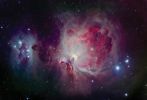
M 42~0.jpgM 42 in real colors146 visiteUna visione ad HD della Grande Nebulosa di Orione: visibile nei nostri cieli invernali anche ad occhio nudo, ma in forma di gran lunga meno spettacolare rispetto a quanto ci è dato vedere in questa ed in altre immagini similari. Ma cos'è che permette alla splendida Grande Nebulosa di Orione di manifestarsi così come noi la vediamo? La "fonte" dello splendore della Nebulosa è dato dal "Trapezio": un gruppo di 4 stelle, le più luminose presenti nella nebulosa. Le strutture a "filamento" che rendono la Nebulosa ancora più suggestiva alla vista sono il prodotto di "onde d'urto" (ovvero di "collisioni" vere e proprie fra elementi pesanti - e che si muovono velocemente nello spazio - con gas stazionari o anch'essi in movimento, ma più lentamente rispetto ai primi). La Grande Nebulosa di Orione si estende nello spazio interstellare per oltre 40 AL e si trova ad una distanza da noi pari a circa 1500 AL, comunque all'interno del medesimo braccio della Via Lattea in cui si trova il nostro Sole (e noi con esso).
(14 voti)
|
|

Moon Eclypse - montage.jpgMoon's eclypse205 visiteL'attraversamento del cono d'ombra proiettato dalla Terra ed il progressivo "ambrarsi" della superficie Lunare. Una composizione davvero molto bella dell'Astronomo Francese Sebastien Gauthier.
(14 voti)
|
|

ZB-Moon and Mars.jpgMoon and Mars309 visiteThe Clay Center Observatory expedition to Bonita Springs, Florida - USA - produced this evocative picture of Mars grazing the Moon's dark edge by digitally stacking and processing a series of telescopic images of the event. With the cratered Moon in the foreground, the bright planet Mars seems alarmingly close. Its global scale features and white south polar cap are easily visible.
(14 voti)
|
|

BH-Black-Hole.jpgComputer simulation of a Black-Hole from start to finish115 visitePlasma is falling slowly toward the black hole in a (at the upper left). The plasma has a magnetic field, shown by the white lines. It picks up speed as it falls toward the hole in b (at the upper right), c (lower left) and d (lower right). However, the rotating black hole twists up space itself (and the magnetic field lines) and ejects electromagnetic power along the north and south poles above the black hole. The red and white color shows the immense electromagnetic power output, which eventually will pick up particles and form squirting jets.
(14 voti)
|
|
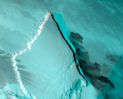
Io-Zal Patera-PIA02553.jpgThe "Zal" Patera81 visiteThis stereo image of Jupiter's moon Io shows the topography of a region on Io that includes the Zal Patera feature and a mountain or plateau that borders it to the west. It was created by combining two different views taken by NASA's Galileo spacecraft on November 25, 1999 (shown in red) and February 22, 2000 (shown in blue).
A mountain 120 kilometers (75 miles) wide rises to the west of the patera, a dark volcanic depression. By measuring the shadow, scientists were able to determine that the eastern margin of this mountain is about 1.5 kilometers (5000 feet) high. To the west and northwest, the mountain's margins are scalloped, which may indicate that a process called sapping is eroding them. Sapping occurs when fluid escapes from the base of a cliff, causing the material above it to collapse. Along the northwestern margin, the rough material at the base of the cliff maybe debris left over from the sapping process. Dark lava flows can be seen coming from a fissure to the east of the mountain.
Galileo scientists are in the process of generating topographic maps from these images. Such maps will reveal the heights and slopes of different landforms in this region, which will help scientists determine the strength and other properties of Io's surface materials. They will also be useful in understanding the processes of uplift and erosion on Io.
The picture is centered at 42.3 degrees north latitude and 76.9 degrees west longitude. North is to the top of the picture. The observations used to make the stereo image were made at ranges of 26,000 and 33,500 kilometers (16,200 and 20,900 miles) from Io. The resolution of the stereo image is about 335 meters (370 yards) per picture element.
(14 voti)
|
|

M-032-1.jpgM 32 - Dwarf Elliptical Galaxy78 visite"...Comunque, se fossi giudice, qualche volta stringerei la mano all'uomo che avessi condannato e gli chiederei scusa; e così a quello che avessi assolto direi "Che io non ti veda mai più"! Ma soprattutto sono certo che darei sempre ragione all'ultimo che parla. Sicuramente. Perchè l'ultimo a parlare sarei io, con la mia Coscienza..."
Carlo Braca, Dottore in Giurisprudenza , Salerno 10 Novembre 1954
(14 voti)
|
|

M-015-1.jpgM 15 - Globular Star Cluster69 visite"...Omnes, si ad originem primam revocantur, a coelis sunt..."
(Seneca)
"...Tutti noi, se ci riportiamo alla prima origine, veniamo dai Cieli..."
(14 voti)
|
|

NGC-6726.jpgNGC 6726 - Nebula in Corona Australis 86 visite"Your heavenly Father knows that you need all these things"
Matthew 6:32
(14 voti)
|
|

M-042-9.jpgM 42 - The Great Orion Nebula90 visite"...In questa guerra ed in questo mondo un uomo, da solo, non fa la differenza.
Non conta nulla.
Non serve a niente.
Il suo coraggio, il suo sacrificio - da soli! - non servono a nulla, in questo mondo.
Ed oltre a questo mondo, amico mio, non ce ne sono altri..."
(dal film "La sottile linea rossa")
(14 voti)
|
|
| 25332 immagini su 2111 pagina(e) |
 |
|
|
|
|
47 | |
|
|
|
|





