| Piú votate |

ZE-I-Viking2-p140b.jpgFrom the "Viking Archive" - Viking 2: a few seconds before Sunrise (1)132 visite"...Early in the mission, when it became clear that there was a large amount of scattering particles in the lower atmosphere, we realized the potentially dramatic appeal of low Sun pictures. However, the first priority was to document the landscape with HR and color images. Following several weeks of successful operation on the Martian Surface we relaxed to the point of attempting exotic but high risk pictures...".
(14 voti)
|
|

HD 209458b.jpgPlanet HD 209458b123 visiteDa "NASA - Picture of the Day" del 5 Aprile 2005:"Light emitted by a planet far beyond our Solar System has been identified for the first time. The planet, illustrated in the above drawing, had its light detected by comparing the brightness of only the parent star, when the planet was behind the star, to the light emitted when both the planet and its parent star were visible. The Earth-orbiting Spitzer Space Telescope made the observation in infrared light, where the intrinsic glow of the planet outshines the light it reflects from its central star. The direct observation of light allowed a measurement of both the temperature and size of the planet: HD 209458b. Planet HD 209458b was confirmed to be larger than expected for its mass and on an orbit around its parent star that was unexpectedly close to a circle".
(14 voti)
|
|

Image036-52-10075567_A.jpgBlue Flares and the Invisible Crater: Cone Crater226 visiteIn soccorso ci viene il fotogramma S70-49764 scattato il 12 Gennaio 1970 con obbiettivo 120mm - b/w - dallo stesso Apollo 14.
Mi limito a far notare come l’ombra del bordo occidentale si estenda per oltre 200 mt e, dato che sappiamo che l’ombra di quello orientale corrisponde ad un dislivello di circa 100 mt rispetto al fondo del Cone Crater, non ci vuole molto a stimare in diverse decine di metri l’altezza dell’orlo incriminato. In questo dettaglio è possibile stimare meglio le proporzioni ed i particolari del cratere: tutti elementi di cui, nelle foto panoramiche riprese "from the surface", non si trova alcuna traccia.
(14 voti)
|
|

VisibleandInvisible-PIA07490.jpgBlinded by the Light...104 visite"...Grande solacium est cum Universo rapi..."
(Seneca)
"...E' di grande conforto sapere che la nostra natura mortale è condivisa da tutto quanto esiste nell'Universo..."
(14 voti)
|
|

ZZ-Z-One_small_step___-1.jpgOne small step... (false colors)342 visiteGuardiamo dentro una delle innumerevoli impronte lasciate da Spirit sul suolo di Marte. Non sono necessari commenti: si tratta di un'immagine che possiede una definizione davvero splendida e che ci permette - davvero! - di "vedere" il suolo Marziano come se ci trovassimo lì...
(14 voti)
|
|
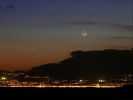
MoonMercMonaco_jacques_full.jpgThe Moon and Mercury, from Monaco (FRA)139 visiteUna falce di Luna ed una piccola scintilla, piuttosto alta nel cielo della sera: Mercurio.
Una bella immagine che ci arriva dalla Francia e che ha trovato spazio anche nella Rubrica "NASA - Picture of the Day".
Questa la caption originale:"Low on the western horizon after sunset, a slender crescent Moon and wandering planet Mercury join the lights of Menton and Monaco along the French Riviera. Astronomer Vincent Jacques took advantage of this gorgeous photo opportunity a week ago on March 11, when the Moon and Mercury were separated in the sky by just 3°. Of course, the Moon in a slender crescent phase is always seen near the horizon, as is Mercury - a bright planet which can be difficult to glimpse as it never strays far from the Sun in Earth's sky. In the coming days good views of Mercury will indeed be fleeting as the Solar System's innermost planet is rapidly dropping closer to the glare of the setting Sun".
(14 voti)
|
|
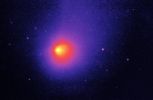
Comets-Schwassmann_Wachmann_1-00.jpgComet Schwassmann-Wachmann I and two asteroids61 visiteSchwassmann-Wachmann 1 (its nucleus is about 30 Km in diameter and is too small to be resolved by the SST while the micron-sized dust grains in the coma and tail stream out away from the Sun) is thought to be a member of a relatively new class of objects called "Centaurs," of which 45 objects are known. These are small icy bodies with orbits between those of Jupiter and Neptune. Astronomers believe that Centaurs are recent escapees from the Kuiper Belt, a zone of small bodies orbiting in a cloud at the distant reaches of the Solar System. Two asteroids, 1996 GM36 (left) and 5238 Naozane (right) were serendipitously captured in the comet image. Because they are closer to us than the comet and have faster orbital velocities, they appear to move relative to the comet and background stars, thereby producing a slight elongated appearance. The SST data have allowed astronomers to use thermal measurements, which reduce the uncertainties of visible-light albedo (reflectivity) measurements, to determine their size.
(14 voti)
|
|

Craters-Unnamed_Crater_with_Dark_Streaks-2003_08.jpgDark Slope Streaks on the edge of an Unnamed Crater (Saturated Natural Colors; credits: NASA/MGS/MSSS)101 visiteCaption NASA originale:"This June 2003 MGS-MOC image shows a crater rim mantled with fine dust near 7.6°N, 171.8°W. Occasional avalanches of dust have created dark streaks that are tapered at their source and broaden downslope.
A suite of particularly large streaks are seen in the lower right quarter of the picture. The MOC narrow angle camera does not take color images; this full-resolution (1,5 m/pixel; 5 ft/pixel) picture has been "colorized" using data from a previous color image of Mars.
Sunlight illuminates this scene from the lower left".
(14 voti)
|
|

Image011.jpgThe "Hills of Disgrace" : the "Picture"406 visiteQuesta nuova "Indagine" - ancora una volta affidata al Dr Alessio Feltri - ci porterà alle pendici delle Columbia Hills, in prossimità di un rilievo battezzato dai Tecnici NASA con il nome di "West Spur".
Ciò che avrete occasione di vedere e di scoprire, durante questo secondo viaggio, non può essere riassunto in poche righe, ma una piccola premessa va comunque fatta: la querelle - ormai consolidata, ma non per questo meno "sentita" - attiene le ormai note "FALSIFICAZIONI" poste in essere dalla NASA (come sostengono alcuni) oppure le "INTERPOLAZIONI" (che sono sinonimo di "correzioni, aggiunte, sottrazioni" e/o, comunque, altre "alterazioni") - sempre eseguite dalla NASA - su alcuni (forse molti o moltissimi...) frames provenienti da quelli che abbiamo deciso di definire come gli "avamposti" USA nel Sistema Solare e cioè la Luna, Marte, Giove, Saturno ed i loro Satelliti.
Adesso andremo a discutere un possibile (ed a nostro avviso di difficilissima comprensione e spiegazione...) nuovo "falso" Made in USA.
(14 voti)
|
|

001.jpgSpace-(Heat)-Shields - The "Space-Wreck" on the edge of Bonneville Crater388 visite"Qual è colui che grande inganno ascolta
che li sia fatto, e poi se ne rammarca,
fecesi Flegiàs ne l'ira accolta".
(DANTE ALIGHIERI, La Divina Commedia, Inferno - Canto VIII)
Tra i tanti enigmi marziani che Lunar Explorer Italia tenta di portare alla Vostra attenzione, uno dei più intriganti è lo strano “oggetto” fotografato da Spirit sul bordo del Cratere Bonneville ed identificato - dalla versione ufficiale NASA - come l’Heat-Shield (Scudo Termico) utilizzato dalla Sonda Spirit durante la discesa sul pianeta.
Per verificare l’attendibilità di questa versione proviamo ad esaminare la questione non tanto sul piano scientifico, quanto su quello tipico dei processi di “intelligence”.
1 - L’OGGETTO
In questa prima immagine possiamo vedere la "forma incriminata" così come appare nella maggioranza delle fotografie fornite dalla NASA.
Un aspetto sconcertante è che l’oggetto ripreso nell’arco di diversi giorni presenta visibili modificazioni, non spiegabili con la semplice variazione dei filtri delle fotocamere, come si può verificare in questa sequenza 3D ordinata cronologicamente, ripresa da un articolo della mia rubrica su Space Freedom http://www.margheritacampaniolo.it/Feltri/Int18.gif.
(14 voti)
|
|
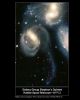
Stephan_s_Quintet-PIA04201_modest.jpgGalaxy Group "Stephan's Quintet"61 visite"...Ho visto una lumaca scivolare...
Lungo il filo...
Di un rasoio.
Ecco il mio sogno.
Il mio incubo.
Scivolare...Strisciare...
Lungo il filo...
Di un rasoio.
E sopravvivere".
Dal film "Apocalypse Now"
(14 voti)
|
|

Miranda-PIA01354_modest.jpgMiranda (close-up of the Verona Rupes Region) - HR85 visiteCaption NASA originale:"Miranda, innermost of Uranus' large satellites, is seen at close range in this Voyager 2 image, taken Jan. 24, 1986, as part of a HR mosaicing sequence. Voyager was some 36.000 Km (22.000 miles) away from Miranda. This clear-filter, narrow-angle image shows an area about 250 Km (150 mi) across, at a resolution of about 800 meters (2.600 feet). Two distinct terrain types are visible: a rugged, higher-elevation terrain (right) and a lower, striated terrain. Numerous craters on the rugged, higher terrain indicate that it is older than the lower terrain. Several scarps, probably faults, cut the different terrains.
The impact crater in the lower part of this image is about 25 Km (15 mi) across".
(14 voti)
|
|
| 25332 immagini su 2111 pagina(e) |
 |
|
|
|
|
45 | |
|
|
|
|





