| Piú votate |

NGC-0104.jpgNGC 104 alias 47 Tucanae - Globular Star Cluster90 visite"...I tell you, whatever you ask for in prayer, believe that you have received it, and it will be yours..."
Mark, 11:24
(14 voti)
|
|

Sunrise.jpgCrepuscular Rays Over Utah65 visiteDa "NASA - Picture of the Day", del 31 Agosto 2005:"What could cause such rays of dark? Dark sky rays were caught in spectacular fashion earlier this month above Utah, USA. The cause is something surprisingly familiar: shadows. Clouds near the horizon can block sunlight from reflecting off air, making columns outward from the Sun appear unusually dark. Cloud shadows can be thought of the complement of the more commonly highlighted crepuscular rays, also visible above, where sunlight pours though cloud holes. Sometimes, on the opposite side of the sky, anticrepuscular rays can also be seen".
(14 voti)
|
|
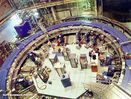
G - 2.jpgAnother Universe behind our Universe?138 visiteHow fast do fundamental particles wobble? A surprising answer to this seemingly inconsequential question has come out of Brookhaven National Laboratory in New York, USA and may not only indicate that the Standard Model of Particle Physics is incomplete but also that our universe is filled with a previously undetected type of fundamental particle. Specifically, the muon, a particle with similarities to a heavy electron, has had its relatively large wobble under scrutiny since 1999 in an experiment known as g-2 (gee-minus-two), pictured above. The result has galvanized other experimental groups around the world to confirm it, and pressures theorists to better understand it. The rate of wobble is sensitive to a strange sea of virtual particles that pop into and out of existence everywhere. The unexpected wobble rate may indicate that this sea houses virtual particles that include nearly invisible supersymmetric counterparts to known particles. If so, a nearly invisible universe of real supersymmetric particles might exist all around us.
(14 voti)
|
|

NGC 0001 and 0002.jpgNGC 1 and 259 visite"Professor does cold exist?"
The professor replied "Of course it exists. Have you never been cold?"
The students snickered at the young man's question.
The young man replied, "In fact sir, cold does not exist. According to the laws of physics, what we consider cold is in reality the absence of heat. Everybody or object is susceptible to study when it has or transmits energy, and heat is what makes a body, or matter, have or transmit energy.
Absolute zero (- 460 degrees F) is the total absence of heat. Cold does not exist. We have created this word only to describe how we feel if we have no heat".
The student continued. "Professor, does darkness exist?"
The professor responded, "Of course it does."
The student replied, "Once again you are wrong sir. Darkness does not exist either. Darkness is in reality the absence of light. Light we can study, but not darkness. In fact we can use Newton's prism to break white light into many colors and study the various wavelengths of each color.
You cannot measure darkness. A simple ray of light can break into a world of darkness and illuminate it. How can you know how dark a certain space is? You measure the amount of light present. Isn't this correct? Darkness is a term used by man to describe what happens when there is no light present".
(14 voti)
|
|

Asteroids-Sylvia_compo680.jpg87 Sylvia and the Founders of Rome60 visiteDa "NASA - Picture of the Day" del 17 Agosto 2005:"Discovered in 1866, Main Belt Asteroid 87 Sylvia lies 3.5 AU from the Sun, between the orbits of Mars and Jupiter. Also shown in recent years to be one in a growing list of double asteroids, new observations during August and October 2004 made at the Paranal Observatory convincingly demonstrate that 87 Sylvia in fact has two moonlets - the first known triple asteroid system. At the center of this composite of the image data, potato-shaped 87 Sylvia itself is about 380 Km wide. The data show inner moon, Remus, orbiting Sylvia at a distance of about 710 Km once every 33 hours, while outer moon Romulus orbits at 1360 Km in 87,6 hours. Tiny Remus and Romulus are 7 and 18 Km across respectively. Because 87 Sylvia was named after Rhea Silvia, the mythical mother of the Founders of Rome, the discoverers proposed Romulus and Remus as fitting names for the two moonlets (...)".
(14 voti)
|
|

NGC-6210.jpgNGC 6210 - Planetary Nebula67 visite"...More things change, the more they stay the same..."
dal film "Escape from L.A."
(14 voti)
|
|

SNR-0103.jpgSNR 0103 - Supernova Remnant72 visite"...The poet is the priest of the invisible..."
Wallace Stevens (1879-1955) - "Adagia"
(14 voti)
|
|

M-008-1.jpgM 8 - The "Lagoon Nebula"94 visite"...Capita spesso di incontrare delle belle ragazze e di desiderarle, ma in lei c’era qualcosa di diverso che me la faceva piacere, che non svegliava i miei sensi ma mi faceva stare bene.
C'era una sorta di affinità naturale che metteva sulla stessa lunghezza d'onda le nostre vibrazioni.
Mi venne spontaneo pensare, rifacendomi alle esperienze di Huygens sulle oscillazioni sincrone, che nell'Universo ogni cosa è influenzata da ciò che la precede e da ciò che la segue, ma solo le cose contigue possono armonizzarsi e creare un sistema energetico in perfetto equilibrio.
Questo era quanto stava accadendo a noi e la facilità con la quale ciò accadeva, poteva esserne la prova..."
Giuseppe Spina - "L'Intervista"
(14 voti)
|
|
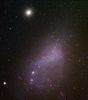
SmallMagellanCloud.jpgSmall Magellanic Cloud, NGC 362 and 47 Tucanae74 visiteDa "Astronomy Picture of the Day" del 17 Giugno 2005:"Portuguese navigator Ferdinand Magellan and his crew had plenty of time to study the southern sky during the first circumnavigation of planet Earth.
As a result, two celestial wonders easily visible for southern hemisphere skygazers are known as the Clouds of Magellan. These cosmic clouds are now understood to be dwarf irregular galaxies, satellites of our larger spiral Milky Way Galaxy. The Small Magellanic Cloud pictured above actually spans 15.000 LY or so and contains several hundred million stars. About 210.000 LY distant in the constellation Tucana, it is the forth closest of the Milky Way's known satellite galaxies, after the Canis Major and Sagittarius Dwarf galaxies and the Large Magellanic Cloud. This gorgeous view also includes two foreground globular, star clusters NGC 362 (top left) and 47 Tucanae. Spectacular 47 Tucanae is a mere 13.000 LY away and seen here to the right of the Small Magellanic Cloud".
(14 voti)
|
|

OPP-SOL001-02-MERB_Sol1_Postcard-B002R1_br2.jpgThe "First Color View" of Eagle Crater (2) - Sol 1196 visiteCaption NASA originale:"The interior of a Crater surrounding the Mars Exploration Rover Opportunity at Meridiani Planum on Mars can be seen in this color image from the Rover's PanCam. This is the darkest landing site ever visited by a spacecraft on Mars. The rim of the Crater is approximately 10 mt (approx. 32 feet) from the Rover. The Crater is estimated to be 20 mt (approx. 65 feet) in diameter. Scientists are intrigued by the abundance of rock outcrops dispersed throughout the Crater, as well as the Crater's soil, which appears to be a mixture of coarse gray grains and fine reddish grains. Data taken from the camera's near-infrared, green and blue filters were combined to create this approximate true color picture, taken on the first day of Opportunity's journey. The view is to the west-southwest of the Rover".
(14 voti)
|
|
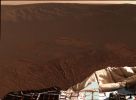
OPP-SOL001-01-MERB_Sol1_Postcard-B002R1_br2.jpgThe "First Color View" of Eagle Crater (1) - Sol 1205 visiteGli air-bags sono sgonfi e formano un 'cuscino' sul quale siede il Rover Opportunity.
Ben visibile (e luccicante) è l'antenna MAST, in posizione eretta; tutto intorno al "nido" ci sono le intriganti tracce dei rimbalzi sul suolo Marziano ed il cielo è a tratti rosato ed a tratti di un colorito celeste pallido. Sono le prime immagini in "approximately true colors" che arrivano da Meridiani Planum e, come è già accaduto, sono anche le più dettagliate, chiare e realistiche.
Il tempo, anzichè chiarire, ha finito con il confondere...
(14 voti)
|
|

ZE-I-Viking2-vl2_22g144.jpgFrom the "Viking Archive" - Viking 2: surroundings160 visiteCaption NASA originale:"Viking 2 Lander close-up of the surface of Mars. The metal cylinder at right is the shroud for the surface sampler instrument, which was ejected after landing. To the left of it are trenches dug by the sampling arm, and at lower right part of a footpad can be seen. Note the holes in the rocks, which appear to be vesicles produced by gas bubbles when the rocks first solidified from lava. The camera is looking due east and local time is 19:47. The shroud is about 30 cm long. (Viking 2 Lander, 22G144)".
(14 voti)
|
|
| 25332 immagini su 2111 pagina(e) |
 |
|
|
|
|
44 | |
|
|
|
|





