| Piú votate |
In the Mind-1.jpgIn the mind79 visitenessun commento
(14 voti)
|
|

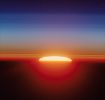
SN 1006-1.jpgSN 1006: A New Sun over the Ocean...79 visite...Si tratta soltanto di una - riuscita - ricostruzione/falsificazione, ma il risultato finale è comunque molto bello e ci dimostra, una volta ancora, che se si è capaci di "giocare" con le immagini, si può creare qualsiasi cosa e si può ingannare chiunque...
Caption originale:"A new star, likely the brightest supernova in recorded human history, appeared in planet Earth's sky about 1000 years ago, in 1006 AD. The expanding debris cloud from the stellar explosion is still visible to modern astronomers, but what did the supernova look like in 1006? In celebration of the millennial anniversary of SN1006, astronomer Tunc Tezel offers this intriguing suggestion, based on a photograph he took on February 22, 1998 from a site overlooking the Mediterranean Sea, south of Antalya, Turkey. On that date, bright Venus and a waning crescent Moon shone in the early morning sky. Adopting calculations which put the supernova's apparent brightness between Venus and the crescent Moon, he digitally superposed an appropriate new star in the picture. He placed the star at the supernova's position in the southerly constellation of Lupus and used the water's reflection of moonlight in the final image".
(14 voti)
|
|

NGC-7635-1.jpgNGC 7635 (the "Bubble Nebula") and Star Cluster M 5258 visite"Il Passato non è, ma se lo pinge
La viva Rimembranza:
Il Futuro non è, ma se lo pinge
La credula Speranza:
Il Presente sol è, che in un baleno
Passa del nulla in seno.
Adunque il Tempo è appunto
Una Memoria, una Speranza, un Punto".
Rossetti - "Poesie"
(14 voti)
|
|
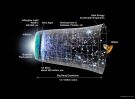
Timeline.jpgThe Timeline of the Universe69 visiteThe Universe is expanding gradually, now, but its initial expansion was almost impossibly rapid as it likely grew from quantum scale fluctuations in a trillionth of a second. In fact, this cosmological scenario - known as "Inflation" - is now reported to be further quantified by an analysis of 3 years of data from the WMAP Spacecraft. WMAP's instruments detect the Cosmic Microwave Background Radiation - such as the afterglow light from the early Universe. WMAP's amazing success in exploring the first trillionth of a second and favoring specific inflationary scenarios, lies in its ability to make unprecedented, precise measurements of the properties of the Microwave Background. The subtle properties are distilled from conditions in the early Universe and related to its first moments of existence. Schematically, this diagram traces the 13,7 BY (plus a trillionth of a second) history of the Universe from the quantum scale to the formation of stars, galaxies, planets and WMAP itself.
(14 voti)
|
|

Z machine_sandia_big-1.jpgThe Heart of a Star...On Earth: the Z Machine113 visiteWhy is this plasma so hot? Physicists aren't sure. What is known for sure is that the Z Machine running at Sandia National Laboratories created a plasma that was unexpectedly hot. The plasma reached a temperature in excess of two billion Kelvin (!), making it arguably the hottest human made thing ever in the history of the Earth and, for a brief time, hotter than the interiors of stars. The Z Machine experiment, pictured above, purposely creates high temperatures by focusing 20 million amps of electricity into a small region further confined by a magnetic field. Vertical wires give the Z Machine its name. During the unexpected powerful contained explosion, the Z machine released about 80 times the world's entire electrical power usage for a brief fraction of a second. Experiments with the Z Machine are helping to explain the physics of Solar flares, design more efficient nuclear fusion plants, test materials under extreme heat, and gather data for the computer modeling of nuclear explosions.
(14 voti)
|
|

NGC-7293-0.jpgNGC 7293 - The "Helix Nebula"64 visite"...Veritas una vis, una facies est..."
(Seneca)
"...Della Verità, una sola è la forza ed uno solo è l'aspetto..."
(14 voti)
|
|

M-087-5.jpgM 87 - Gas Disk inside the Nucleus61 visite"...Homini plurima ex homine sunt mala..."
(Plinio)
"...Molte umane afflizioni derivano dalla stessa umana natura..."
(14 voti)
|
|

Venusian_Surface-Venera_13-02.jpgVenus from Venera 13 (camera 2)152 visitenessun commento
(14 voti)
|
|

Venusian_Surface-Venera_14-02.jpgVenus from Venera 14 (camera 2)124 visite"...These images are the original Russian digital images, with a little reprocessing. The original color images were darker and somewhat noisier than the b/w pictures scanned through the clear filter.
In this image, I combined the chroma signal from the color images with the luminance from the clear-filter images. The color chart, extended from the spacecraft was originally painted with gray, red, green and blue silicone enamel. On Venus, its color was shifted by effects of heat and pressure, and tinted by the orange sky. I adjusted the image colors slightly to match the calculated hues of the chart, but these pictures are not precisely color balanced..."
(14 voti)
|
|

Venusian_Surface-Venera_14-00.jpgVenus from Venera 14 (camera 1)132 visite"...The quality (of the Venera frames) is remarkably good, and a nearly perfect transmission can be compiled by carefully merging the information from multiple transmissions. A few sections appear damaged by noise, but these are actually bit synchronization errors which can be repaired in software. For example: work on this data set is in progress. Recovering the radiometric response function and balancing color are the next steps. Since the scene was scanned several times, it may be possible to calculate a super-resolution image from multiple panoramas, as NASA has done with Mars Pathfinder images..."
(14 voti)
|
|
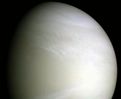
1-Venus_Galileo_Visible.jpgVenus144 visiteUna magnifica ricostruzione di Venere - ad opera dello "Space Artist" Don P. Mitchell - nei colori in cui un umano che fosse nello spazio la vedrebbe.
Queste le annotazioni originali dell'Artista:
Full spectral data is rarely available, and instead we must use views through color filters. Above, the Galileo probe captured Venus through a clear filter (left) and through a 410 nm violet filter, which reveals the subtle yellow and white clouds. Unfortunately, many different color images could result in the same two clear and violet signals above. Even when so-called red, green and blue filters are used, the problem is just as difficult, because the filters are not really the right red, green and blue to just plug into the channels of a color display. Theoretically, information from the two images above and from the Cassini spectrum could be combined using Bayesian decision theory, to compute the most probable color image. If colors are estimated correctly, there is a final issue of tone mapping. How bright does the image appear to the eye in a given context. The image above is the best color image of Venus I've found, showing the planet as it would likely appear to a human observer in space. It was made by Turkish astronomer A. Tayfun Oner, using the two color channels from the Galileo camera, and a third interpolated channel.
(14 voti)
|
|

Moon-1.jpgThe Moon over a "Red Planet"88 visiteOriginal caption:"Near its Northernmost declination, tonight's Full Moon (Dec. 15, 2005) will be a special one, arcing high in Northern Hemisphere skies. But a Full Moon won't occur on this calendar date for another 19 years, a period known as the Lunar Metonic Cycle (...)".
(14 voti)
|
|
| 25332 immagini su 2111 pagina(e) |
 |
|
|
|
|
42 | |
|
|
|
|





