| Piú votate |

SOL1366-2P247639452EFFAWCCP2414L7M1.jpgPanorama - Sol 1366 (3 - true colors; elab. Lunexit)61 visitenessun commentoMareKromium
(14 voti)
|
|

The_Moon.jpgThe Hunter's Moon...60 visite"...Caelum, avarus, in coeno quaerit..."
(Binder)
"...L'avaro (inteso anche come chi è "moralmente misero") cerca il Cielo nel fango..."MareKromium
(14 voti)
|
|

Voyagers-00.gifTowards the "Terra Incognita" (1)62 visiteInterstellar Mission - Mission Objective
The mission objective of the Voyager Interstellar Mission (VIM) is to extend the NASA exploration of the Solar System beyond the neighborhood of the outer planets to the outer limits of the Sun's sphere of influence, and possibly beyond. This extended mission is continuing to characterize the outer Solar System environment and search for the heliopause boundary, the outer limits of the Sun's magnetic field and outward flow of the solar wind. Penetration of the heliopause boundary between the solar wind and the interstellar medium will allow measurements to be made of the interstellar fields, particles and waves unaffected by the solar wind.
The VIM is an extension of the Voyager primary mission that was completed in 1989 with the close flyby of Neptune by the Voyager 2 spacecraft. Neptune was the final outer planet visited by a Voyager spacecraft. Voyager 1 completed its planned close flybys of the Jupiter and Saturn planetary systems while Voyager 2, in addition to its own close flybys of Jupiter and Saturn, completed close flybys of the remaining two gas giants, Uranus and Neptune.
At the start of the VIM, the two Voyager spacecraft had been in flight for over 12 years having been launched in August (Voyager 2) and September (Voyager 1), 1977. Voyager 1 was at a distance of approximately 40 AU (Astronomical Unit - mean distance of Earth from the Sun, 150 million kilometers) from the Sun, and Voyager 2 was at a distance of approximately 31 AU.
As of July 2007, Voyager 1 was at a distance of 15.4 Billion Kilometers (103 AU) from the sun and Voyager 2 at a distance of 12.4 Billion kilometers (83 AU).
Voyager 1 is escaping the solar system at a speed of about 3.6 AU per year, 35 degrees out of the ecliptic plane to the north, in the general direction of the Solar Apex (the direction of the Sun's motion relative to nearby stars). Voyager 2 is also escaping the solar system at a speed of about 3.3 AU per year, 48 degrees out of the ecliptic plane to the south.
Both Voyagers are headed towards the outer boundary of the solar system in search of the heliopause, the region where the Sun's influence wanes and the beginning of interstellar space can be sensed. The heliopause has never been reached by any spacecraft; the Voyagers may be the first to pass through this region, which is thought to exist somewhere from 8 to 14 billion miles from the Sun. In December 2004 Voyager 1 crossed an area known as the termination shock. This is where the million-mile-per-hour solar winds slows to about 250,000 miles per hour—the first indication that the wind is nearing the heliopause. Voyager 2 is currently observing preshock phenomena, indicating that it is close to the termination shock. The Voyagers should cross the heliopause 10 to 20 years after reaching the termination shock. The Voyagers have enough electrical power and thruster fuel to operate at least until 2020. By that time, Voyager 1 will be 12.4 billion miles (19.9 billion KM) from the Sun and Voyager 2 will be 10.5 billion miles (16.9 billion KM) away. Eventually, the Voyagers will pass other stars. In about 40,000 years, Voyager 1 will drift within 1.6 light years (9.3 trillion miles) of AC+79 3888, a star in the constellation of Ophiucius. In some 296,000 years, Voyager 2 will pass 4.3 light years (25 trillion miles) from Sirius, the brightest star in the sky . The Voyagers are destined—perhaps eternally—to wander the Milky Way. For current distances, check: Mission Weekly Reports
MareKromium
(14 voti)
|
|

M-45~0.jpgM 45 and Venus61 visite"...L'Opium agrandit ce qui n'a pas de bornes,
Allonge l'Illimité,
Approfondit le Temps, creuse la Volupté,
Et de plaisirs noirs et mornes
Remplit l'ame au-delà de sa capacité..."
Charles Baudelaire (1821 - 1867) - "Le Poison" (1857)
(14 voti)
|
|

CometHale-Bopp-970401C_lodriguss.jpgOn the edge of Oblivion...59 visite"...Mi dispiace vedere che gran parte delle persone vivano la loro Vita non secondo un modello personale - magari discutibile, ma proprio -, bensì secondo il modello creato solo ed esclusivamente dalla televisione (o da chi per essa).
Un modello orrendo e della razza peggiore.
Certo, non esiste un modello predefinito di "Vita" e allora ognuno di noi cresce assieme a quello che gli sta attorno, aiutandosi con quanto si trova in giro. Però...
Però vedo sempre più maiali inconsapevoli di viaggiare verso il mattatoio e, anche se dovrei (forse) preoccuparmi più di me stesso, questa visione - un pò - mi duole..."
Giorgio Picciau - "Lettere"MareKromium
(14 voti)
|
|

SOL1025-2P217371620ESFAS20P2578R1M1.jpgPale Blue Sky... - Sol 1025111 visiteIl risultato delle colorizzazioni che operiamo sui frames NASA originali in b/n non sono diverse soltanto in rapporto alle "premesse logiche" da noi stessi individuate (ad es.: l'ora del giorno, l'O.A., la dominante cromatica etc.), ma anche avutosi riguardo al tipo di filtro/colore usato dal Rover.
La NASA non sempre specifica, a margine di ciascun frame, il filtro/colore impiegato e noi abbiamo notato che, mantenendo le "nostre" premesse, alle volte il risultato finale cambia. In altre parole: i nostri dati di riferimento-base influiscono sul risultato finale solo in parte.
Questo cielo di un pallido celeste (con riflessi verdognoli) è il prodotto derivante dalla applicazione del nostro sistema di colorizzazione su un sub-frame Spirit EDR PanCam. Ebbene, nelle nostre premesse la dominante scelta era il color giallo/arancio/marrone.
Quali sono i "veri" colori di Marte?!?...MareKromium
(14 voti)
|
|

ZZ-ZZ-ZZ-ZZ-ZZ-FastWalker-konig080895.gifFast-walker in transit224 visiteDa una ripresa telescopica ottenuta da Terra, il transito di un Fast-Walker (o meglio: l'ombra di un Fast-Walker in transito che si proietta sulla grigia superficie della Luna).
Ora, come già si disse in passato e come il Dr Fienga scrisse nell'articolo "L'Anno del Centauro" - pubblicato sul Sito UFO-ONLINE - perchè un oggetto "possa/riesca a proiettare la propria ombra sulla superficie della Luna" è ragionevole supporre che:
1) trattasi di un oggetto DECISAMENTE VICINO alla superficie della Luna (e comunque molto più vicino alla Luna di quanto non lo sia alla Terra) e
2) trattasi di un oggetto avente NOTEVOLISSIME DIMENSIONI (così notevoli da poter essere visto - e BENE - anche da oltre 300000 Km di distanza.
E allora? Che cosa stiamo guardando?...
Observer: Mr. Steve Massey
Location: Residence - Dee Why - New South Wales
Time and date of observation: 00.30 to 00.40 Hrs EST 08/08/95
Object's location: Object seen passing over the northern quadrant of the Mare Humorum a little south of the crater "Gassendi". This area is located in the lower south I west quadrant of the Moon.
Object visible for: 0.74 of a second as determined from video sequence at normal running speed.
Equipment used: 10" Meade Reflector Telescope fitted with clock drive unit for tracking. The eyepiece used at the time of observation was a 25 mm focal length of f4.5 rating together with a 2x barlow lens. The telescope mirror was 1l40 mm. In addition to this, a video camcorder set at 8x zoom and was hand-held at the eyepiece to record the moon's surface features. The total magnification ratio was as follows - 1140 mm divided by 25mm = 45.6x + 2x barlow = 91.2x + camcorder 8x zoom = 729.6x.
Moon details: At the time of observation the Moon was in the western quadrant at 39.40 degrees above the horizon. It was 8/10ths illuminated with the full Moon due 110895. See (visual) direction graphic for astronomical position data.
Observation: Steve is a keen amateur astronomer and has been interested in the subject since an early age. He has an excellent knowledge of astronomy and uses a 10" Meade Reflecting Telescope fitted with a drive unit for tracking. At between 30 to 40 minutes after midnight on the 8th of August he was videotaping an area of the Moon known as the Mare Humorum in the general vicinity of the crater Gassendi. He was hand holding a camcorder set at maximum zoom ratio of x8 up to the telescope eyepiece and while watching through the viewfinder, noticed an object enter the field of view from the lower right just above the crater "Konig" moving at extremely high speed to disappear out of the field of view in the upper left.
(14 voti)
|
|
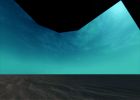
087-Marshorizon_opportunity_big.jpg(almost) Blue Skies over Meridiani (2)119 visitenessun commento
(14 voti)
|
|

Dunes-S2200554sub-00.jpgMigrating Dunes (Original NASA/MGS/MSSS b/w Frame)114 visiteCaption NASA originale:"This MGS-MOC image shows a suite of dunes in one of the several North Polar Dune Fields. The bright surfaces adjacent to some of the dunes are patches of frost. These dunes spend much of the Autumn, Winter, and Spring seasons covered with CO2 frost. Only in late Spring and in Summer are the dark windblown sands fully exposed.
Over the course of the 9+ years of the MGS mission, the MOC team has sought evidence that sand dunes may be migrating downwind over time. However, no clear examples of the movement of a whole dune have been identified. On Earth, such movement is typically detectable in air photos of the smallest active dunes over periods of a few years. Owing to the fact that the North Polar Dunes spend much of each Martian Year under a cover of frost, perhaps these move much more slowly than their frost-free, terrestrial counterparts. The sand may also be somewhat cemented by ice or minerals, likewise preventing vigorous dune migration in the present environment.
This view covers an area approximately 3 km (1.9 mi) wide and is illuminated by sunlight from the lower left. The dunes are located near 79.8°N, 127.1°W, and the picture was acquired on 11 September 2006.
(14 voti)
|
|

Polar Flash.jpgPolar "Flash"59 visitenessun commento
(14 voti)
|
|
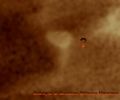
OPP-SOL072-1N134581705EFF0932P1972L0M1-A1.jpgEarly Days... (detail mgnf - true colors) - Sol 72112 visiteTanti Lettori ci hanno chiesto una definizione di "Struttura Effimera" e poi, naturalmente, se le "Strutture Effimere" fossero una sola prerogativa della Luna.
E allora, ricapitolando, Vi diciamo che la "Struttura Effimera" è un Rilievo il quale, nelle immagini riguardanti una precisa regione (rectius: porzione di superficie) di un qualsiasi Corpo Celeste (Terra inclusa), appare SOLO in alcune di esse (p.e.: è "Effimera" la Struttura - e cioè il "rilievo" - che si vede solo quando l'Osservatore si pone in una determinata angolazione rispetto alla superficie osservata oppure il rilievo che si vede solamente allorchè detta superficie si trova in determinate condizioni di illuminazione - p.e. solo con luci alte, o radenti etc.)".
(14 voti)
|
|

SH2-170.jpgSH2-17069 visite"...Non so che farmene del tuo Dio.
Anzi: non so che farmene di un Dio, il tuo come quello di qualsiasi altro.
Un "Dio" che guarda e che, dall'alto della Sua Onnipotenza, Bontà e Saggezza, lascia che le sue pecore si scannino fra loro nel nome di Lui o nel nome dell'interesse del gregge a cui esse appartengono, è solo un vigliacco, un ipocrita, un nulla.
Il Dio nel quale credi tu e tanti altri assieme a te, non è nulla più di una parola, vuota ed abusata.
Accetta la realtà: c'è molto più Dio nella Fede di coloro che sono morti nel Suo Nome e nelle pietre usate per erigere le Sue Cattedrali, di quanto io ne veda nella candida immagine che tu, vanamente, continui a temere e supplicare...".
P.C. Floegers - "Conversations for Tomorrow"
(14 voti)
|
|
| 25332 immagini su 2111 pagina(e) |
 |
|
|
|
|
41 | |
|
|
|
|





