| Piú votate |
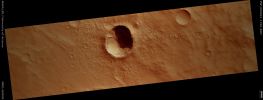
Psp_009622_1590_red.jpgMedium-size Impact Crater (possible True Colors; credits: Lunar Explorer Italia)56 visiteMars Local Time: 15:31 (middle afternoon)
Coord. (centered): 20,9° South Lat. and 184,4° East Long.
Spacecraft altitude: 257,3 Km (such as about 160,8 miles)
Original image scale range: 51,5 cm/pixel (with 1 x 1 binning) so objects ~1,54 mt across are resolved
Map projected scale: 50 cm/pixel
Map projection: EQUIRECTANGULAR
Emission Angle: 3,5°
Phase Angle: 70,5°
Solar Incidence Angle: 68° (meaning that the Sun is about 22° above the Local Horizon)
Solar Longitude: 112,9° (Northern Summer)
Credits: NASA/JPL/University of Arizona
Additional process. and coloring: Lunar Explorer ItaliaMareKromium 
(5 voti)
|
|
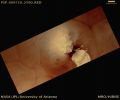
PSP_009710_2590_RED.jpgRelatively Fresh Ice-Patch near the North Polar Layered Deposits (possible True Colors; credits: Lunar Explorer Italia)57 visiteMars Local Time: 14:57 (early afternoon)
Coord. (centered): 78,7° North Lat. and 285,2° East Long.
Spacecraft altitude: 323,6 Km (such as about 202,2 miles)
Original image scale range: 32,4 cm/pixel (with 1 x 1 binning) so objects ~97 cm across are resolved
Map projected scale: 25 cm/pixel
Map projection: EQUIRECTANGULAR
Emission Angle: 11,8°
Phase Angle: 50,0°
Solar Incidence Angle: 60° (meaning that the Sun is about 30° above the Local Horizon)
Solar Longitude: 116,1° (Northern Summer)
Credits: NASA/JPL/University of Arizona
Additional process. and coloring: Lunar Explorer ItaliaMareKromium
(5 voti)
|
|
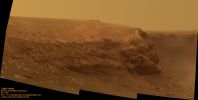
OPP-SOL1329-1193591285_32257-4_Sol1329B_P2379_L257atc-1.jpgCape Verde, according to NASA - Sol 132958 visiteCaption NASA:"A promontory nicknamed "Cape Verde" can be seen jutting out from the walls of Victoria Crater in this approximate true-color picture taken by the PanCam on NASA's MER Opportunity. The Rover took this picture on Martian Day, or Sol, 1329 (Oct. 20, 2007), more than a month after it began descending down the crater walls - and just 9 Soles shy of its second Martian birthday on Sol 1338 (Oct. 29, 2007).
Opportunity landed on the Red Planet on Jan. 25, 2004. That's nearly 4 years ago on Earth, but only 2 on Mars, because Mars takes longer to travel around the Sun than Earth. One Martian year equals 687 Earth days.
The overall soft quality of the image, and the "haze" seen in the lower right portion, are the result of scattered light from dust on the front sapphire window of the Rover's camera.
This view was taken using 3 PanCam filters, admitting light with wavelengths centered at 750 (near infrared), 530 (green) and 430 nanometers (violet)".MareKromium
(5 voti)
|
|

Mars&Iran-0.jpgMars and Iran: where "nothing" becomes "something"! (1)803 visiteCome prevedibile – e sebbene a malincuore – inauguriamo la nostra Galleria di “Scemenze Spaziali” con una serie di frames proposti sul Sito del Prof. Richard Hoagland, “The Enterprise Mission”.
Si tratta di sei frames (MGS, Odyssey e MRO), estratti da un articolo dello stesso Prof. Richard Hoagland (“Mars Reconnaissance Orbiter...and the lost Cities of Barsoom”) i quali mettono a confronto (dobbiamo dire in maniera bella e graficamente accattivante, ma – ahinoi! – anche intrinsecamente scorretta, ingannevole e fuorviante) alcuni paesaggi Marziani con delle aree Archelogiche di indubbio fascino, situate nell’odierno Iran.
Dov’è la “baggianata”, ci chiederete?
Beh, di “baggianate” – a dire il vero – ce ne sono davvero parecchie in questi “arditi raffronti”, ma noi Vi suggeriamo di soffermarVi su queste semplici ed immediatissime riflessioni.
Come si legge nelle captions dei frames usati dallo stesso Hoagland per la sua speculazione, i frames relativi alle “Rovine Persiane” (riprese da un aereo) sono stati ottenuti da altezze comprese fra i 427 ed i 2000 mt.
Si tratta davvero di poca cosa se pensate che i frames relativi alle presunte “Rovine Marziane” sono stati invece ottenuti da altezze comprese tra i 550 ed i 2489 Km!
(12 voti)
|
|

Linear_Ridges-PCF-LXTT-1.jpgLinear Ridges (Enhanced Natural Colors; credits for the additional process. and color.: Dr Paolo C. Fienga - Lunexit Team)58 visitenessun commentoMareKromium
(8 voti)
|
|

00-M-FAGONE-GreenMars.jpgThe "True Colors" of Mars?780 visiteLun-Ex-It has decided to open a new Main Section of its "Library" which will be entirely dedicated to the Readers (we thought that some Works that were sent to us deserved some kind of recognition and...Here we are!).
We are not all Scientists so, please, do not expect any "graduated-like" Work here: this Section is just given to those who have something to 'Show&Tell', no matter what their "cv" might say: anybody can come to this (small) Tribune and speak-up (but nobody needs to scream, because Lunar Explorer's Friends are not deaf).
A small space for the Readers had already been created in the Deep Sky Section and, we must say, after a little more than a year, the stats show that the experiment was successful. Now therefore, after Writers&Poets, it is time to listen to what our Truth-Seeking Friends have to say about the Moon, Mars and the Universe.
So, if you are not scared of your own ideas and opinions being - let's say - "exposed", write us!
(in English or French; pictures are welcome)
(17 voti)
|
|
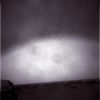
OPP-SOL1395-1.jpgLook at those grains of dust... - Sol 1395 (false colors; credits: Dr M. Faccin)60 visiteUna brillante intuizione (molto probabilmente corretta) del Dr Faccin sulla struttura fisica delle Camere di cui i MER sono dotati. Ma lasciamo che sia lui stesso a spiegare quello che ha scoperto:"...la NASA fa vedere che si ci sono nubi di polvere (intorno ai Rover) ma, osservando bene, si può notare che ci sono anche dei grani di questa polvere sugli obbiettivi.
Ora notate: alcune di queste macchie scure sono esagonali, una forma data dal diaframma. Scoperto questo, noi sappiamo che i CCD dei MER sono muniti di diaframma meccanico, al pari di una semplice camera digitale da 50 Euro.
Quanto detto si riferisce alla NavCam - che presumo sia analoga alla PanCam - la quale si distingue dalle Rear e FrontHazCam poichè esse, credo, sono ad obbiettivo fisso - simili alle webcam, tanto per intenderci...".
Allora: la NASA usa sempre "supertecnologie" da milioni di Dollari, oppure - magari qualche volta... - "tira a risparmiare"? E soprattutto: ma siamo così sicuri che ci vogliano "suprtecnologie" per "sopravvivere alle "estreme" (ma dove?!?) condizioni di Marte?
Siamo sempre più dell'idea che qualcosa non torni: complimenti e congratulazioni al Dr Faccin ed ora, se volete, la parola a Voi!...MareKromium
(8 voti)
|
|

Beyond_the_Hills.jpgBeyond the Hills (by Ermes Sansottera)267 visite"...Vedere e capire ciò che è giusto fare, e poi non farlo, significa non avere coraggio..."
(Confucio)MareKromium
(18 voti)
|
|

Mars&Iran-1.jpgMars and Iran: where "nothing" becomes "something"! (2)1135 visiteOra, l’idea di mettere a confronto delle immagini anche similari (alcune affinità nei rilievi superficiali, anche se non sono affatto nette come Hoagland vorrebbe farci credere, ci sono e non facciamo fatica ad ammetterlo), ma ottenute da distanze così profondamente diverse, significa tentare di stabilire un rapporto di “parentela” – o di somiglianza esteriore – tra rilievi superficiali il quale è non solo estremamente forzato, ma pure (logicamente e tecnicamente) scorrettissimo.
Se, infatti, volessimo anche ammettere che quanto si vede nei frames Marziani rappresenta effettivamente ciò che resta di una città o di un insediamento urbano affine a quelli presenti in Iran, come potremmo valutare il “rapporto dimensionale” esistente fra i diversi rilievi?
In altre parole: se le rovine Persiane sembrano avere una dimensione “X” (DA o Dimensione Apparente) da poche centinaia di metri di altezza, e questa DA rimane conservata allorché l’immagine viene scattata – diciamo – da 1000 Km di distanza, quanto grandi dovremmo supporre che sìano gli insediamenti Marziani?
Quanto grandi sarebbero le loro “case” (per non parlare delle loro “città”)?
Dovremmo forse dedurre che i Marziani sono/erano dei Ciclopi i quali avrebbero fatto impallidire anche il povero Polifemo?
(15 voti)
|
|

ESP_014188_1320_RED_abrowse.jpgUSGS Dune Database Entry Number 0894-475 (Natural Colors; credits: Lunexit)64 visitenessun commentoMareKromium
(14 voti)
|
|

Titan - artwork.jpgHuygens on Titan89 visiteThin methane clouds dot the horizon and a narrow methane spring or "methanefall" flows from the cliff at left and drifts mostly into vapor. Smooth ice features rise out of the methane/ethane lake, and crater walls can be seen far in the distance.
(14 voti)
|
|

SOL1492.jpgBright Panorama - Sol 1492 (Credits: Dr Marco Faccin and Elisabetta Bonora)134 visiteHey, NASA Guys: look at this! Can you do any better?!?MareKromium
(9 voti)
|
|
| 25332 immagini su 2111 pagina(e) |
 |
|
|
|
|
2103 | |
|
|
|
|





