| Piú votate |

Mars&Iran-4.jpgMars and Iran: where "nothing" becomes "something"! (5)625 visiteInsomma: l’approccio usato dal Signore di Enterprise Mission, in questo caso, non è solo scientificamente scorretto, ma è pure logicamente carente.
Fare raffronti di questo tipo vuol dire (a nostro parere) che non solo non si hanno le idee chiare in testa, ma che si è pure disposti a fare qualsiasi tipo di assunzione e di comparazione pur di arrivare a dimostrare la propria teoria, la propria ipotesi di partenza.
In altre parole: pur di dimostrare la bontà di un assunto iniziale (ad oggi) indimostrabile con certezza assoluta, non si è esitato un attimo ad ingannare i Lettori, mostrando loro rapporti e similitudini (e cioè “confluenze”) fra realtà – di fatto – del tutto incongruibili.
Questa è Scienza?
E’ divulgazione?
No: questo è pressappochismo e disonestà intellettuale, almeno a nostro parere.
E quindi, per chiudere, dobbiamo per forza dire: ”No, caro Richard, no: così proprio non va...”.

(11 voti)
|
|

Backshell.jpgBackshell on Sight! (by Doug Ellison)62 visitenessun commentoMareKromium
(10 voti)
|
|

SOL813-PIA08423-1.jpgWhen the Sun goes down... (1) - Sol 813 (Natural Colors; credits: Dr Paolo C. Fienga - Lunexit Team)71 visitenessun commentoMareKromium
(8 voti)
|
|

SOL667-2P185581899EFFAJNZP2405R1M1-2.JPGUnbelievable - and perhaps impossible - Balance! - Sol 667 (credits: Dr G. Barca)162 visiteIl detail mgnf predisposto dal nostro Big "G" è, come sempre, AUTOESPLICATIVO, e la "Morale" non può che risolversi nel solito dubbio, anzi: nella solita alternativa.
Che è questa:
1) o questa "roccia" si trova in uno stato di Equilibrio Improprio (il quale non esiste sulla Terra), o
2) questa "roccia" è stata ripresa mentre stava rotolando (ed allora la sua "postura", stiracchiando un pò la nostra Logica, potremmo anche arrivare a spiegarla).
Tertium non datur.MareKromium
(8 voti)
|
|
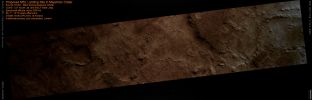
PSP_007704_1765_RED_abrowse~0.jpgProposed MSL Landing Site in Miyamoto Crater (MULTISPECTRUM; credits: Lunexit)55 visiteMiyamoto Crater is located in South-Western Meridiani Planum (and South-West of the Mars Exploration Rover Opportunity Landing Site).
This image shows fairly smooth plains and some areas covered by Windstreaks.
The streaks suggest that wind is an active process here, depositing surface material downwind in this distinctive form. This Landing Site is adjacent to the Hematite-bearing plains unit where the Opportunity Rover sits.
The CRISM instrument has detected Phyllosilicates (Clay Minerals) at this Landing Site, which scientists believe to have formed in the presence of water.
The Mars Science Laboratory rover would investigate the mineral diversity here, which includes Phyllosilicates and Sulfate Minerals.MareKromium
(6 voti)
|
|
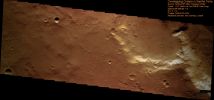
Collapse_Features-Xanthe_Terra-20080403a-PCF-LXTT.jpgSurface Features in Xanthe Terra (Enhanced Natural Colors; credits for the additional process. and color.: Dr Paolo C. Fienga - Lunexit Team)56 visitenessun commentoMareKromium
(6 voti)
|
|

Psp_009731_2165_red.jpgPeriglacial Modification of a Fairly Fresh Crater in Utopia Planitia (possible True Colors; credits: Lunar Explorer Italia)57 visiteMars Local Time: 15:19 (early afternoon)
Coord. (centered): 36,0° North Lat. and 80,7° East Long.
Spacecraft altitude: 295,3 Km (such as about 184,6 miles)
Original image scale range: 29,5 cm/pixel (with 1 x 1 binning) so objects ~89 cm across are resolved
Map projected scale: 25 cm/pixel
Map projection: EQUIRECTANGULAR
Emission Angle: 8,4°
Phase Angle: 53,4°
Solar Incidence Angle: 45° (meaning that the Sun is about 45° above the Local Horizon)
Solar Longitude: 116,8° (Northern Summer)
Credits: NASA/JPL/University of Arizona
Additional process. and coloring: Lunar Explorer ItaliaMareKromium
(6 voti)
|
|

W-5_Star_Forming_Region-PIA11726.jpgIn the Cosmic Hurricane...71 visiteThis image from NASA's Spitzer Space Telescope shows the nasty effects of living near a group of massive stars: radiation and winds from the massive stars (white spot in center) are blasting planet-making material away from stars like our sun. The planetary material can be seen as comet-like tails behind three stars near the center of the picture. The tails are pointing away from the massive stellar furnaces that are blowing them outward. The picture is the best example yet of multiple sun-like stars being stripped of their planet-making dust by massive stars.
The sun-like stars are about 2 three 3 million years old, an age when planets are thought to be growing out of surrounding disks of dust and gas. Astronomers say the dust being blown from the stars is from their outer disks. This means that any Earth-like planets forming around the sun-like stars would be safe, while outer planets like Uranus might be nothing more than dust in the wind.
This image shows a portion of the W5 star-forming region, located 6,500 light-years away in the constellation Cassiopeia. It is a composite of infrared data from Spitzer's infrared array camera and multiband imaging photometer. Light with a wavelength of 3.5 microns is blue, while light from the dust of 24 microns is orange-red.MareKromium
(4 voti)
|
|

SOL758-4.jpgRocky Landscape - Sol 758 (possible True Colors; credits: Dr G. Barca & Lunexit)55 visitenessun commentoMareKromium
(4 voti)
|
|

SOL1202-2P233075147EFFATCXP2368L2M1.jpgRover Tracks (3) - Sol 120258 visitenessun commentoMareKromium
(4 voti)
|
|

SOL2255-1.jpgSol 2255 - A Truly Beautiful Panorama (credits for the additional process. and color: Marco Faccin ed Elisabetta Bonora)134 visitenessun commentoMareKromium
(9 voti)
|
|
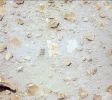
SOL0382-MF-EB-LXTT-IPF.jpg"Laser" effects on Morning "Frost" at Gale? - Sol 382 (Natural Colors; credits for the additional process. and color.: Elisabetta Bonora and Marco Faccin/Lunar Explorer Italia/Italian Planetary Foundation)117 visitenessun commentoMareKromium
(9 voti)
|
|
| 25332 immagini su 2111 pagina(e) |
 |
|
|
|
|
2097 | |
|
|
|
|





