| Piú votate |

Jupiter-water cloud-GAL-PIA01639_modest.jpgWater clouds on Jupiter71 visiteThis false-color picture of a convective thunderstorm 10.000 Km(6.218 miles) northwest of Jupiter's Great Red Spot was obtained by NASA's Galileo spacecraft on June 26, 1996. The white cloud in the center is a tall, thick cloud about 1.000 Km (620 miles) across, standing 25 Km (15 miles) higher than most of the surrounding clouds. Its base extends off to the left and appears red in this representation. This red color indicates that the cloud base is very deep in the atmosphere, about 50 Km (30 miles) below the surrounding clouds. Most of the wisps and features in Jupiter's clouds are thick and thin ammonia clouds, forming at a pressure just less than Earth's sea level pressure. On Jupiter, water is the only substance to form a cloud at a depth where the pressure is about 5 times the Earth's sea level pressure. The red base of this thunderstorm is so deep that it can only be a water cloud. In 1979 NASA's Voyager spacecraft saw convective clouds of this type near the Great Red Spot. They erupted like this roughly once every 10 days and lasted a few days each. But Voyager's cameras could not allow the determination of the storms' altitude. It is thought that this storm is analogous to an Earth thunderstorm, with the cloud's high, bright, white portion comparable to the familiar anvil cloud on Earth. Whether any rain or snow is falling below this cloud is unknown, but there are indications that similar storms on Jupiter have lightning in them. 
(13 voti)
|
|

The Sun in Hydrogen-Alpha light (2).jpgThe Sun in Hydrogen-Alpha light63 visiteCaption NASA originale:"The above image, taken in a single color of light called Hydrogen Alpha, records a great amount of detail of the simmering surface of our parent star. The gradual darkening towards the Sun's edge, called limb darkening, is caused by increased absorption of relatively cool solar gas. Further over the edge, a giant prominence is visible, while a different prominence can be seen in silhouette as the dark streak near the image center. Two active areas of the Sun are marked by bright plages. The above amateur photograph of the Sun was taken just through a small telescope and a standard digital camera".
(13 voti)
|
|

ZB-Uranus-HP-V2-PIA01391_modest.jpgFarewell Uranus...61 visiteUna veduta finale di Urano, registrata dalla Sonda Voyager 2 il 27 Gennaio 1986. Come potete vedere chiaramente, Urano si sta facendo sempre più piccolo, quasi che fosse "divorato" dall'oscurità che lo circonda...
Quest'immagine, per Voyager 2 (e per noi tutti), rappresenta l'addio ad Urano ed al suo Sistema di Anelli e di Lune.
Ci torneremo mai? Sicuramente si, ma potrebbero passare tantissimi anni prima che ciò accada davvero...
(13 voti)
|
|
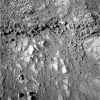
SOL239-2N147592573EFF8800P0506R0M1.jpgRocky Hills - Landscape (9) - Sol 23955 visitenessun commento
(13 voti)
|
|

ZV-Apollo 14-Landing Site.jpgThe Apollo 14 Landing Site150 visiteSiamo riusciti, cercando e ricercando fra i tanti Siti (Governativi e non) che si occupano ancora del Programma Apollo, a reperire delle interessantissime ed estremamente dettagliate Mappe dei siti di allunaggio, comprensive di riferimenti fotografici. Ve le proponiamo così come sono, per il Vostro piacere. Per quanto riguarda Lunar Explorer, ci vorrà parecchio tempo prima di poter esprimere delle compiute valutazioni sull'utilità di questo materiale per le nostre specifiche ricerche.
(13 voti)
|
|

ZB-Surface map of Pluto-HST-PIA00826_modest.jpgA "Map" of Pluto, from HST85 visiteCaption NASA originale:"This map that covers about 85% of the surface of the Planet confirms that Pluto has a dark equatorial belt and bright polar caps. The brightness variations in this map may be due to topographic features such as basins and fresh impact craters. Pluto itself probably shows even more contrast and perhaps sharper boundaries between light and dark areas than is shown here, but HST resolution (just like early telescopic views of Mars) tends to blur edges and blend together small features sitting inside larger ones".
(13 voti)
|
|
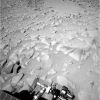
SOL233-2N147049604EFF8600P1871R0M1.jpgUnusual rocks near the Rover63 visite...Attenzione: noi non stiamo in nessun modo inferendo od asserendo che questa roccia "arcuata e levigata" sia di certa origine artificiale! Se lo facessimo, infatti, nulla ci distinguerebbe da quei Ricercatori che vedono "manufatti" ovunque, così banalizzando la ricerca di Anomalie reali e rendendo ridicole le ricerche poste in essere dall'intero Movimento. Noi diciamo solo che rocce come questa che Vi abbiamo adesso evidenziato meritano, a nostro parere, un'analisi maggiormente attenta e mirata.
(13 voti)
|
|

Phobos2-C_Fobos_14.jpgPhobos, from Phobos-2: the "Mysterious Encounter"210 visitenessun commento
(13 voti)
|
|

ZA-Neptune_s Rings-PIA01996_modest.jpgThe Rings of Neptune (closest approach)61 visiteCaption NASA originale:"The Voyager 2 spacecraft took this picture after closest approach to Neptune on Aug. 25 1989, using the clear filter of the wide-angle camera with an exposure time of 255 seconds. The view back towards Neptune at a phase angle of 135° found the 2 known rings to be 5 to 10 times brighter than seen in backscattering during Voyager approach at much lower phase angle. This brightness increase implies a large percentage of microscopic particles within the rings".
(13 voti)
|
|

ZA-Neptune_s Rings-PIA01997_modest.jpgThe Rings of Neptune (full system) 165 visiteCaption NASA originale:"These two 591-second exposures of the rings of Neptune were taken with the clear filter by the Voyager 2 wide-angle camera on Aug. 26, 1989 from a distance of 280.000 Km (175.000 miles). The 2 main rings are clearly visible and appear complete over the region imaged. The time between exposures was 1 hour and 27 minutes. [During this period the bright ring arcs in the outer bright ring were not visible in either picture (they were unfortunately on the opposite side of the planet for each exposure).] Also visible in this image is the inner faint ring at about 42.000 km (25.000 miles) from the center of Neptune and the faint band which extends smoothly from the 53.000 Km (33.000 miles) ring to roughly halfway between the 2 bright rings".
(13 voti)
|
|
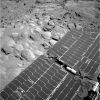
SOL229-2N146694188EFF8600P1805L0M1.jpgClose view of the Rover and Martian soil58 visite
(13 voti)
|
|

SOL229-2N146694237EFF8600P1805R0M1.jpgClose view of the Rover and Martian soil64 visite
(13 voti)
|
|
| 25332 immagini su 2111 pagina(e) |
 |
|
|
|
|
2067 | |
|
|
|
|





