| Piú votate |

Hyperion-N00040207.jpgHyperion (4)70 visiteSiamo a meno di 75.000 Km da Hyperion: il rilievo a forma ellissoidale a cui avevamo fatto cenno in precedenza (e che la NASA battezzerà certamente come "impact basin") si riesce a vedere molto bene, così come si vede molto bene che l'intera superficie di Hyperion, in tutte le direzioni, è (letteralmente) martoriata da crateri (crateri che, sulla base della nostra esperienza, presentano caratteristiche esteriori - diremmo una "conicità" pronunciata - tali da renderli decisamente anomali). Molto interessante, inoltre, potrebbe essere il rilievo - che abbiamo cerchiato in grigio - il quale è appena intuibile, fra luce ed ombra, sul Polo Nord apparente di Hyperion.
Forse una montagna? O forse, dopo una depressione posta proprio su quello che, in questi frames, appare come il Polo Nord di Hyperion, si innalza una nuova parete rocciosa di svariati Km? Noi non lo sappiamo, ma quello che vediamo ci spinge a credere che il record di altezza di un crepaccio (attualmente detenuto dalle "Verona Rupes") sia in pericolo.
(13 voti)
|
|
APOLLO 15 AS 15-M-R44-1851.jpgAPOLLO 15 AS 15-M-R44-1851 - Highly reflective "peaks"? (3)151 visitenessun commento
(13 voti)
|
|
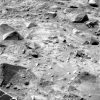
SOL422-2P163830012EFFA890P2377L2M1.jpgFlat, conical and squared stones on Sol 422 (3)77 visitenessun commento
(13 voti)
|
|

Enceladus-N00030040.jpgEnceladus, from approx. 46.000 Km56 visiteGli immensi crepacci e le striature (la cui origine è ancora ben lungi dall'essere anche solo immaginata) che caratterizzano tutta la superficie di Encelado sono molto ben definiti in questa veduta della "luna di neve", ripresa da una distanza di circa 46.000 Km.
(13 voti)
|
|

Dione-N00027217.jpgSinking in the Rings...60 visiteScusateci il "calambour", ma nessuna espressione ci è sembrata più azzeccata di questo "Sinking in the Rings" (che tanto ci ricorda la famosissima "Singing in the Rain"...) per commentare un'immagine simile e di enorme, intrinseca ed unica bellezza.
(13 voti)
|
|

The Moon from Clem-usgs_19.jpgRising Earth over the Moon's North Pole141 visiteCaption NASA originale:"Clementine colorized image showing the full Earth over the Moon's North Pole. The angular distance between the Earth and the Moon has been reduced for illustration pruposes.
This image was taken by the UV/visible camera at the end of mapping orbit 102 on 13 March 1994.
The 109 km diameter Crater Plaskett is in the foreground at 82° North and 174° East (Clementine, USGS slide 19)".
(13 voti)
|
|

16-Vitello Crater.jpgRolling Boulders and the "Gravity Wasting" process inside Vitello Crater123 visiteCaption NASA originale:"Lunar Orbiter 5 image of a boulder (just right of center) which has rolled and slid down a slope and left a trail on the Moon's surface. This is within the Crater Vitello and demonstrates the small role that such processes, called "gravity wasting", have on the Lunar Surface. The main source of surface modification on the Moon is meteorite and micrometeorite bombardment. North is up (Lunar Orbiter 5, frame 168-H2)".
Un piccolo promemoria: questa immagine è stata impropriamente usata per "sostanziare" la presenza di attività controllate (e dunque di origine NON naturale) sulla Luna (vedi "Qualcun altro è sulla Luna" di George H. Leonard ). Un nostro consiglio: tentate di studiare e di verificare SEMPRE prima di credere!
Location & Time Information
Date/Time (UT): 1967-08-17 T 04:04:40
Distance/Range (km): 172
Central Latitude/Longitude (deg): -30.54,322.40
(13 voti)
|
|

Miranda-PIA00042_modest.jpgMiranda in natural colors (elab. NASA)87 visiteCaption NASA originale:"This color composite of the Uranian satellite Miranda was taken by Voyager 2 on Jan. 24, 1986, from a distance of 147.000 Km (91.000 miles). This picture was constructed from images taken through the narrow-angle camera's green, violet and ultraviolet filters. It is the best color view of Miranda returned by Voyager. Miranda, just 480 Km (300 mi) across, is the smallest of Uranus' 5 major satellites. Miranda's regional geologic provinces show very well in this view of the Southern Hemisphere, imaged at a resolution of 2,7 km (1,7 mi). The dark and bright-banded region with its curvilinear traces covers about half of the image. HR pictures taken later show many fault valleys and ridges parallel to these bands. Near the terminator (at right), another system of ridges and valleys abuts the banded terrain; many impact craters pockmark the surface in this region. The largest of these are about 30 Km in diameter; many more lie in the range of 5 to 10 Km in diameter".
(13 voti)
|
|

APOLLO 16 AS 16 116-18718.jpgAS 16-116-18718 - Astronaut and Lunar Rover148 visiteSuggestiva inquadratura - sebbene ampiamente sovraesposta - di un Astronauta (Duke?!?) che si sta avvicinando al Lunar Rover. Si può notare, nonostante la sovraesposizione, ma con sufficiente chiarezza, il grande quantitativo di polvere che ricopre il Lunar Rover.
(13 voti)
|
|

Atlas and others-PIA06522_modest.jpgSaturn's Rings + Atlas, Prometheus and Janus78 visiteCaption NASA originale: "Saturn hosts its own miniature solar system with an entourage of more than 30 moons. This image shows Saturn's "A" and "F" Rings, along with 3 of the moons that orbit close to them. From innermost to outermost, tiny Atlas (32 Km across) orbits just outside of the bright "A-Ring" and is seen above center in this view. Prometheus (102 Km across) is visible near lower right. Prometheus and its smaller cohort, Pandora, shepherd the thin, knotted F-Ring. Janus (181 Km across) can be seen near lower left. Janus shares its orbit with the moon Epimetheus. Density waves due to Janus cause some of the bright bands seen in the A-Ring in this image. Prometheus and Atlas also produce waves in the rings, but their wave regions are too narrow to be seen here. The planet's shadow stretches all the way across the main rings in this view. The shadow has an oval shape now but over the next few years it will become more rectangular as the planet orbits the Sun and the angle Sunlight-Rings decreases".
(13 voti)
|
|

ZZ-ZZ-Sea of Tranquillity-2.jpgMare Tranquillitatis - detail mgnf221 visiteTranquillity Base Close-up photographed with a 7-inch refractor with 12-m effective focal length (3-meter prime focal length of the refractor is 3m increased by a 4x Barlow-lens), Philipps TuoCam webcam, single frame shot, enhanced with unsharp masking.
(13 voti)
|
|
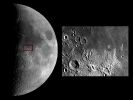
ZZ-Z-Sea of Tranquillity.jpgSea of Tranquillity - Mission Overview223 visiteApollo 11 (CSM Columbia and LM Eagle)
Saturn V
July 16-24, 1969
Neil A. Armstrong
Michael Collins
Edwin E. "Buzz" Aldrin, Jr.
08 days, 03 hours, 18 minutes
First manned lunar landing mission and lunar
surface EVA. "HOUSTON, TRANQUILLITY BASE HERE.
THE EAGLE HAS LANDED." - July 20, 1969
Landing site: Sea of Tranquillity.
Landing Coordinates: 0.67409 degrees North, 23.47298 degrees East
(Source: National Space Science Data Center)
1 EVA of 02 hours, 31 minutes. Flag and instruments deployed; unveiled plaque on the LM descent stage with inscription: "Here Men From Planet Earth First Set Foot Upon the Moon. July 1969 A.D. We Came In Peace For All Mankind." Lunar surface stay time 21.6 hours; 59.5 hours in lunar orbit, with 30 orbits. LM ascent stage left in lunar orbit. 20 kg (44 lbs) of material gathered.
(13 voti)
|
|
| 25332 immagini su 2111 pagina(e) |
 |
|
|
|
|
2065 | |
|
|
|
|





