| Piú votate |

Hero Rupes-PIA02413.jpgHero Rupes67 visiteCaption NASA originale:"After passing Mercury the first time and making a trip around the Sun, Mariner 10 again flew by Mercury on September 21 at 1:59 PMPDT. This encounter brought the spacecraft in front of Mercury in the southern hemisphere.
Hero Rupes, the large scarp visible running across the bottom of the image, is thought to thought to have been formed by global tectonic forces, possibly due to shrinkage of the planet as it cooled. Mariner 10 was looking obliquely across Mercury's southern hemisphere when it acquired this dramatic shot near the beginning of its southern hemisphere pass (FDS166618)".
(11 voti)
|
|
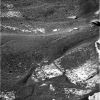
OPP-SOL758-1P195468752EDN65C3P2365L2M1.jpgMore "Martian Sandglasses" (2) - Sol 75889 visiteCaption Originale:"Left Panoramic Camera Non-linearized Downsampled EDR acquired on Sol 758 of Opportunity's mission to Meridiani Planum at approximately 10:10:30 Mars local solar time, camera commanded to use Filter 2 (753 nm)".
(11 voti)
|
|

Copernicus Gif.gifCopernicus...on line!132 visitenessun commento
(11 voti)
|
|

Amalthea and Io-PIA01626.jpgAmalthea and Io (approx. true colors)144 visiteComposite view of Amalthea and Io at the same scale. The visible part of Amalthea is about 150 Km across. The colors are just approximate. Amalthea is actually much darker than Io, but is displayed at a similar brightness for ease of viewing. The shape of Amalthea is controlled largely by impact cratering and fragmentation. In contrast, Io, like Earth, has gravity sufficient to form it into a slightly ellipsoidal sphere. Amalthea is covered by craters because there are no processes which erode or cover them efficiently. On extremely volcanically active Io, impact craters are covered quickly by lavas and other volcanic materials. Some of the volcanic materials escape from Io and probably contribute to the reddish colors of Amalthea and the other small inner satellites. The Amalthea and Io composites, obtained by the Solid State Imaging (SSI) camera on NASA's Galileo spacecraft on different orbits, were placed side by side for comparison purposes. The Amalthea composite combines data taken with the clear filter of the SSI system during orbit six, with lower resolution color images taken with the green, violet, and 1 micrometer filters during orbit 4. The Io data was obtained on July 2nd, 1998 (orbit 14) using the green, violet, and 1 micrometer filters.
(11 voti)
|
|

SOU-SOL008-81430_full.jpg"Monster-Pan" in 3-D (2) - Sol 870 visitenessun commento
(11 voti)
|
|

ZD-VikingLander1-p131b.jpgFrom the "Viking Archive" - Viking 1: Solar Eclypse on Mars127 visitePossibly the most unusual of all Viking Lander pictures records the passage of Phobos' shadow during a solar eclipse. On Earth the apparent size of the Moon is exactly the same as that of the much larger but more distant Sun. Consequently, direct sunlight is completely blocked out during a total solar eclipse. On Mars, Phobos covers only 1/4 of the solar disc. However, passage of the penumbral shadow causes a general drop in light level that is instrumentally detectable. This frame is a repeated line scan image looking back across Viking Lander 1. The colors have been distorted purposely to enhance detail. The blue and white horizontal stripes correspond to test chart patches. The brownish stripes in the middle represent the martian surface visible above the spacecraft. Note a decrease in light levels in the sky midway through the imaging event. The darkening, caused by the passage of the penumbral shadow of Phobos, is present over approx. 100 vertical lines. Moving at about 2 Km/sec, the shadow took about 20 sec to pass over the Lander.
(11 voti)
|
|

ZO-U-PIA07849_fig1.jpgThe path of Spirit up to Sol 450225 visiteAncora una Mappa - ottenuta grazie ad immagini MGS - che ci ricorda e spiega il viaggio di Spirit, dal momento del Landing (Columbia Memorial Station), al transito accanto al sempre più enigmatico Cratere Bonneville (a proposito: fate caso all'estrema definizione e relative dimensioni - colte da un'altezza di quasi 300 Km! - del 'presunto Heat-Shield' che giace sul bordo del Cratere ad ore 12 e poi provate a rileggerVi la dissertazione "Space Heat Shields" del Dr Feltri nella Sezione "Investigations"...), attraverso la distesa di rocce laviche chiamata Santa Anita e sino all'ascesa sulla Collina Husband, passando attraverso il West Spur (update Sol 450).
Il "riassunto" della marcia di Spirit, ottenuto con questo tipo di grafica, è davvero suggestivo ed agevolmente leggibile anche per chi, pur non essendo esperto di mappe e planimetrie, volesse solo farsi un'idea della geografia della zona che Spirit, da oltre un anno, sta visitando.
(11 voti)
|
|

Craters-Wanda_Crater-PIA00250.jpgMagellan Probe: radio image of "Wanda" Impact Crater in Akna Montes97 visiteCaption NASA originale:"This Magellan full-resolution image show the northern part of the Akna Montes. The Akna range is a North-South trending ridge belt that forms the western border of the elevated smooth plateau of Lakshmi Planum. The Lakshmi plateau plains are formed by extensive volcanic eruptions and are bounded by mountain chains on all sides. The plains appear to be deformed near the mountains. This suggests that some of the mountain building activity occurred after the plains formed. An impact crater (Official International Astronomical Union name 'Wanda,' mapped first by the Soviet Venera 15/16 mission in 1984 at LR) with a diameter of 22 Km was formed by the impact of an asteroid in the Akna mountains. The crater has a rugged central peak and a smooth radar-dark floor, probably volcanic material. The crater does not appear to be much deformed by later crustal movement that uplifted the mountains and crumpled the plains".
(11 voti)
|
|

Enceladus-N00030084.jpgEnceladus, from approx. 17.000 Km60 visiteAncora il grande cratere che avevamo visto nel frame precedente, più vicino di oltre 4000 Km. Stupenda, semplicemente, la visione del terminatore di Encelado ed i conseguenti grandi contrasti luce-ombra, determinati dalle differenti altezze dei rilievi fotografati.
(11 voti)
|
|

Enceladus-N00030070.jpgEnceladus, from approx. 22.500 Km : a controversial "crack"66 visiteNon ci vogliono "occhi da geologo" o grandi esperienze nella classificazione dei rilievi superficiali dei corpi celesti esterni per capire che il crack che attraversa tutta l'immagine presenta della caratteristiche assolutamente peculiari ed anomale. Esso sembra avere inizio dal margine di un piccolo cratere da impatto (che vedete in basso, a ridosso del bordo inferiore del frame) e poi si prolunga per centinaia di Km, seguendo quasi una linea retta ed aumentando le proprie dimensioni per poi, improvvisamente, dopo aver costeggiato un grande cratere da impatto, dividersi in due cracks più piccoli e tortuosi (parte alta dell'immagine).
Si tratta di un crack "giovane", senza dubbio, e molto diverso da quelli che caratterizzano la maggior parte di questa piccola luna.
(11 voti)
|
|
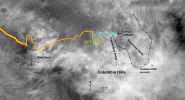
ZO-SPIRIT-SOL354_MERA_MOC-A357R1.jpgApproaching an "overlook"212 visiteThe path of NASA's Mars Exploration Rover Spirit through the rover's 354th martian day, or sol (Dec. 31, 2004), plus some future travel options, are indicated on this map of the "Husband Hill" region of the "Columbia Hills" within Mars' Gusev Crater. The rover team plans to send Spirit to a vantage point dubbed "Larry's Lookout" for views to help in deciding whether to dip into "Tennessee Valley."
The base image for the map was taken by the Mars Orbiter Camera aboard NASA's Mars Global Surveyor.
(11 voti)
|
|
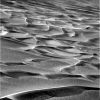
OPP-SOL244-1P149845199EFF3600P2427L2M1.jpgDunes... (1) - Sol 24462 visiteTre istantanee delle dune di Endurance Crater. Vi abbiamo già proposto tante immagini di queste stranissime "sabbie" che si trovano sul fondo del Cratere Endurance (come di tanti altri crateri Marziani), ma le loro fattezze non smettono mai di stupire e di stupirci. Noi sappiamo che l'eventuale ingresso del Rover Opportunity "dentro" le dune di Endurance potrebbe, quasi certamente, rivelarsi "letale" per il nostro "Pioniere Meccanico", ma la verità è che, standone sempre alla larga, non sapremo mai di che cosa esse esattamente siano fatte e se esse, come molti pensano (anche noi), siano davvero "umide".
E' anche per questo che una macchina, per quanto perfetta essa possa essere, non basterà mai per svelare i "Segreti di Marte".
(11 voti)
|
|
| 25332 immagini su 2111 pagina(e) |
 |
|
|
|
|
2054 | |
|
|
|
|





