| Piú votate |

M-070-1.jpgM 70 - Globular Star Cluster81 visite"...Dubita pur che gli astri sian di foco,
Dubita pur che il sol si sposti in giro,
Che Verità, di noi, si prenda gioco,
Ma non ch'io ver' te, amante, ognor sospiro..."
(W. Shakesperare - "Hamlet" Atto II, scena II)
(14 voti)
|
|

Sunspots - SST.jpgSunspots70 visiteCaption NASA originale:"This stunning image shows remarkable and mysterious details near the dark central region of a planet-sized sunspot in one of the sharpest views ever of the surface of the Sun. Just released, the picture was made using the Swedish Solar Telescope now in its first year of operation on the Canary Island of La Palma. Along with features described as hairs and canals are dark cores visible within the bright filaments that extend into the sunspot, representing previously unknown and unexplored solar phenomena".
(14 voti)
|
|

Jupiter_s Aurora-HST-PIA03155_modest.jpgJupiter's Aurora - HST79 visiteCaption NASA originale:"Auroras are curtains of light resulting from high-energy electrons racing along the planet's magnetic field into the upper atmosphere.
The electrons excite atmospheric gases, causing them to glow.
The image shows the main oval of the aurora, which is centered on the magnetic north pole, plus more diffuse emissions inside the polar cap. The HST image shows also unique emissions from the magnetic "footprints" of 3 of Jupiter's largest moons.
Auroral footprints can be seen in this image from Io (along the lefthand limb), Ganymede (near the center), and Europa (just below and to the right of Ganymede's auroral footprint).
These emissions, produced by electric currents generated by the satellites, flow along Jupiter's magnetic field, bouncing in and out of the upper atmosphere".
(14 voti)
|
|

Io-sulphur_s role-PIA02547_modest.jpgThe Role of Sulphur in Io's Volcanoes73 visiteCaption NASA originale:"Sulphur gas, consisting of pairs of sulphur atoms (S2) - as detected above Io's volcano Pele by the HST in October 1999 - is ejected from the hot vents of Io's volcanoes (green arrow). Such sulphur gas lands on the cold surface where the sulphur atoms rearrange into molecules of 3 or 4 atoms (S3 and S4) which give the surface a reddish color. In time, the atoms rearrange into their most stable configuration (S8) that forms ordinary pale-yellow sulphur".
(14 voti)
|
|
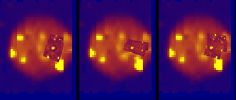
Io-active volcanoes-PIA02558_modest.jpgActive volcanoes on Io in 3 different months59 visiteCaption NASA originale:Changes in the volcanoes on Io can be seen in these 3 views, taken by NASA's Galileo spacecraft during its 3 flybys of Io in October and November 1999 and February 2000. All the images show the active volcanoes as bright yellow, corresponding to hot lava flows that appear glowing in infrared wavelengths. The 3 views were taken by the spacecraft's near-infrared mapping spectrometer and show the comparison of a typical low-resolution observation to the high-resolution views. The Prometheus volcano is seen near the middle of all three images. Before the recent flybys, only Prometheus and three other volcanoes were known to be active in this region. After these and other high-resolution observations, scientists were able to detect 14 volcanoes in the same area. The fainter volcanoes (hot spots) show some significant changes over intervals of 1 to 3 months. The area shown by all three observations put together is about 2 million square kilometers (about 770,000 square miles)".
(14 voti)
|
|
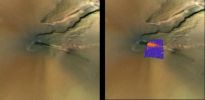
Io-Pele Volcano-PIA02560_modest.jpgThe "Pele" Volcano80 visitePele, one of Io's best-known volcanoes, was observed by the infrared spectrometer, an instrument onboard NASA's Galileo spacecraft, during the flyby of Jupiter's moon Io on February 22, 2000. The temperature map is shown here on the left in false color, superimposed on a visible color image of the Pele region obtained by the Voyager spacecraft in 1979. The red color represents the hottest lava flows. The purple colors are cooler materials. Preliminary results show that the temperatures of the hottest lava flows are at least 1,400 Kelvin (about 2,000 Fahrenheit), consistent with the temperatures of basaltic lava seen on the Kilauea volcano in Hawaii. It is possible that the eruption temperatures at Pele are even higher, as lava cools quickly once it starts to spread over the surface. The Voyager context image is 200 kilometers (124 miles) across.
(14 voti)
|
|

Io-Tohill Mons-PIA03600_modest.jpgTohill Mons62 visitenessun commento
(14 voti)
|
|

ZV_Apollo 15-Landing Site.jpgThe Apollo 15 Landing Site377 visiteSiamo riusciti, cercando e ricercando fra i tanti Siti (Governativi e non) che si occupano ancora del Programma Apollo, a reperire delle interessantissime ed estremamente dettagliate Mappe dei siti di allunaggio, comprensive di riferimenti fotografici. Ve le proponiamo così come sono, per il Vostro piacere. Per quanto riguarda Lunar Explorer, ci vorrà parecchio tempo prima di poter esprimere delle compiute valutazioni sull'utilità di questo materiale per le nostre specifiche ricerche.
(14 voti)
|
|

Sun-PIA03149_modest.jpgSolar Flares from Soho85 visiteCaption NASA originale:"Extreme Ultraviolet Imaging Telescope (EIT) image of a huge, handle-shaped prominence taken on Sept. 14,1999 taken in the 304 angstrom wavelength - Prominences are huge clouds of relatively cool dense plasma suspended in the Sun's hot, thin corona. At times, they can erupt, escaping the Sun's atmosphere. Emission in this spectral line shows the upper chromosphere at a temperature of about 60,000 degrees K. Every feature in the image traces magnetic field structure. The hottest areas appear almost white, while the darker red areas indicate cooler temperatures".
(14 voti)
|
|

Triton-PIA02214_modest.jpgTriton from Voyager 2 (false colors)69 visiteCaption NASA originale:"This false color image of Triton is a composite of images taken through the violet, green and ultraviolet filters. The image was taken early on Aug. 25, 1989 when Voyager 2 was about 190.000 Km (118.000 miles) from Triton's surface. The smallest visible features are about 4 Km(2,5 miles) across. The image shows a geologic boundary between completely dark materials and patchy light/dark materials. A layer of pinkish material stretches across the center of the image. The pinkish layer must be thin because underlying albedo patterns show through. Several features appear to be affected by the thin atmosphere; the elongated dark streaks may represent particulate materials blown in the same direction by prevailing winds and the white material may be frost deposits".
(14 voti)
|
|

ZA-The Men Of Apollo 14-Apollo14-s70-45581.jpgThe Men of Apollo 14146 visiteDall'alto: Mitchell, Roosa e Shepard
(14 voti)
|
|

M-008-2.jpgM 8 - The "Lagoon Nebula" (deep inside)79 visite"...Se davvero non riesci a stupirti per le infinite Meraviglie che ogni giorno ti vengono messe davanti agli occhi, allora ti conviene fermarti e accettare la tua nuova realtà: sei morto".
Paolo C. Fienga
(14 voti)
|
|
| 25332 immagini su 2111 pagina(e) |
 |
|
|
|
|
2051 | |
|
|
|
|





