| Piú votate |

OPP-SOL297-2-merb_ncam_site38_pos97_cyl-B305R1_br2.jpgLooking for a "way out"... (2)86 visiteCome si diceva in sede di commento originale alla frazione di frame precedente, dunque, l'uscita da Endurance non deve essere azzardata. Nessuna "scorciatoia", quindi: si esce per la stessa strada dalla quale si era entrati e poi...E poi si vedrà che cosa fare e, soprattutto, si deciderà DOVE andare.
Noi suggeriamo, ancora una volta, di andare a dare un'occhiata da vicino allo "scudo termico"...
(14 voti)
|
|

Jupiter - HST.jpgTriple eclypse on Jupiter (false colors - HST)68 visiteDa "NASA - Picture of the Day" dell'11.11.2004: "This false-color image of banded gas giant Jupiter shows a triple eclipse in progress on March 28 - a relatively rare event, even for a large planet with many moons. Captured by the Hubble Space Telescope's near-infrared camera are shadows of Jupiter's moons Ganymede (left edge), Callisto (right edge) and Io, three black spots crossing the sunlit Jovian cloud tops. In fact, Io itself is visible as a white spot near picture center with a bluish Ganymede above and to the right, but Callisto is off the right hand edge of the scene. Viewed from Jupiter's perspective, these shadow crossings would be seen as solar eclipses, analogous to the Moon's shadow crossing the sunlit face of planet Earth. Historically, timing the eclipses of Jupiter's moons allowed astronomer Ole Roemer to make the first accurate measurement of the speed of light in 1676".
(14 voti)
|
|
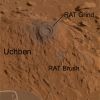
SOL298-Uchben_Rock-06-RA-06-Uchben_Rat-A298R1_br2.jpg"Uchben Rock" - Sol 298 (Almost True Colors; credits: NASA/JPL-Caltech)75 visiteAnche per questa immagine valgono le medesime considerazioni svolte a proposito di "Tetl Rock". Qui, però, possiamo vedere un dettaglio di uno dei pannelli solari del Rover Spirit, in basso a Sn. Si tratta di un dettaglio davvero interessante poichè ci permette di vedere piuttosto bene che il pannello è quasi completamente ricoperto di polvere: il suo colore, infatti, anzichè essere nero (o comunque scuro) e lucido, sembra vagamente aranciato ed opaco. Da qui traiamo due spunti di riflessione:
1) quando lo strato di polvere si inspessirà oltre una determinata soglia, i pannelli solari non saranno più in grado di raccogliere luce sufficiente per ricaricare le batterie del Rover: sarà questa la causa principale (e NON il freddo intenso o le presunte condizioni estreme di Marte) a determinare la "morte" di Spirit.
2) nelle immagini in b/n, fateci caso, i pannelli solari appaiono sempre lucidi ed il panorama sembra comunque più nitido ed "affilato" (o meno "velato", se preferite). Come mai?
(14 voti)
|
|

GASPRA-PIA00119.jpgAsteroid Gaspra75 visiteThis picture of asteroid 951 Gaspra is a mosaic of 2 images taken by the Galileo spacecraft from a range of 5.300 Km, some 10 minutes before closest approach on October 29, 1991. The Sun is shining from the right; phase angle is 50 degrees. The resolution, about 54 meters/pixel, is the highest for the Gaspra encounter and is about three times better than that in the view released in November 1991. Additional images of Gaspra remain stored on Galileo's tape recorder, awaiting playback in November. Gaspra is an irregular body with dimensions about 19 x 12 x 11 Km. The portion illuminated in this view is about 18 Km from lower left to upper right. The north pole is located at upper left; Gaspra rotates counterclockwise every 7 hours. The large concavity on the lower right limb is about 6 Km across, the prominent crater on the terminator, center left, about 1.5 Km. A striking feature of Gaspra's surface is the abundance of small craters. More than 600 craters, 100-500 meters (330-1650 feet) in diameter are visible here. The number of such small craters compared to larger ones is much greater for Gaspra than for previously studied bodies of comparable size such as the satellites of Mars.
(14 voti)
|
|

APOLLO 15 AS 15 88-12011.jpgAS 15-88-12011 - What is that???291 visiteUn debole riflesso, ora di colore indefinibile, è quanto rimane delle due luci colorate a forma di "U" che erano apparse qualche frame indietro. Noi non vogliamo creare il mistero a tutti i costi e la ricerca di "Anomalie" (anche se questo è parte del lavoro di Lunar Explorer Italia) deve essere costante, ma mai ossessiva - se lo fosse, perderemmo l'obiettività che deve invece seguirci sempre: e secondo noi, quando si è persa l'"obiettività", si finisce inevitabilmente con il perdere anche la "credibilità" che magari, con fatica , ci siamo con il tempo guadagnati...
Eppure, ogni qual volta analizziamo la Collezione Apollo, dobbiamo ammettere che le sorprese, come gli esami, "non finiscono davvero mai"...
(14 voti)
|
|
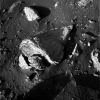
OPP-SOL235-1N149058214EFF35CRP1898L0M1.jpgClose encounter with Martian "stones" - Sol 235141 visiteRistabiliti i "contatti" con Marte, ecco che cominciano ad arrivare nuove immagini dopo 11 Soles di buio e silenzio. Questo frame si riferisce al Sol 235 di Opportunity e riguarda una gruppo di rocce che giacciono (quasi) sul fondo del Cratere Endurance. Se le osservate attentamente non potrete non notare la fortissima usura (probabilmente determinata dallo scorrere dell'acqua) che la roccia più grande sembra aver sofferto.
(14 voti)
|
|
SOL255-2N149005426EDN8800P1574L0M1.jpgThe first "complete" picture from Mars, after the "Black-out" - Sol 25555 visiteSol 255: dopo alcuni tentativi di invìo immagini riusciti solo parzialmente, ecco il primo "frame completo" che ci giunge da Marte ora che il transito del Pianeta dietro al Sole (e del conseguente radio black-out) è terminato.
Tutto sembra in ordine. Vedremo poi le novità (se ce ne sono o ce ne saranno) nei prossimi giorni...
(14 voti)
|
|

APOLLO 11 AS 11-36-5307.jpgAS 11-36-5307 - Leaving Planet "Earth" (7)309 visiteVedi il commento al frame precedente.
(14 voti)
|
|

M-087.jpgM 87 - Elliptical Galaxy69 visiteElliptical galaxy M 87 is a type of galaxy that looks much different than our own Milky Way Galaxy. Even for an elliptical galaxy, though, M 87 is peculiar. M 87 is MUCH bigger than an average galaxy, appears near the center of a whole cluster of galaxies (known as the Virgo Cluster) and shows an unusually high number of globular clusters. These globular clusters are visible as faint spots surrounding the bright center of M 87. In general, elliptical galaxies contain similar numbers of stars as spiral galaxies, but are ellipsoidal in shape (spirals are mostly flat), have no spiral structure and little gas and dust.
(14 voti)
|
|

SOL182 (4).jpgSol 182 - "Engineering Flats" Panorama - (4)55 visitenessun commento
(14 voti)
|
|

M 55.jpgM 55 - Globular Star Cluster66 visiteM 55 is a large Globular Star Cluster of around 100.000 stars. Only 20.000 LY away in the constellation Sagittarius, M 55 appears to earth-bound observers to be nearly 2/3 the size of the full Moon. Globular star clusters like M 55 roam the halo of our Milky Way Galaxy as gravitationally bound populations of stars known to be much older than stellar groups found in the galactic disk. Astronomers who make detailed studies of globular cluster stars can accurately measure the cluster ages and distances. Their results ultimately constrain the age of the Universe and provide a fundamental rung on the astronomical distance ladder.
(14 voti)
|
|

IC-1805-4.jpgIC 1805 - The "Heart" Nebula122 visite"...Nelle chiese abbandonate
Si preparano rifugi,
E nuove astronavi,
Per viaggi interstellari...
In una vecchia miniera,
Distese di sale
E un ricordo di Te:
Come un incantesimo..."
F. Battiato - "I Treni di Tozeur"
(14 voti)
|
|
| 25332 immagini su 2111 pagina(e) |
 |
|
|
|
|
2050 | |
|
|
|
|





