| Piú votate |

FadingMoon-01.gifFading Sun-Lights... (1)131 visiteLa Sonda Clementine orbita intorno alla Luna e, nel farlo, riesce ad immortalare albe e tramonti. Questo, dall'angolo visuale di Clem, è un tramonto.
La luce del Sole (la sua "corona"), lentamente, sbiadisce ed il profilo della Luna si confonde nell'oscurità.
Lo star-like object che vedete in tutti e quattro i frames in alto a Dx, è Venere.
(12 voti)
|
|

Amalthea-PIA01074.jpgFour views of Amalthea77 visiteThese 4 images of Amalthea were taken by Galileo's Solid State Imaging System at various times between February and June 1997. North is approx. up in all cases. Amalthea, whose longest dimension is about 247 Km (154 miles) across, is tidally locked (like Thebe) so that the same side of the moon always points towards Jupiter. In such a tidally locked state, one side of Amalthea always points in the direction in which Amalthea moves as it orbits about Jupiter. This is called the "leading side" of the moon and is shown in the top 2 images. The opposite side of Amalthea, such as the "trailing side," is shown in the bottom pair of images. The Sun illuminates the surface from the left in the top left image and from the right in the bottom left image. Such lighting geometries, similar to taking a picture from a high altitude at sunrise or sunset, are excellent for viewing the topography of the satellite's surface such as impact craters and hills. In the two images on the right, however, the Sun is almost directly behind the spacecraft. This latter geometry, similar to taking a picture from a high altitude at noon, washes out topographic features and emphasizes Amalthea's albedo (light/dark) patterns. It emphasizes the presence of surface materials that are intrinsically brighter or darker than their surroundings. The bright albedo spot that dominates the top right image is located inside a large south polar crater named Gaea.
(12 voti)
|
|

Hyperion-N00040251.jpgHyperion (5)59 visiteIl Fly-By di Hyperion, compiutosi durante l'ultimo week-end di Settembre 2005 è, forse, il più spettacolare - in termini di immagini ottenute dalla Sonda Cassini - fra tutti quelli sino ad ora effettuati. In questa (lunga) sequenza di frames - abbiamo estratto quelli, a nostro parere, più belli e significativi fra i tanti inviati a Terra - passeremo accanto ad Hyperion e guarderemo "dentro" ai suoi stranissimi crateri "conici" i quali, allorchè saremo davvero vicini alla superficie di questo piccolo mondo, ci faranno intuire la presenza di "qualcosa" sul loro fondo. Qualcosa di scuro che, in qualche immagine, potrebbe ricordare un fluido. Che i crateri di Hyperion sìano pieni di idrocarburi? Tutto può essere, ma una sola cosa è certa: queste immagini sono fra le più belle mai arrivate sino alla Terra...
Adesso siamo a poco più di 51.000 Km da Hyperion.
(12 voti)
|
|

Japetus-A-W-Deathstar-28.jpgThe "Pentagon", again73 visite...alla fine - ed a nostro modesto parere - scarsamente credibile o, comunque, da "prendersi con estrema cautela" e da " raffinare a lungo", prima di essere "assunto e metabolizzato". La Scienza Convenzionale - e questo lo andiamo dicendo sian dall'inizio delle nostre 'prolusioni/conversazioni' - NON è in grado di spiegare tutto. Pensare fermamente il contrario, non è da Scienziati nè da persone razionali: è da stupidi. Ma è anche da stupidi (diciamo che è "indice di leggerezza"...) credere altresì che la Scienza Convenzionale NON sia in grado di spiegare alcunchè. Giapeto, la Luna e Marte, inter alia, tentano di essere capiti e spiegati - dal CICAP, per esempio - solo alla luce del loro (presunto) pensiero razionale. Errore! Costoro non arriveranno mai, a nostro parere, da nessuna parte. Il Prof. Hoagland, invece, sta accantonando (sempre più nettamente e decisamente) la Scienza Convenzionale per cercare SOLO spiegazioni esotiche e sensazionalistiche alle (tante) Singolarità che il Cosmo ci offre.
(12 voti)
|
|

0-APOLLO 15-launch_wide.jpgThe Launch of Apollo 15234 visiteThe "ORIGINAL" Apollo Time-Table (from Apollo 13)
APOLLO 13. March, 1970. Land in Fra Mauro formation of flat highlands, stay about 22 hours. Collect soil and rock from an old area relatively untouched by what many believed were ancient floods or volcanoes.
APOLLO 14. July, 1970. Land in Censorinus Crater area for a stay of about 22 hours. Investigate craters, possibly carved in Moon's surface by meteors.
APOLLO 15. November, 1970. Land in Littrow area of volcano-like projections, remain about 22 hours. Attempt a pinpoint landing on an exact, pre-selected target.
APOLLO 16. March, 1971. Descend to Crater Copernicus, remaining for about 70 hours. Extract from crater and high-rising column within formation rocks believed to be from far below the lunar surface.
APOLLO 17. Late in 1971. Land near rugged highland crater Tycho for stay of about 70 hours. Test first moon "rover" vehicle.
APOLLO 18. Early 1972. Land in Marius Hills, remain about 70 hours. Collect soil and rock samples from volcanic-like domes and valleys between.
APOLLO 19. Middle or late 1972. Land deep in Schroeter's Valley, with about 70 hours on the surface. Attempt a descent into a deep crater to determine cause of mysterious "red flashes" seen there by astronomers.
APOLLO 20. Late 1972 or early 1973. Land near the Hyginus Rill, a long, major canyon, for stay of about 70 hours. Investigate canyon for possible lunar core material.
This timeline had been altered slightly even before the Apollo 13 mission, when in January, 1970, Apollo 20 was cancelled in order to reserve the last production Saturn V for use in launching the planned Skylab orbiting laboratory a few years later. This change shifted the planned Apollo 18 and 19 lunar missions to 1974 to follow Skylab, but further budget-cutting in late 1970 also resulted in the cancellation of Apollo 18 and 19.
(12 voti)
|
|

Titan-N00023130.jpgTitan58 visiteDue immagini di Titano, riprese da una distanza di circa 1,5 milioni di Km. Alcune caratteristiche superficiali di Titano incominciano a distinguersi con una certa chiarezza ed il giorno del "contatto" si avvicina. Certo è che, ancora oggi, fra le tante lune di Saturno, Titano, perennemente avvolto in una spessa coltre di nuvole di colore giallastro, sembra essere davvero la più enigmatica. Se la Sonda Huygens sarà fortunata, forse riusciremo a vedere ed a scoprire qualcosa. Titano ci sta aspettando...
(12 voti)
|
|

APOLLO 13 AS 13-60-8591.jpgAS 13-60-8591 - Good-bye Earth...178 visitenessun commento
(12 voti)
|
|
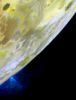
Io-Masubi plume-GAL-PIA02502_modest.jpgThe "Masubi" plume80 visiteA plume of gas and particles is ejected some 100 kilometers (about 60 miles) above the surface of Jupiter's volcanic moon Io in this color image, recently taken by NASA¹s Galileo spacecraft.
The plume is erupting from near the location of a plume first observed by the Voyager spacecraft in 1979 and named Masubi. However, during the course of the Galileo tour of Jupiter and its moons, a plume has appeared at different locations within the Masubi region.
This color image is the same as the previously released false color mosaic of Io, but with special processing to enhance the visibility of the plume. The plume appears blue because of the way small particles in the plume scatter light.
North is to the top of the picture, and the Sun illuminates the surface from almost directly behind the spacecraft. The resolution is 1.3 kilometers (0.8 miles) per picture element. The images were taken on July 3, 1999 at a distance of about 130,000 kilometers (81,000 miles) by the Galileo¹s camera.
(12 voti)
|
|
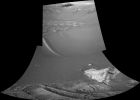
OPP-SOL206-mer_b_sol206_ncam_puffin_cyl-B209R1_br2.jpgNear the dunes of Endurance Crater85 visiteOpportunity non si addentrerà verso le stranissime dune che giacciono sul fondo di Endurance Crater: c'è il rischio, infatti, che le sabbie siano troppo molli e non consentano trazione alle ruote del Rover il quale finirebbe con l'impantanarsi. A nostro avviso, questa considerazione sulla possibile "eccessiva morbidezza" delle sabbie deve farci dubitare, ancora una volta, sui dati relativi all'accuratezza delle temperature di Marte al suolo. Ma non dovrebbe essere tutto ghiacciato e compatto?
(12 voti)
|
|

M-078-1.jpgM 78 - The "Dark Nebula" in Orionis87 visite"...Le stelle sono immobili, in questo Spazio Estremo; non c'è moto, nè differenza di luce, o di spazio, o di tempo: tutto è fermo. Guardo gli strumenti della mia Nave ed essi mi confortano, dicendo che tutto va bene e che ci stiamo muovendo, lungo la prevista rotta. Ma i miei occhi mi dicono che siamo fermi, ormai da molto tempo. L'anemometro dice che il vento sta soffiando, ma la bandiera è immobile. Dunque a cosa, o a chi, dovrei credere, a questo punto?!?..."
P.C. Floegers - "Memorie di viaggio"
(12 voti)
|
|

OPP-SOL163-1N142658124EFF3221P1971L0M1.jpgThe inner side of Endurance Crater198 visitenessun commento
(12 voti)
|
|

M-017-4.jpgM 17 - The "Omega Nebula" Region95 visite"...Repetendum videtur ut non modo casus eventusque rerum, sed ratio etiam causaeque noscantur..."
(Tacito)
"...E' necessario conoscere non solo gli eventi (per quello che sono), ma anche le loro ragioni e cause..."
(12 voti)
|
|
| 25332 immagini su 2111 pagina(e) |
 |
|
|
|
|
2037 | |
|
|
|
|





