| Piú votate |

OPP-SOL249-12-SS3-01-Endurance_Escape_br2.jpgOpportunity's escape-way - Sol 249 (Almost True Colors; credits: NASA/JPL-Caltech)115 visiteUna simpatica immagine che rappresenta la "via di fuga" (ma forse è meglio dire il "corridoio di uscita") dal Cratere Endurance che è stata individuata per il Rover Opportunity da parte dei Tecnici del Controllo Missione. Questa immagine (sempre in colori "quasi veri") ci interessa anche perchè sembra risolvere il "mistero" della roccia argentea (o cristallina) che tanto ci aveva interessato: la potete vedere sulla Sn dell'immagine in alto, indicata da una freccia la quale ci dice che si tratta dello "Scudo Termico" della Navicella. Il dato interessante è che al Centro Controllo Missione sembrano intenzionati a mandare il Rover, una volta fuori da Endurance, a "guardare meglio" e "più da vicino" questo "rottame": ne converrete che si tratta di una strana idea per i pragmatici uomini della NASA.
Noi, comunque, la "approviamo" categoricamente e, a titolo di commento, Vi diciamo che, secondo noi, alla NASA non sono ancora per niente sicuri che si tratti davvero dell'Heatshield... 
(15 voti)
|
|

OPP-SOL242-1P149669677EFF35CYP2592R1M1.jpgA "Big Rock" inside Endurance Crater80 visiteUna roccia bianca di cospicue dimensioni giace al suolo, in parte sepolta, sul fondo di Endurance Crater. Queste rocce, a quanto ci è dato vedere e capire, rivestono un grande interesse per gli Scienziati che stanno seguendo l'evolversi della Missione. Noi, dopo averne vista qualcuna "da vicino", pensiamo che esse ricordino molto (almeno esteriormente) le rocce che troviamo, con discreta abbondanza, sul fondo del mare, a basse profondità e/o in prossimità di scogliere coralline. Alcune di queste rocce, infatti, ricordano molto le "madrepore"... Si tratta di congetture, come ovvio, ma se l'intera area di Meridiani Planum era davvero, un tempo, un "Oceano" (sebbene non molto profondo), allora - forse - potremmo anche non essere lontanissimi dalla realtà.
(15 voti)
|
|

ZD-Pluto.jpgPluto and the stars around...96 visiteUn'immagine, a nostro parere, altamente suggestiva di Plutone e del campo stellato che lo circonda. Anche questo frame è stata estratto dalla "2MASS Atlas Image Gallery at IPAC".
Plutone è l'oggetto posizionato ESATTAMENTE AL CENTRO della fotografia.
(15 voti)
|
|

ZA-Sunspot.jpgSunspot and Solar "granules" (detail mgnf)87 visiteCaption NASA originale:"Sometimes, small regions of the Sun appear unusually dark. Visible above is a close-up picture of a sunspot, a depression on the Sun's face that is slightly cooler and less luminous than the rest of the Sun. Sunspots can be larger than the Earth and usually last for only a few days. As you can see, the Sun's face is a bubbling sea of separate cells of hot gas. These cells are known as "granules" and a solar "granule" is about 1000 Km across and "lives" for + or - 10 minutes, then explodes".
(15 voti)
|
|

Io-Pele plume-PIA02546_modest.jpgThe "sulphuric plume" of Pele66 visiteThis image depicts the discovery of sulfur gas in the plume of the Pele volcano on Jupiter's moon Io, as seen by the Hubble Space Telescope in October 1999, during a flyby of Io by NASA's Galileo spacecraft. The main image shows Io passing in front of Jupiter as seen by Hubble's Wide-Field Planetary Camera (WFPC2) in near-ultraviolet light. The small inset shows that when a WFPC2 image at shorter ultraviolet wavelengths is included in a color composite with the near-ultraviolet image, Io's Pele plume appears as a dark smudge off the edge of Io's disk, silhouetted against Jupiter. The larger inset shows data from Hubble's Space Telescope Imaging Spectrograph, which mapped the composition of Pele's plume by analyzing the ultraviolet light from Jupiter which had passed through the plume. The regions shown in yellow were rich in sulfur gas, which was precisely centered over the Pele volcano, whose position is shown along with the edge of Io's disk.
(15 voti)
|
|
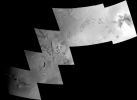
Io-Zamama Plume-PIA03531_modest.jpgThe "Zamama" flow field60 visiteThe source area of what had been a towering volcanic plume two months earlier lies in the far-right frame of this mosaic of images taken of Jupiter's moon Io by NASA's Galileo spacecraft on Oct. 16, 2001.
The region in the images includes the Zamama lava flow in Jupiter's northern hemisphere. The Zamama flow field emanates from the northernmost of two small volcanoes in the far left frame. These lava flows were not present in Voyager images of Io, so they formed some time between the Voyager 1 flyby in 1979 and the first Galileo observations of Io in 1996. Galileo also observed Zamama during Io encounters in 1999, and scientists identified narrow, long, dark lava flows thought to be similar to lava flows in Hawaii.
Moving northeast, the second and third frames of this mosaic contain lava flow fields and several unnamed volcanic depressions, called "paterae." It is unclear whether the broad, shield-like features or plateaus on which the paterae rest were created by eruptions from the paterae, or if they were preexisting features. Some fractures and dark lines suggest that the crust here is breaking up, creating cracks that magma can use to rise to the surface.
The far-right frame of this mosaic shows dark lava flows and bright spots. The bright spots are probably sulfur-bearing plume deposits, which are thought to be associated with the source of a plume eruption 500 kilometers (310 miles) high that was observed by the Galileo spacecraft in August, 2001. It was the largest plume eruption ever observed on Io.
(15 voti)
|
|

NGC-4038_and_NGC-4039_(2).jpgNGC 4039 and NGS 4038 - The "Antennae" Colliding Galaxies75 visiteThe image was taken by Spitzer's infrared array camera and is a combination of infrared light ranging from 3.6 microns (shown in blue) to 8.0 microns (shown in red). The dust emission (red) is by far the strongest feature in this image. Starlight was systematically subtracted from the longer wavelength data (red) to enhance dust features. The two nuclei, or centers, of the merging galaxies show up as white areas, one above the other. The brightest clouds of forming stars lie in the overlap region.
(15 voti)
|
|
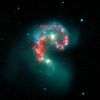
NGC-4038_and_NGC_4039-1.jpgNGC 4039 and NGS 4038 - The "Antennae" Colliding Galaxies70 visiteThis false-color image composite from NASA's Spitzer Space Telescope reveals hidden populations of newborn stars at the heart of the colliding "Antennae" galaxies. These 2 galaxies are located around 68 million light-years away and have been merging together for about the last 800 M years. The latest SST observations provide a snapshot of the tremendous burst of star formation triggered in the process of this collision, particularly at the site where the 2 galaxies overlap.
(15 voti)
|
|

NGC-0246-SST-PIA06755_modest.jpgNGC 246 - The "Skull (Planetary) Nebula"87 visite"...Quandoquidem et illi peccant, quos minime putes, et qui non peccant, impugnantur fraudibus..."
(Fedro)
"...Sovente i veri colpevoli sono coloro che meno pensi (lo potrebbero essere) e, altrettanto spesso, gli innocenti sono vittime delle ingiustizie..."
(15 voti)
|
|

Neptune-PIA01539_modest.jpgFarewell Neptune: a "bright smile" for the Earthlings...64 visiteCaption NASA originale:"Voyager 2's post-encounter view of Neptune's South Pole as the spacecraft sped away on a southward trajectory".
E con la Sonda Voyager 2 che sfiorava Nettuno e poi si dirigeva verso i più estremi confini del Sistema Solare - perdendosi per sempre nello spazio interstellare - quest'ultimo frame ci mostra (passateci il termine) il "sorriso" di Nettuno per noi Terrestri.
Un "luminoso sorriso" che a noi piace pensare sia il suo modo di dire "Arrivederci"...
(15 voti)
|
|

Neptune-PIA02245.jpgNeptune from 16.000.000 Km56 visiteCaption NASA originale:"This color image, produced from a distance of about 16 MKM, shows several complex and puzzling atmospheric features. The Great Dark Spot (GDS) seen at the center is about 13.000 Km by 6.600 km in size - as large along its longer dimension as the Earth. The bright, wispy "cirrus-type" clouds seen hovering in the vicinity of the GDS are higher in altitude than the dark material of unknown origin which defines its boundaries".
(15 voti)
|
|

Ganymede-PIA01618.jpgGanymede's surface (detail mgnf)64 visiteView of the Marius Regio and Nippur Sulcus area of Jupiter's moon, Ganymede showing the dark and bright grooved terrain which is typical of this satellite. This regional scale view was imaged near the terminator (the line between day and night) and provides geologic context for small areas that were imaged at much higher resolution earlier in the tour of NASA's Galileo spacecraft through the Jovian system. The older, more heavily cratered dark terrain of Marius Regio is rutted with furrows, shallow troughs perhaps formed as a result of ancient giant impacts. Bright grooved terrain is younger and is formed through tectonism probably combined with icy volcanism. The lane of grooved terrain in the lower left, Byblus Sulcus, was imaged during the spacecraft's second orbit, as were Philus Sulcus and Nippur Sulcus, seen here in the upper left. Placing the small higher resolution targets of Galileo's second orbit into the context of more distant, lower resolution views of the areas surrounding and connecting them, and imaging them along Ganymede's terminator, allows for an integrated understanding of Ganymede' s geology.
North is to the top left of the picture and the sun illuminates the surface from the lower right. The image, centered at 43 degrees latitude and 194 degrees longitude, covers an area approximately 664 by 518 kilometers. The resolution is 940 meters per picture element. The image was taken on May 7, 1997 at 12 hours, 50 minutes, 11 seconds Universal Time at a range of 92,402 kilometers by the Solid State Imaging (SSI) system on NASA's Galileo spacecraft.
(15 voti)
|
|
| 25332 immagini su 2111 pagina(e) |
 |
|
|
|
|
2034 | |
|
|
|
|





