| Piú votate |
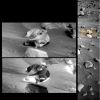
SOL364-2.jpgExtremely Unusual Landform (credits: Dr Marco Faccin)55 visitenessun commentoMareKromium
(7 voti)
|
|
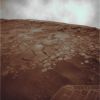
OPP-SOL1298-1N243420226EFF86L0P1909L0M1-1.jpgOn the edge of Victoria - Sol 1298 (interpret. n. 1 - possible natural colors; dominant: grey - brown/yellow; elab. Lunexit)62 visitenessun commentoMareKromium
(7 voti)
|
|

Hyperion-PIA08240.jpgPink Hyperion...75 visiteCaption NASA originale:"Unlike most of the dull grey moons in the Solar System, Hyperion's color is a rosy tan (---> Light Pink), as this view shows.
The origin of the moon's unusual hue is not known. Some scientists suspect the color comes from falling debris from moons further out.
A similar origin has been suggested for the dark reddish material on Saturn's moon Iapetus.
Images taken using red, green and blue spectral filters were combined to create this natural color view. The images were taken in visible light with the Cassini spacecraft narrow-angle camera on June 28, 2006 at a distance of approx. 291.000 Km (about 181.000 miles) from Hyperion. Image scale is roughly 2 Km (a little more than 1 mile) per pixel".
(7 voti)
|
|

South_Polar_Vortex-01.jpgVenusian South Polar Vortex (2)63 visiteOriginal ESA caption:"Infrared images taken by the Ultraviolet-Visible-Near-Infrared spectrometer (VIRTIS) on board the spacecraft, not only provided the first clear view of the vortex, but also gave a much closer insight into it when Venus Express flew over the South Pole at the end of May 2006.
VIRTIS is an instrument that can operate at different wavelengths. Each infrared wavelength provides a view of the Venusian atmosphere at a different altitude, like a 'cross-section'.
"When we looked at this gigantic vortex at different depths, we realised how much its shape is varying over altitude", said Pierre Drossart, VIRTIS co-Principal Investigator, from the Observatoire de Paris, France.
"It is like if we were looking at different structures, rather than a single one.
And the new data we have just started gathering and analysing reveal even stronger differences".
(7 voti)
|
|

ZZ-ZZ-ZZ-ZZ-ZZ-ZZ-ZZ-ZZ-ZZ-ZZ-ZZ-ZZ-APOLLO 17 AS 17-136-20732 HR.jpgAS 17-136-20732 - What is that thing?140 visiteUn'immagine incredibile e difficilissima da commentare: l'oggetto color argento e dalla forma che ricorda un boomerang, sarà un UFO oppure un photoartifact?
O magari uno "scherzo" degli Astronauti?
Noi una risposta non l'abbiamo. E Voi?...
(7 voti)
|
|

OPP-SOL713-1F191489490EFF64KSP1214R0M1-2.jpgThe "True Colors" of Erebus... (2) - Sol 71357 visite...e nella versione (2), quello che un occhio umano dovrebbe vedere nel caso di cielo sereno, ma opacità atmosferica più alta (e quindi diciamo con un congruo quantitativo di micropolveri in sospensione).
Sono interpretazioni credibili? Secondo noi si, ma non solo (e non tanto) perchè abbiamo lavorato duramente; secondo noi sono interpretazioni credibili perchè utilizzano parametri semplici, verificabili ed individuati in maniera razionale, utilizzando una base statistica.
Insomma, abbiamo provato a fare quello che i Tecnici NASA - se avessero avuto un minimo di buon senso in più - avrebbero già fatto da tempo, e cioè: "omogeneizzare" le diverse (e spesso totalmente incongruenti) immagini a colori di Marte, utilizzando meno filtri e softwares improbabili e più raziocinio.
I risultati, giudicateli Voi.
(7 voti)
|
|

Saturn-N00047654.jpgWhite ice-clouds on Saturn's upper atmosphere (2)59 visiteOriginal caption:"N00047654.jpg was taken on January 02, 2006 and received on Earth January 03, 2006. The camera was pointing toward Saturn that, at the time, was approximately 2.732.434 Km away, and the image was taken using the CL1 and CL2 filters. This image has not been validated or calibrated".
Note: anche questa seconda immagine (molto suggestiva) ci mostra che, negli strati superiori dell'atmosfera di Saturno, sembra esserci spazio per il passaggio di nuvole bianche - presumibilmente formate da ghiaccio d'acqua - le quali, nelle loro caratteristiche esteriori, ci ricordano i cirri ed i cirro-strati che, di tanto in tanto, vediamo anche nei nostri cieli.
Se, al di sotto di queste nuvole, piova o nevichi, non ci è dato saperlo ma, a quanto sembra, questa possibilità - già verificata per le nuvole di Giove - è tutt'altro che remota.
(7 voti)
|
|

SOL692-2P187795818ESFAJ2EP2578R1M1.jpgThe Martian "Cobra-Stone" - Sol 69285 visiteMai il titolo di un frame fu più autoesplicativo di questo...
Original caption:"Right Pan-Cam Non-linearized Sub-frame EDR acquired on Sol 692 of Spirit's mission to Gusev Crater at approximately 11:28:08 MLT.
Camera commanded to use Filter 1 (436 nm)".
(7 voti)
|
|

SOL690-2R187625923EFFAJ2EP1312L0M1.jpgMartian "bird" (or UFO) on sight! (1) - Sol 69078 visiteQuesto è un caso più unico che raro e quindi abbiamo ritenuto opportuno evidenziare l'Anomalìa in maniera netta ed esplicita: nella cerchiatura verde, infatti, si può vedere - secondo noi piuttosto bene - un minuscolo oggetto scuro che appare sia in questo frame, sia nel successivo (così formando uno stereo-pair unico nel suo genere).
Mentre opererete le Vostre valutazioni, ricordate che le due immagini sono state ottenute solo teoricamente nello stesso istante (in realtà esiste uno scarto di circa 1/4 di secondo) e che, a quanto ne sappiamo, questa è la prima volta che una possibile Anomalìa del Cielo di Marte appare in due "scatti" consecutivi, mutando la propria posizione, ma non le caratteristiche apparenti.
Escludendo - come ipotesi di partenza - che si tratti di un photoartifact (a noi, questa volta, pare proprio di no), che cosa potrebbe mai essere?!?
Original caption:"Left Rear Haz-Cam Non-linearized Full frame EDR acquired on Sol 690 of Spirit's mission to Gusev Crater at approx. 13:32:05 MLT".
(7 voti)
|
|

Rhea-PIA06641.jpgTirawa impact basin on Rhea58 visiteCaption NASA originale:"The large Tirawa impact basin on Saturn's moon Rhea is visible at the two o'clock position in this Cassini image. This view shows principally the trailing hemisphere on Rhea and is centered on the moon's equator. North is up and tilted 25° to the left.
The image was taken with the Cassini spacecraft narrow-angle camera on March 13, 2005, through a filter sensitive to wavelengths of ultraviolet light centered at 338 nnmts.
The image was obtained at a distance of approximately 1,7 MKM(such as 1,1 MMs) from Rhea and at a phase angle of 90°. Resolution in the original image was 10 Km (approx. 6 miles) per pixel. The image has been contrast-enhanced and magnified by a factor of two to aid visibility".
(7 voti)
|
|

OPP-SOL340-Sol340B_P2583_L257-B344R1.jpgThe broken "Heat-Shield", from very close! - Sol 340 (true colors; credits: NASA)82 visiteCaption NASA originale:"This image from NASA's Mars Exploration Rover Opportunity features a cross section through the structure and Thermal Protection System of the Rover's Heat-Shield. Shown is 1 of 6 separation fittings used to join and separate the Heat-Shield from the backshell during atmospheric entry, descent, and landing. Upon impact, this separation fitting punched through the structure.
This is an approximately true-color rendering of the scene acquired around 13:21 MLT on Opportunity's sol 340 (Jan. 7, 2005) using panoramic camera filters at wavelengths of 750, 530, and 430 nanometers".
(7 voti)
|
|
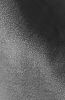
North_Polar_Features-Polygons-PIA07354-0.jpgNorth Polar "Polygons" (Original NASA/MGS/MSSS b/w Frame)74 visiteCaption NASA originale:"This Mars Global Surveyor (MGS) Mars Orbiter Camera (MOC) image shows Polygons formed in ice-rich material in the North Polar Regions of Mars. The bright surfaces in this image are covered by a thin Water Ice Frost".
(7 voti)
|
|
| 25332 immagini su 2111 pagina(e) |
 |
|
|
|
|
2022 | |
|
|
|
|





