| Piú votate |

ZZ-ZZ-Horizon-Span4.jpgGusev's Horizon (natural colors - elab. Lunexit)84 visiteUn esempio classico delle elaborazioni in colori naturali operate da Lunexit. Ecco alcuni parametri che a noi sembrano essenziali e che altri "colorizzatori" (bravissimi anche loro, senza dubbio) non sembrano voler considerare (forse per amor di "bellezza finale" del paesaggio ottenuto):
1) Marte è "luminoso" (come la NASA stessa ha - finalmente! - ammesso), ma è COMUNQUE MENO LUMINOSO della Terra e la sua luminosità varia in rapporto alla posizione del Sole nel cielo ed in rapporto alla altezza del cielo (dal punto di vista dell'Osservatore). Colorizzare un paesaggio Marziano ignorando il dato "luminosità ambientale" e gli elementi ancillari summenzionati, vuol dire - secondo noi - sbagliare "a monte";
2) Marte, a differenza della Terra, POSSIEDE una DOMINANTE CROMATICA - che è l'arancio/rosso, almeno nelle sue Regioni Equatoriali. Colorizzare un paesaggio Marziano ignorando il dato della cosiddetta "dominante cromatica" vuol dire - sempre secondo noi - ignorare l'evidenza e sbagliare - ancora una volta - "a monte";
3) su Marte esiste, anche a "livello Datum" una (quasi) costante nebbia (chiamata "O.A." - Opacità Atmosferica) la quale, come ovvio, esalta ed esaspera i suoi effetti allorchè vengono inquadrati dei rilievi distanti dal punto di ripresa.
I frames (colorizzati o non) i quali si collocano "a fuoco" su tutta la linea visibile e che risultano estremamente accurati anche nella definizione nei dettagli "lontani" (e qui, come ovvio, ci riferiamo alle immagini ottenute dal suolo) sono, ancora una volta (e sempre a nostro parere) dei frames che evidenziano un errore di base.MareKromium
(8 voti)
|
|

ZZ-ColorMars-08-KL-V03689003color.jpgMars from Orbit, as a "Human" would see it...by Keith Laney (2)67 visitenessun commentoMareKromium
(8 voti)
|
|

Jupiter_s System-PIA01481.jpgJupiter's (Main) System70 visiteCaption NASA originale:"Jupiter and its four planet-size moons, called the Galilean Satellites, were photographed in early March by Voyager 1 and assembled into this collage. They are not to scale but are in their relative positions. (...) Nine other much smaller satellites circle Jupiter, one inside Io's orbit and the other millions of miles from the Planet.
Not visible is Jupiter's faint ring of particles, seen for the first time by Voyager 1".
(8 voti)
|
|

OPP-SOL762-1N195804327ESF65KEP1588L0M1.jpgPhotoartifacts and a Little Star-like Object? - Sol 76278 visiteCaption NASA originale:"Left NavCam Non-linearized Sub-frame EDR acquired on Sol 762 of Opportunity's mission to Meridiani Planum at approximately 04:55:10 MLT".
Nota: gli oggetti luminosi (visibili in prevalenza sulla Vostra Sx) sono, con ogni probabilità, dei photoartifacts; l'oggetto cerchiato in verde - sulla superficie di Marte - potrebbe non essere un photoartifact; i due oggetti cerchiati in rosso nella prima cerchiatura rossa da Sx, a nostro parere, non dovrebbero essere dei photoartifacts; l'oggetto isolato e cerchiato in rosso nella seconda cerchiatura rossa da Sx NON è un photoartifact.
(8 voti)
|
|

Titan_and_Dione-PIA07644.jpgTitan & Co.62 visiteOriginal caption:"In a rare moment, the Cassini spacecraft captured this enduring portrait of a near-alignment of four of Saturn's restless moons. Timing is critical when trying to capture a view of multiple bodies, like this one. All four of the moons seen here were on the far side of the Rings from the spacecraft when this image was taken; and about an hour later, all four had disappeared behind Saturn.
Seen here are Titan (5.150 Km, or 3.200 miles across) and Dione (1.126 Km, or 700 miles across) at bottom; Prometheus (102 Km, or 63 miles across) hugs the Rings at center; Telesto (24 Km, or 15 miles across) is a mere speck in the darkness above center.
The image was taken in visible light with the Cassini narrow-angle camera on Oct. 17, 2005 at a distance of approx. 3,4 MKM (2,1 MMs) from Dione and 2,5 MKM (about 1,6 MMs) from Titan. The image scale is 16 Km (10 miles) per pixel on Dione and 21 Km (about 13 miles) per pixel on Titan".
(8 voti)
|
|

TheRings-G-Ring-PIA07643.jpgThe G-Ring's "Glow"59 visiteOriginal caption:"Saturn's G-Ring glows like a neon garland in this lovely narrow angle camera image from Cassini. The comparison between the diffuse outer boundary and the sharp inner edge of this Ring, which consists of fine, dust-sized icy particles, is particularly noteworthy. Close Cassini views such as this should provide Ring scientists with clues about how this Ring is produced and confined.
The G-Ring extends from 166.000 to 173.200 Km (about 103.100 to 107.600 miles) from Saturn's center. (remember: Saturn is 120.500 Km [about 74.900 miles] wide at its equator).
The image was taken in visible light with the Cassini narrow-angle camera on Oct. 24, 2005, at a distance of approx. 2,1 MKM (about 1,3 MMs) from Saturn. The image scale is 12 Km (about 8 miles) per pixel".
(8 voti)
|
|

Saturn-PIA07731-2.jpgSpokes (2)59 visiteAt the bottom left corner of the 1 st and 2nd image, the bright inner edge of the A-Ring is visible. Continuing radially inward (or toward Saturn) are several bands that lie within the Cassini Division, bounded by the bright outer edge of the B-Ring. The rounded shadow of Saturn cuts across the Rings in the image at right.
Cassini's first sighting of Spokes occurs on the unilluminated side of the Rings, in the same region in which they were seen during the Voyager flybys. Although the most familiar Voyager images of spokes showed them on the sunlit side of the Rings, spokes also were seen on the unilluminated side.
In Voyager images, when Spokes were seen at low phase angles, they appeared dark; when seen at high phase angles, they appeared bright. The Spokes seen here are viewed by Cassini at a very high phase angle, which is about 145° at the center of each image.
(8 voti)
|
|
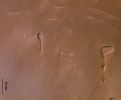
Volcanoes-Ascraeus_Mons-1-027-150304-0068-6-co-01.jpgAscraeus Mons from Mars Express (1 - ESA/ DLR/ FU Berlin - G. Neukum)79 visiteDue immagini in colori naturali del Vulcano Ascraeus Mons e dei suoi rilievi assolutamente affascinanti.
Ed eccoVi la Caption ESA originale:"This colour image shows a larger portion of the southern flank of Ascraeus Mons. The lighter, pink areas on the colour image, are clouds.
The visible lava tubes are caused by the crusting (or cooled lava) which occurs over a lava channel, a covering making the channel into a tunnel.
When lava production ceases, the tunnel empties and the roof of the tunnel falls in, making an elongated depression.
Occasionally, the depression forms a chain of small pits over an emptied lava tunnel. Pit chains and lava tunnels are common on the Martian surface and are also seen on other terrestrial planets and the Moon".
(8 voti)
|
|

Controversial_Features-The_D_M_Pyramid-02.jpgThe D&M Pyramid (Original NASA/MGS/MSSS b/w Frame)151 visiteCaption NASA originale:"The mosaics shows a Cydonia landform popularly known as the "D&M Pyramid." It is located near 40.7°N, 9.6°W. Although it is not really shaped like a pyramid, the Cydonia landform is 1 of thousands of massifs, buttes, mesas, knobs and blocks that mark the transition from the far northwestern Arabia Terra cratered highlands down to the northeastern Acidalia Planitia lowlands. Each block, whether shaped like a face, a pyramid, or simply a mesa, massif or knob, is a remnant of the bedrock of northeastern Arabia that was left behind as erosion slowly degraded the terrain along this zone between the highlands and the lowlands. A few outcroppings of layers in this ancient bedrock can be seen in the mosaic of the pyramid-like landform shown here; much of the landform is covered with eroded mantling material that was deposited long after this highlands remnant became an isolated feature in Cydonia".
Lunar Explorer, questa volta, concorda pienamente con quanto riportato nella caption NASA.
(8 voti)
|
|

OPP-SOL322-Sol322B_P2574_True_RAD-B344R1.jpgApproaching the Heat-Shield (true colors)120 visiteUna serie di frames in "almost true colors" che riguardano ancora lo Scudo Termico - o presunto tale - di Opportunity.
Ovviamente queste immagini ci offrono un Marte ancora diverso ed ancora più sconcertante, il cui cielo è verdastro e le dune di Meridiani Planum sono arancio/giallastre, con riflessi verdi.
Il nostro consiglio è di andare a riguardare le prime immagini a colori veri riprese da Opportunity e di metterle a confronto con queste ultime: ogni dubbio sarà legittimo...
Caption NASA originale:"In this view, Opportunity is approx. 130 meters (427 feet) away from the device that protected it while hurtling through the Martian atmosphere.
The rover spent 36 Sols investigating how the severe heating during entry through the atmosphere affected the heat shield. The most obvious is the fact that the heat shield inverted upon impact.
This is the PanCam Team's BEST current attempt at generating a true-color view of what this scene would look like if viewed by a human on Mars".
(8 voti)
|
|

OPP-SOL322-Opportunity-B_DeckPan-B381R1_br2.jpgOpportunity's "Self-Portrait" - Sol 322 (Approximate True Colors; credits: NASA/JPL-Caltech)67 visiteAutoritratto (anzi: autoscatto), ricostruito frame dopo frame, di un Rover (Opportunity) i cui pannelli solari sembrano davvero ben puliti. Certo è che, dopo un anno di peregrinazioni in un deserto ed un'esposizione costante a nuvole di "polveri in sospensione", questo risultato ci sembra sorprendente. Quasi incredibile.
Anzi: diremmo POCO credibile!...
Comunque sia, guardate ancora una volta con attenzione i colori del suolo Marziano e poi confrontateli con l'auoritratto di Spirit.
Questa è la caption NASA:"NASA's Mars Exploration Rover Opportunity used its panoramic camera to take the images combined into this mosaic view of the rover. The downward-looking view omits the mast on which the camera is mounted. It shows Opportunity's solar panels to be relatively dust-free. The images were taken through the camera's 600-, 530- and 480-nanometer filters during Opportunity's 322nd and 323rd Martian Days".
(8 voti)
|
|
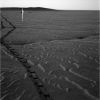
OPP-SOL361-1P160236096EFF4100P2363L7M1.jpgThe "distant shine" of the Heat-Shield... (2)69 visiteUn leggero cambio di prospettiva, ma l'immagine è analoga alla precedente e, come la precedente, è molto bella e suggestiva.
Non ci sembra necessario fare altri commenti; solo un rilievo: guardate con attenzione le "profonde tracce del Rover"!...
(8 voti)
|
|
| 25332 immagini su 2111 pagina(e) |
 |
|
|
|
|
2008 | |
|
|
|
|





