| Piú votate |

Volcanic_Features-Collapse_Pits-Pavonis_Mons_Area.jpgPit Chain on the Eastern Flank of Pavonis Mons (Original NASA/MGS/MSSS b/w Frame)82 visiteCaption NASA originale:"Pavonis Mons is the middle of the 3 large Tharsis Montes Volcanoes in the Martian Western Hemisphere.
Located on the Equator at about 113° West Longitude, Pavonis Mons stands as much as 7 Km above the surrounding Plain. The MGS-MOC recently spied the above Chain of Elliptical Pits on the lower East Flank of Pavonis Mons. The picture covers an area approx. 3 Km wide by 3,4 Km in length. The Pits are aligned down the center of a 485 meters-(approx. 530 yards)-wide, shallow Trough.
The straight Trough and the Pits were both formed by collapse associated with faulting. The Scarp on each side of the Trough is a "Fault Line" - Troughs of this type are known to geologists as "Graben". Such features are typically formed when the ground is being moved apart by tectonic forces, or when the ground is uplifted by molten rock injected into the near sub-surface from deeper underground. Both processes may be contributing to the features seen on Pavonis Mons. The Pits follow the trend of these Faults, and indicate the locus of collapse".
(5 voti)
|
|
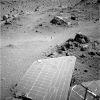
SOL406-2N162413854EFFA756P0675L0M1.jpgSol 406: a different view of the "Nest"?!?62 visiteE' passato un giorno, su Marte: nessun dettaglio ingrandito della Singolarità che abbiamo chiamato "Nest" ci sembra disponibile.
Qualche Associato ritiene che, in questo frame, ci sia uno scorcio del "Nest" da un'angolazione diversa.
Difficile dirlo... Voi che ne pensate?!?
(5 voti)
|
|

SOL405-2N162320225EFFA700P1775L0M1.jpgStones...One on top of the other: a "nest", maybe? (ANOMALY)80 visiteGuardate al centro dell'immagine: si nota con una certa facilità un mucchio di "sassi" che formano una specie di outcrop. Nulla di nuovo? Ingrandite l'immagine ed osservate attentamente: i sassi, tutti più o meno delle stesse (modeste) dimensioni) sono ACCATASTATI IN ORDINE L'UNO SULL'ALTRO e formano (scusateci la fantasia...) una costruzione vagamente semicircolare (o, se volete, ad "anfiteatro") che ha tutta l'aria di essere l'ingresso di una tana. Ora noi non possiamo dirVi che cosa si nasconda al di sotto di quel cumulo ordinato di sassi, però possiamo certamente dire che, in Natura, le pietre - di regola - NON SI DISPONGONO IN QUESTO MODO.
Allora sarà un'opera del vento e dei "dust devils", potrebbe suggerire qualcuno.
Certo: ma sarebbe come dire, trovandosi davanti ad un igloo, che si tratta di una curiosa configurazione naturale del ghiaccio e della neve la quale si è disposta in maniera "apparentemente logica" solo a seguito di forti correnti convettive e di turbolenze anomale localizzate...
(5 voti)
|
|

Tethys-PIA06590.jpgTethys from approx. 1,9 MKM55 visiteCaption NASA originale:"This Cassini view of Saturn's moon Tethys shows several large craters near the moon's eastern limb. These craters have fanciful names such as Phemius, Polyphemus and Ajax. The moon's massive rift-like canyon system, Ithaca Chasma, is in the darkness to the west. The image has been rotated so that north on Tethys is up and this view shows mainly the moon's trailing hemisphere. The image was taken in visible blue light with the Cassini spacecraft narrow angle camera on Jan. 19, 2005, at a distance of approximately 1,9 MKM (approx. 1,2 MMs) from Tethys and at a phase angle of 111°. Resolution in the original image was 11 Km (approx. 7 miles) per pixel. The image has been contrast-enhanced and magnified by a factor of two to aid visibility".
(5 voti)
|
|

04-Copernicus Crater.jpgOblique view of Copernicus Crater from Lunar Orbiter 2136 visiteCaption NASA originale:"Lunar Orbiter 2 oblique northward view of the interior of the 100 Km diameter Copernicus Crater on the Moon. The central peaks are in the middle of the image, rising about 400 m above the crater floor and stretching for about 15 Km. The northern wall of the crater is in the background. This is the top frame of a set of 3 adjoining HR frames, which are available in image lo2_h162_123 (Lunar Orbiter 2, frame 162-H3)".
Location & Time Information
Date/Time (UT): 1966-11-24 T 00:05:43
Distance/Range (km): 130
Central Latitude/Longitude (deg): +05.48/340.00
(5 voti)
|
|

APOLLO 17 AS 17 133-20244.jpgAS 17-133-20244 - Crater with outcrops (3)118 visiteLa Ricerca e l'Investigazione, infatti (siano esse Scientifiche o meramente Amatoriali), non devono fermarsi solo davanti a ciò che è "strano" o "curioso" o "anomalo": esse devono investire (o almeno tentare di farlo) il "tutto", sempre nutrendo Curiosità per l'Ignoto e sincera ammirazione per chi ha avuto il coraggio di "andare avanti il più possibile".
Buona passeggiata, dunque...
(5 voti)
|
|

OPP-SOL330-1NN325EFF40CYLA3P0685L000M1-crop-B330R1.jpgThe Heat-Shield and its surroundings - full panorama - Sol 33084 visiteCaption NASA originale:"Mars Exploration Rover Opportunity gained this view of its own Heat-Shield during the Rover's 325th Sol (Dec. 22, 2004). The main structure from the successfully used shield is to the far left; additional fragments of the Heat-Shield lie in the upper center of the image. The Heat Shield's impact mark is visible just above and to the right of the foreground shadow of Opportunity's camera mast. This view is a mosaic of 3 images taken with the rover's NavCam". E con questo splendido ed esauriente panorama che ricopre tutta l'area d'impatto dello Scudo - dal cratere che si è formato, ai frammenti sparsi dappertutto - chiudiamo l'indagine relativa a quella che avevamo originariamente (ed erroneamente) classificato come un'Anomalia di Superficie. Fra pochi Soles, in base ai dati NASA ufficiali, Opportunity si rimetterà in marcia, dirigendosi verso Sud. Che cosa troverà, dunque, oltre alle sabbie, alle sferule ed alle curiose dunette che formano il deserto arancione di Meridiani Planum?!?...
(5 voti)
|
|

SOL328-2N155489725EFF9700P0655L0M1.jpgMars panorama, with sand-dunes and rocks of all kinds (2)57 visitenessun commento
(5 voti)
|
|

Hyperion-PIA06527.jpgHyperion from approx. 2.200.000 Km61 visiteCaption NASA originale:"This image reveals the odd shape of Saturn's moon Hyperion and an intriguing variation in brightness across its surface (ndr: just like Japetus?!?).
The diameter of Hyperion is 266 Km.
The image was taken in visible light with the Cassini spacecraft narrow angle camera on Oct. 20, 2004, at a distance of about 2.2 MKM from Hyperion and at a Sun-Hyperion-spacecraft, or phase, angle of 50°. The image scale is 13 Km per pixel".
(5 voti)
|
|

OPP-SOL287-1P153661918EFF37MIP2270L7M1.jpg"Burns Cliff": the inner wall of Endurance Crater (2)78 visitenessun commento
(5 voti)
|
|

OPP-SOL265-1N151715598EFF3759P1905R0M1-PCF-LXTT-00.jpgEndurance Crater, the Dunes and Wopmay (1)66 visiteDue visioni sequenziali riprese all'interno di Endurance Crater che raffigurano - con una grande abbondanza di particolari - i bordi, alcune rocce e le dune di Endurance (primo frame) e poi la Grande Roccia Bianca (chiamata "Wopmay" dai Tecnici del Mission Control) verso cui Opportunity si sta dirigendo. Ottime immagini, di grande impatto visivo!
(5 voti)
|
|

Hyperion-PIA06486.jpgHyperion, the "tumbling" moon57 visiteUn'immagine non particolarmente bella ma comunque densa di suggestione e di mistero: si tratta di Iperione (o "Hyperion"), la luna di Saturno che non "scorre", ma "rotola" (come dicono gli Scienziati) lungo la sua orbita. Si tratta, probabilmente, di una delle lune che sono state - letteralmente - "rubate" dal Signore degli Anelli: un macigno proveniente dalle profondità del Sistema Solare (un "KBO") che si è avvicinato troppo a Saturno ed è stato catturato dal suo "abbraccio gravitazionale". Il movimento caotico di Iperione - tenendo a mente che l'impulso iniziale impresso ad un corpo, nello spazio, viene dal corpo stesso mantenuto (praticamente) all'infinito - deriva, con ogni probabilità, dal fatto che si tratta di un frammento di un oggetto celeste di più grandi dimensioni il quale andò in pezzi a seguito di un impatto occorso in epoche assai remote.
Una delle "schegge" che derivarono dalla collisione la vediamo orbitare (anzi: "rotolare") ancora oggi intorno a Saturno: questo è Iperione.
(5 voti)
|
|
| 25332 immagini su 2111 pagina(e) |
 |
|
|
|
|
1999 | |
|
|
|
|





