| Piú votate |

SOL0003-0003ML0000010000E1_DXXX-PCF-LXTT.jpgExtremely Foggy Horizon at Gale Crater - Sol 3 (Absolute Natural Colors; credits for the additional process. and color.: Dr Paolo C. Fienga/Lunar Explorer Italia/Italian Planetary Foundation)112 visitenessun commentoMareKromium
(5 voti)
|
|

Clouds-Elysium_Mons-20080616a-PCF-LXTT-1.jpgLow altitude Clouds (or maybe "Fumes") from Elysium Mons (Absolute Natural Colors; credits for the additional process. and color.: Dr Paolo C. Fienga - Lunexit Team)67 visitenessun commentoMareKromium
(5 voti)
|
|

ESP_018301_2505_RED_abrowse-00.jpgLouth Crater (CTX Frame- Natural Colors; credits for the additional process. and color.: Dr Paolo C. Fienga - Lunexit Team)68 visiteThis HiRISE image shows a large Ice Mound located in Louth Crater. At 70° North (in the Region of Vastitas Borealis), this is the lowest latitude permanent deposit of water ice on Mars.
The HiRISE image, taken in early Summer, shows details of the Mound and non-ice portions of the Crater Floor.
The Mound is characterized by rough textures and layering similar to features seen on the North Polar Layered Deposits near the Martian North Pole. Zooming in to an area in the South-Eastern part of the Mound (see the following EDMs), dark Sinuous Ridges appear.
These may be the crests of partially defrosted Dark Sand Dunes or perhaps some other feature that we do not understand.
This is the only area on Louth where these enigmatic Ridges are found.MareKromium
(5 voti)
|
|
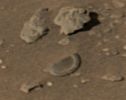
SOL814-932-PIA01907-GB2.jpgExplain THIS! - Sol 814 (EDM - Natural Colors; credits: Dr Gianluigi Barca - Lunexit Team)212 visiteEDM from 'McMurdo' Panorama from Spirit's 'Winter Haven' - The Pancam began shooting component images of this Panorama during Spirit's sol 814 (April 18, 2006) and completed it on sol 932 (Aug. 17, 2006). MareKromium
(5 voti)
|
|
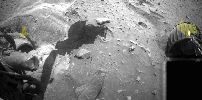
SOL2147-MF.gifWATCH CAREFULLY! - Sol 2147 (GIF-Movie - credits: Dr M. Faccin)139 visiteInsabbiato o disinsabbiato? Questo GIF-Movie, realizzato dal nostro eccezionale Marco Faccin, è stato costruito con frames ottenuti TUTTI durante il Sol 2147 della "Campagna Marziana" del MER Spirit.
Ebbene, se guardate attentamente il filmato - magari scaricatelo e poi guardatelo frame-by-frame -, Vi accorgerete che in UN SINGOLO frame, la "ruota insabbiata" di Spirit APPARE FUORI DALLA SABBIA (quasi completamente)!
Spirit nuovamente libero, dunque?
No. Nei Soles successivi, infatti, la ruota sepolta è nuovamente "sepolta" (e dunque il nostro Amico Rover non può abbandonare la sua posizione).
Secondo noi, però, Cari Amici, qui c'è qualcosa che non va. Noi non siamo "Complottisti" e, dato che basta poco per essere tacciati di cialtronaggine, ci fermiamo qui.
Ma Voi, se volete, potete anche andare avanti, scriverci, e speculare sulle possibili implicazioni derivanti da quel "frame che non dovrebbe esistere" e che invece è lì, e ci fa vedere qualcosa che non si potrebbe nè dovrebbe vedere (secondo gli Amici di Pasadena...).
Che ne pensate?MareKromium
(5 voti)
|
|
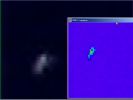
LRO-1008-392738main_vlcsnap-2009-10-08-19h02m22s101.pngGo "Centaur", go!80 visiteImage of the Centaur separation as viewed from the InfraRed Camera.
LCROSS Centaur Separation occurred at 9:50 p.m. EDT (6:50 p.m. PDT), Oct. 8, 2009. After separation, the Spacecraft performed a 180° pitch maneuver (turning around) to reorient the LCROSS science payload towards the receding Centaur.MareKromium
(5 voti)
|
|
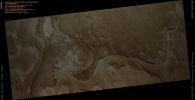
ESP_014167_1300_RED_abrowse.jpgExposures of Layered Rocks in Argyre Planitia (Natural Colors; credits: Lunexit)60 visitenessun commentoMareKromium
(5 voti)
|
|

SOL075-2F133027365EFF21CEP1201R0M1.jpgBoulders on sight! - Sol 75 (natural colors; credits: Lunexit)56 visitenessun commentoMareKromium
(5 voti)
|
|
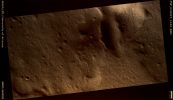
PSP_010025_1410_RED.jpgDark Area in Hartwig Crater (possible True Colors; credits: Lunar Explorer Italia)59 visiteMars Local Time: 15:39 (middle afternoon)
Coord. (centered): 38,2° South Lat. and 344,1° East Long.
Spacecraft altitude: 256,7 Km (such as about 160,4 miles)
Original image scale range: 51,4 cm/pixel (with 1 x 1 binning) so objects ~1,54 mt across are resolved
Map projected scale: 50 cm/pixel
Map projection: EQUIRECTANGULAR
Emission Angle: 6,6°
Phase Angle: 82,8°
Solar Incidence Angle: 78° (meaning that the Sun is about 12° above the Local Horizon)
Solar Longitude: 127,6° (Northern Summer)
Credits: NASA/JPL/University of Arizona
Additional process. and coloring: Lunar Explorer ItaliaMareKromium
(5 voti)
|
|

Dunes-Terra_Tyrrhena.jpgReddish Dunes in Terra Tyrrhena (Natural Colors; credits for the additional process. and color.: Dr Paolo C. Fienga - Lunar Explorer Italia)59 visiteSource: NASA/2001 Mars Odyssey Orbiter
Coord.: 9,9° South Lat. and 98,1° East Long.MareKromium
(5 voti)
|
|

SOL932-1-2.jpgHigh Tau...Again! - Sol 932 (natural colors; credits: Dr G. Barca & Lunexit)57 visitenessun commentoMareKromium
(5 voti)
|
|

Haumea2.jpgHaumea and other "Dwarf" Companions59 visiteCaption NASA:"One of the strangest objects in the Outer Solar System was classified as a Dwarf Planet last week (September 2008) and given the name Haumea.
This designation makes Haumea the 5th designated Dwarf Planet after Pluto, Ceres, Eris, and Makemake. Haumea's smooth but oblong shape make it extremely unusual. Along one direction, Haumea is significantly longer than Pluto, while in another direction Haumea has an extent very similar to Pluto, while in the third direction is much smaller.
Haumea's orbit sometimes brings it closer to the Sun than Pluto, but usually Haumea is further away.
Illustrated above, an artist visualizes Haumea as a nearly featureless ellipsoid. Quite possibly, however, Haumea has interesting craters and surface features that currently remain unknown. Originally discovered in 2003 and given the temporary designation of 2003 EL61, Haumea was recently renamed by the IAU for a Hawaiian goddess. Haumea has two small moons discovered in 2005, recently renamed Hi'iaka and Namaka after the daughters of the Goddess".MareKromium
(5 voti)
|
|
| 25332 immagini su 2111 pagina(e) |
 |
|
|
|
|
1996 | |
|
|
|
|





