| Piú votate |
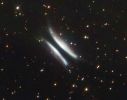
Gomez_s Hamburger - HST.jpgProtoplanetary Nebula - "Hamburger"136 visiteUn commento a questa immagine si impone: questa nebulosa protoplanetaria è stata chiamata "hamburger" - si, proprio come i panini di Mc Donald's... -. Un elevatissimo quantitativo di oggetti relativi allo spazio ed ai pianeti in generale ed a Marte in particolare viene quotidianamente battezzato usando una nomenclatura - quando va bene - "oscura" e, quando va male, "ridicola" sino ai limiti dell'offensivo. Ci siamo spesso chiesti il perchè di questo (per lo meno "curioso") approccio ai Misteri dell'Universo e, alla fine, ci siamo convinti che l'attribuzione di nomi ridicoli costituisca un modo di esorcizzare quello che non riusciamo a comprendere, in tutto o in parte, facendolo ricadere sotto una realtà che deve essere "nota" ed "innocua". Noi non sappiamo se questo modo di ragionare sia giusto o no, ma una cosa è certa: alle volte si esagera. La nebulosa "Hamburger", secondo noi, fa parte della casistica in cui si è esagerato nella semplificazione, ottenendo il risultato della "banalizzazione".
O no?!?..
(15 voti)
|
|

Io-flares and eruptions-PIA02254.jpgFlares and Eruptions on the limb of crescent Io103 visiteUn frame da ricordare, per bellezza ed importanza: ecco come appaiono le "flares" sul bordo di un pianeta in ombra. Sappiamo, in questo caso, che si tratta di eruzioni ed outgassing in corso e nessuno ne dubita. Tuttavia, quando fenomeni similari (o identici) vengono osservati sulla Luna, tutti (o quasi) gli Scienziati ed i Ricercatori si affrettano a dire che non è possibile e che deve trattarsi di sviste o bagliori da impatto. Ma perchè fa così paura l'idea che la Luna possa essere ancora in parte "viva"?
Voyager 2 took this picture of Io July 10, 1979, from a range of 1.2 million kilometers (750,000 miles). It was one of the last of an extensive sequence of "volcano watch" pictures planned as a time lapse study of the nearest of Jupiter's Galilean satellites. The sunlit crescent of Io is seen at the left, and the night side illuminated by light reflected from Jupiter can also be seen. Three volcanic eruption plumes are visible on the limb. All three were previously seen by Voyager 1. On the bright limb Plume 5 (upper) and Plume 6 (lower) are about 100 kilometers high, while Plume 2 on the dark limb is about 185 kilometers high and 325 kilometers wide. The dimensions of Plume 2 are about 1 1/2 times greater than during the Voyager 1 encounter, indicating that the intensity of the eruptions has increased during the four-month time interval between the Voyager encounters. The three volcanic eruptions and at least three others have apparently been active at roughly the same intensity or greater for a period of at least four months.
(15 voti)
|
|

SN1987 A.jpgSupernova 1987 A - HST151 visite"...L'assenza di prove relative alla verificazione di un dato evento non è una prova della non verificazione dell'evento stesso..."
Sir Martin Rees
(15 voti)
|
|
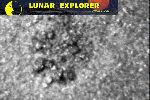
Lifeforms-005-lg_18936-lg_18939-2.gifMicroscopic Lifeforms in Motion? (GIF-Movie; credits: Dr G. Barca)59 visitenessun commentoMareKromium
(10 voti)
|
|
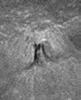
M-N-Lobachewsky.gifThe Lobachevsky Anomaly, from Clementine (2) - detail mgnf227 visitenessun commento
(10 voti)
|
|

Pandora-N00039277.jpgPandora, from about 52.000 Km58 visiteOriginal NASA caption:"N00039277.jpg was taken on September 05, 2005 and received on Earth September 06, 2005. The camera was pointing toward PANDORA at approximately 51.749 Km away".
(10 voti)
|
|

Enceladus-GroundTrack-PIA07723_modest.jpgEnceladus: the "Ground-Track"57 visiteThis graphic shows Cassini's path, or Ground Track, as it crossed over the surface of Enceladus near the time of closest approach during the flyby on July 14, 2005. The Ground Track is indicated by a yellow line, marked by increments of 10" before and after closest approach. The spacecraft came within 175 Km from the surface of Enceladus at closest approach.
The red contour encloses the Region on Enceladus around the South Pole that is the approx. boundary of the warm region, as measured by the Composite Infrared Spectrometer (CIS) on Cassini. As previously announced, temperatures observed within this region reached as high as 110 Kelvin (about -260 Fahrenheit). (...) Results like these, pouring in from various Cassini instruments, indicate the warm South Polar Region and, in particular, the 'tiger stripe' fractures straddling the South Pole, as the sources of heat, water vapor and small, icy particles.
Enceladus is a surprisingly active moon. Why its South Pole is the site of this activity is a mystery.
(10 voti)
|
|
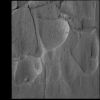
SOL077-x_pubeng_MazTargets-A080R1.jpg"Peeling" Mazatzal - Sol 7759 visiteCaption NASA originale:"Mazatzal, like most rocks on Earth and Mars, has layers of material near its surface that provide clues about the history of the rock. Scientists believe that the top layer of Mazatzal is actually a coating of dust and possibly even salts. Under this light coating may be a more solid portion of the rock that has been chemically altered by weathering. Past this layer is the unaltered rock, which may give scientists the best information about how Mazatzal was formed. Because each layer reveals information about the formation and subsequent history of Mazatzal, it is important that scientists get a look at each of them. For this reason, they have developed a multi-part strategy to use the RAT to systematically peel back Mazatzal's layers and analyze what's underneath with the Rover's MI, and its Moessbauer and APXS. The strategy began on sol 77 when scientists used the microscopic imager to get a closer look at targets on Mazatzal named "New York," "Illinois" and "Arizona." These rock areas were targeted because they posed the best opportunity for successfully using the rock abrasion tool; Arizona also allowed for a close-up look at a range of tones. On sol 78, Spirit's rock abrasion tool will do a light brushing on the Illinois target to preserve some of the surface layers. Then, a brushing of the New York target should remove the top coating of any dust and salts and perhaps reveal the chemically altered rock underneath. Finally, on sol 79, the rock abrasion tool will be commanded to grind into the New York target, which will give scientists the best chance of observing Mazatzal's interior".
(10 voti)
|
|

NGC-4754_and_NGC-4762.jpgNGC 4754, NGC 4762 and Tempel 1 Comet69 visite"...La tv sta diventando un culto osceno terribile, scandito da riti demenziali officiati da sacerdoti dementi.
Pio XII sbagliava: la televisione non è sentina di vizio e teatrino delle vanità; è una gigantesca brain-machine che sta mutando la specie umana, sostituendo alla libertà, alla volontà e alla critica l’adesione incondizionata agli stereotipi di massa, decisi in qualche invisibile consiglio d’amministrazione..."
Paolo Cortesi - "La Televisione: il serpente sotto il letto"
"...La Televisione è la Realtà e la Realtà è Televisione..."
dal film "Videodrome"
(10 voti)
|
|

Claritas_Fossae-5-098-140904-0508-6-3d-01-ClaritasFossae_hires.jpgClaritas Fossae (5 - ESA/ DLR/ FU Berlin - G. Neukum)76 visitenessun commento
(10 voti)
|
|

ZZ-ZZ-ZZ-ZZ-LifeonMars-29.04.04rl.jpgA little crack among the berries?444 visiteNoi vediamo, fra la prima e la seconda immagine, l'aprirsi di un leggero "crack" nella sabbia che divide i diversi "frutti di bosco" Marziani.
O anche questa è un'illusione ottica?
O forse Marte - e le sue incredibili (ed inspiegabili!) peculiarità - sta continuando a sfuggirci di mano?!?
(10 voti)
|
|

Channels-Unnamed_Channels_and_Cracks-PIA07389.jpgMartian "Tori" (Original NASA/JPL/ASU b/w Frame)90 visitenessun commento
(10 voti)
|
|
| 25332 immagini su 2111 pagina(e) |
 |
|
|
|
|
1994 | |
|
|
|
|





