| Piú votate |
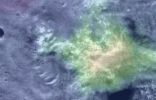
ZO-W-PIA07848.jpgColumbia Hills' elevation map from MGS196 visiteThis elevation map shows the region of the Columbia Hills where Rover Spirit has been working since mid-2004. Areas colored blue are lower in elevation while areas colored yellow are higher.
The map imagery is from the MOC on NASA's MGS orbiter.
More than 15 months after landing on Mars, the Spirit rover is still going strong, having traveled a total of 4.276 mt as of Sol 450 (April 8, 2005). This elevation map shows the traverse followed by Spirit since arriving at the "Columbia Hills" in June, 2004.
The blue area at the foot of the Columbia Hills is approximately 20 mt higher in elevation than the site where Spirit landed in Gusev Crater. The highest peak is on the order of 80 mt higher still". 
(6 voti)
|
|

Rhea-N00032542.jpgRhea, from approx. 242.000 Km (2)60 visitevedi il commento al frame che precede
(6 voti)
|
|

OPP-SOL359-1N160055781EFF40FWP1612L0M1.jpgHeading South and bye-bye, Heat-Shield!... - Sol 359 (2 - RAW b/w Original NASA/MER Opportunity Frame) 66 visiteLo Scudo Termico brilla sotto il Sole e produce il solito artefatto fotografico al quale siamo ormai abituati. Ora - almeno in teoria - Opportunity non dovrebbe più incontrare lungo il suo cammino altri rottami metallici, quindi...Attenzione agli (eventuali) riflessi luminosi che dovessimo incontrare nel prosieguo della marcia: non ci sono più "back-shells", "parachutes" ed "heat-shields" ai quali appigliarsi, ora, per giustificare la presenza di nuovi "riflessi metallici" su Marte!
(6 voti)
|
|

Japetus-N00026231.jpgJapetus (and the "Pentagon") from about 180.000 Km (2)75 visitenessun commento
(6 voti)
|
|
SOL317-2N154515963EFF9400P0745R0M1.jpgPanorama from Sol 317 (8) - Sun's going down...72 visitenessun commento
(6 voti)
|
|

OPP-SOL287-1P153661411EFF37MIP2270R1M1.jpg"Burns Cliff": the inner wall of Endurance Crater (1)84 visiteDue immagini della spettacolare pavimentazione interna delle pareti di Endurance e, sullo sfondo, il quieto (?) Cielo di Marte, apparentemente libero da nuvole.
(6 voti)
|
|

SOL307-2P153620688EFF9000P2425R1M1.jpgSol 307: Panorama from 13:34 until 13:38 - filter 7 - (2)56 visitenessun commento
(6 voti)
|
|

OPP-SOL274-1N152511359EFF37IFP0664L0M1.jpgPaving on the walls of Endurance Crater (2)70 visitenessun commento
(6 voti)
|
|

M-077-1.jpgM 77 - Seyfert Class Spiral Galaxy84 visite"...Difficile est tristi fingere mente iocum..."
(Tibullo)
"...Una profonda tristezza è difficile da nascondersi..."
(6 voti)
|
|

APOLLO 13 AS 13-62-8941.jpgAS 13-62-8941 - Unexplainable367 visiteUna fotografia interessante ma, purtroppo, ancora "unexplainable".
Che cosa rappresenta, esattamente? Noi non lo sappiamo, Voi, se avete delle idee, delle intuizioni o (magari...) delle certezze, non dovete far altro che scrivere!
(6 voti)
|
|

Phobos_from_MGS-000.jpgPhobos from Mars Global Surveyor (1)180 visitePhobos, a quanto pensano gli Scienziati, potrebbe non essere una "luna originale" di Marte. Potrebbe (peraltro verosimilmente) trattarsi di un asteroide 'catturato' da Marte, in epoche remote, mentre transitava nei suoi paraggi. La velocità di rotazione di Phobos è estremamente elevata: questa luna, infatti, completa un'intera orbita intorno a Marte in circa 8 ore. Per quanto attiene, poi, il lato "esteriore" di Phobos, possiamo facilmente notare il grandissimo numero di crateri sulla sue superficie e l'enorme depressione (lo "Stickney Crater") che lo caratterizza in maniera davvero unica.
(6 voti)
|
|

A-The Sun-Solar flare from Soho.jpgPowerful solar flare from Soho61 visiteCaption originale NASA: "Seen through the electromagnetic spectrum, the Sun briefly becomes over than 100 times brighter (in the X-rays wavelength) than normal. This is a so-called "Solar Flare" and, when it happens, energetic particles which are emitted from the Sun strike the Earth causing malfunctions in satellite communications or, in some specific areas, a very unusual (and yet very impressive) phoenomenon known as "Aurora Borealis".
(6 voti)
|
|
| 25332 immagini su 2111 pagina(e) |
 |
|
|
|
|
1988 | |
|
|
|
|





