| Piú votate |
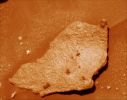
SOL1113-2P225171890EFFASNUP2560L2M1-01.jpgLook who's there... - Sol 1113 (Old Martian Colors/elab. Lunexit)58 visiteMa guarda un pò "chi" - o forse sarebbe meglio dire "che cosa" - si rivede!
La sensazione che la pseudo-roccia da noi già evidenziata qualche giorno fa potesse avere degli oggettivi motivi di interesse c'era ed era palese, ma che anche la NASA si interessasse a questo rilievo al punto da avvicinarsi e riprenderlo così bene...no, non lo credevamo proprio possibile.
Di che si tratta? Secondo noi si potrebbe trattare di un "frammento" di qualcosa (un qualcosa di rotondeggiante e non molto resistente) e non di un semplice sasso dalla forma e tessitura bizzarre. La nostra ipotesi? Si tratta di un frammento di "Guscio Marziano" - e, per i più distratti, ricordiamo che i "Gusci Marziani" sono tutti quei rilievi superficiali che abbiamo battezzato, così sposando la definizione del Dr Alessio Feltri, come "pseudo-rocce".
Si tratta, insomma, di "simil-pietre" le quali, atipiche per forma e tessitura (ossìa per fattezze e composizione), potrebbero rappresentare sia un residuo fossile di antiche forme Vitali le quali vivevano "attaccate" alla superficie delle pietre stesse (come, ad esempio, i "Martian Berries"), sia delle forme vitali indigene vere e proprie (in sè, nella loro completezza e totalità) ed aventi una Natura Bio-Magnetica.
Qualcosa di "alieno" per definizione, insomma.
Ma non restate sorpresi nè delusi se la NASA stessa ci dirà (prima o poi) che quello che stiamo guardando era, in realtà:
1) solo il frammento di un bolide caduto nei pressi;
2) solo la scheggia di una roccia vulcanica andata in frantumi;
3) niente di strano e, comunque, nulla che meritasse attenzioni o commenti "ad hoc".
In fondo, a che cosa è più facile credere?!?...MareKromium
(6 voti)
|
|

Dione-PIA08839.jpgThe "fractured face" of Dione59 visiteCaption NASA:"The fractured terrain so distinctive to Dione curves away toward the South in this view, which looks down at the moon's Northern Hemisphere.
Lit terrain in this view is on the Saturn-Facing Hemisphere of Dione.
The image was taken in visible light with the Cassini spacecraft narrow-angle camera on Nov. 22, 2006 at a distance of approx. 943.000 Km (about 586.000 miles) from Dione and at a Sun-Dione-spacecraft, or phase, angle of 109°.
Image scale is roughly 6 Km (a little less than 4 miles) per pixel".MareKromium
(6 voti)
|
|

Elysium_Planitia-Tra_000867_1875_red-00.jpgElysium Planitia (CTX Frame - False Colors)60 visiteA low, sinuous tectonic ridge ("wrinkle ridge") can be seen in the South-East (lower left) and a rough-textured flow (lava?) fills the North-West (upper right) part of the image. Terraces that may have been carved by floodwaters are visible on the Southeastern side of the contact between the wrinkle ridge and the flow.
On the Northwestern side of this contact, the flow itself has a banded appearance reminiscent of contour lines or bathtub rings. It may be that long ago, when the flow was mobile, its surface level dropped, leaving these bands as indicators of how high it once stood. Alternatively, the bands could be buried terraces draped by the rough-textured flow. Relatively straight and narrow dunes (about 10 mt wide) have marched across the surface of the flow, and a thin layer of light-toned dust blankets the region. A dark spot about 100 mt in diameter on the left side of the image is probably where a cluster of small impacts blew away the dust, revealing the darker shade of the underlying surface.MareKromium
(6 voti)
|
|

Apollo 11 Landing Site from Clem.jpg211-0 - The Apollo 11 "Landing Site"59 visitenessun commento
(6 voti)
|
|

FarSideAlbedo.jpg006 - Farside Albedo62 visiteGlobal map of the albedo from the 750-nanometer filter of the Clementine UV-VIS camera and this is the FarSide of the Moon, shown in Lambert equal-area projection.
Note the lack of maria on the FarSide, as compared to the NearSide.
The relatively dark area at center-bottom outlines the extent of the South Pole-Aitken Basin. This view has been subsampled to a resolution of about 1 Km per pixel, about 5 times lower than the full-resolution data.
(6 voti)
|
|

Daphnis-PIA07809-2.jpgDaphnis and Keeler (detail mgnf)116 visitenessun commento
(6 voti)
|
|

Saturn-W00011753.jpgSaturn's limb60 visiteOriginal caption:"W00011753.jpg was taken on October 30, 2005 and received on Earth October 30, 2005. The camera was pointing toward SATURN at approximately 345.545 Km away, and the image was taken using the CL1 and BL1 filters. This image has not been validated or calibrated".
(6 voti)
|
|

Hyperion-N00040323.jpgHyperion (12)59 visiteSono "solo" 18.000 i Km che dividono Cassini da Hyperion e diverse altre migliaia saranno coperte in poco tempo.
In questo frame c'è poco da aggiungere: il cratere più grande che si vede nell'immagine presenta, sul suo fondo e su parte della parete di Nord-Ovest, la "macchia scura" di cui si è già detto e che pare costituire una fenomenologia ricorrente per Hyperion.
(6 voti)
|
|

Mimas-Thunderbolts.jpgThese "Holes" are way too big for such a small Moon...59 visite"The impact theory of crater formation may not survive the discovery of gigantic craters on relatively small moons or rocks. A good case in point is Saturn’s moon Mimas. Electric Universe proponents say that only electric discharge could produce the observed depression without shattering the moon". Il che significa, in altre e più semplici parole, che la Teoria Shoemakeriana che vuole il 99,99% dei crateri che vediamo sui vari corpi celesti quali mere conseguenze di impatti, alla fine, NON REGGE!
Dopo le teorizzazioni del Dr Feltri e le speculazioni di Lunar Explorer, ora ci accorgiamo che anche ALTRI Ricercatori hanno iniziato a valutare nuovi dati ed elementi per la costruzione di una Teoria Alternativa a quella del (comunque) insigne Shoemaker.
E' possibile che tutti questi "Studi Alternativi" stiano concretando, in una certa misura, l'alba di un periodo di transizione scientifica la cui portata e durata, tuttavia, non sono ancora - ad oggi - stimabili.
(6 voti)
|
|

ZZ-ZZ-ZZ-Squared Structure-01.jpgA 'Squared Lunar Structure' means a 'Squared Cancellation'...262 visiteAncora un ringraziamento ed un complimento all'Amico Paolo Bertoni il quale ci segnala questa nuova Singolarità Lunare, derivata dal mega-planisfero messo a disposizione dal Naval Research Lab. (impostare i seguenti dati per le Vostre verifiche: lat.lun. 0 long.lun. 316; 1Km=1px; formato 768x768). Che cosa dire? Un'evidente 'abrasione/piallatura' di forma perfettamente rettangolare domina nella parte centrale del frame, poco oltre le ore 3. Il Sig. Bertoni si domanda se possa trattarsi di una Struttura Lunare 'censurata'. All'interno di Lunar Explorer, a dire il vero, ci sono almeno 3 - maggiori - correnti di pensiero:
1) le abrasioni sono effettivamente dirette a nascondere delle 'Strutture Lunari' di origine Artificiale (in accordo a quello che dice il Prof. Hoagland, insomma);
2) le Strutture Lunari 'censurate' NON sono affatto artificiali, ma restano 'pericolose' e quindi, in ogni caso, devono essere censurate;
3) le abrasioni servono a distogliere l'attenzione dai VERI 'hot-spots'.
(6 voti)
|
|

ZL-Viking2-Rocks.2jpg.jpgHorizon (4)167 visiteIl "ventifact" - un bellissimo neologismo 'made in NASA' creato per indicare le rocce che acquisiscono fattezze tali da renderle simili a manufatti grazie all'azione del vento - che viene indicato nel frame precedente è, a nostro parere, lo stesso 'oggetto' che il Gruppo Italiano "Eredità Cydonia" ha chiamato "The Hat" (e cioè il 'cappello'). Provate a verificare Voi stessi: dovete guardare il secondo frame Eredità Cydonia che abbiamo pubblicato nella Sezione "Mars and His Moons".
Per Vostra informazione, questi frames non li abbiamo rintracciati dentro Archivi NASA 'segreti' (come invece raccontano di aver fatto i signori di Eredità Cydonia), bensì nel Sito "SP-425 - The Martian Landscape" by the Viking Lander Imaging Team.
Ogni ulteriore commento è veramente superfluo.
(6 voti)
|
|

Tempel 1-PIA07879.jpgComet "Tempel 1"59 visiteCaption NASA originale:"Sixty-nine days before it gets up-close-and-personal with a comet, NASA's Deep Impact spacecraft successfully photographed its quarry, comet Tempel 1, at a distance of 39,7 MMs. The image, taken on April 25, 2005, is the first of many comet portraits Deep Impact will take leading up to its historic comet encounter on July 4, 2005".
(6 voti)
|
|
| 25332 immagini su 2111 pagina(e) |
 |
|
|
|
|
1987 | |
|
|
|
|





