| Piú votate |

OPP-SOL1167-B_P2419_L257F-2.jpgVictoria's Rim: Cape St Vincent - Sol 1167 (Natural Colors; credits: Dr G. Barca)58 visitenessun commentoMareKromium
(6 voti)
|
|

PSP_001367_1620_RED_abrowse.jpgGratteri Crater (Natural Colors; credits: Lunexit)58 visitenessun commentoMareKromium
(6 voti)
|
|

ZZ-Mercury-Terminator-PIA12045.jpgMercurian Terminator (Natural Colors; credits: Lunar Explorer Italia)57 visiteThis high-resolution NAC image shows a view of Mercury's Dawn Terminator, the division between the sunlit dayside and dark nightside of the planet, as seen as the MESSENGER Spacecraft departed the Planet during the mission's second Mercury flyby.
This frame is just one of 195 images that make up the second NAC mosaic obtained following closest approach (see PIA11767). A mosaic is a series of images that form a larger picture, in this case a high-resolution view of a portion of Mercury's Northern Hemisphere. This image is also just one of the 1287 total images acquired during Mercury flyby 2.
Last week, all of the images (as well as data from MESSENGER's other instruments) collected during Mercury flyby 2 were made publicly available on NASA's Planetary Data System (PDS) website, giving scientists around the world access to this exciting new dataset.
Date Acquired: January 14, 2008
Image Mission Elapsed Time (MET): 108829034
Instrument: Narrow Angle Camera (NAC) of the Mercury Dual Imaging System (MDIS)
Resolution: 590 meters/pixel (0,37 miles)
Scale: Moody is approx. 80 Km (about 50 miles) in diameter
Spacecraft Altitude: about 23.100 Km (approx. 14.300 miles)MareKromium
(6 voti)
|
|
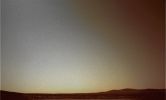
SOL091-2N134433361ESF2600P1556L0M1.jpgGusev Skyline - Sol 91 (possible True Colors; credits: Lunar Explorer Italia)57 visiteLeft Navigation Camera Non-linearized Sub-frame EDR acquired on Sol 91 of Spirit's mission to Gusev Crater at approximately 09:29:22 Mars Local Solar Time.MareKromium
(6 voti)
|
|
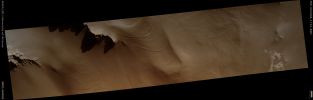
Psp_009408_1715_red.jpgShadowland (possible True Colors; credits: Lunar Explorer Italia)59 visiteMars Local Time: 15:31 (middle afternoon)
Coord. (centered): 8,3° South Lat. and 266,4° East Long.
Spacecraft altitude: 263,4 Km (such as about 164,6 miles)
Original image scale range: 52,7 cm/pixel (with 1 x 1 binning) so objects ~1,58 mt across are resolved
Map projected scale: 50 cm/pixel
Map projection: EQUIRECTANGULAR
Emission Angle: 10,5°
Phase Angle: 53,3°
Solar Incidence Angle: 61° (meaning that the Sun is about 29° above the Local Horizon)
Solar Longitude: 105,3° (Northern Summer)
Credits: NASA/JPL/University of Arizona
Additional process. and coloring: Lunar Explorer ItaliaMareKromium
(6 voti)
|
|

OPP-SOL372-3~0.jpgDeep-down in the trench... - Sol 372 (possible true-colors - version 2; credits: Dr G. Barca)58 visitenessun commentoMareKromium
(6 voti)
|
|

SOU-SOL013-Sunset-NASA.gifSunset over Ares Vallis - Sol 13 (GIF-Movie - False Colors; credits: NASA)67 visiteCaption NASA:"Animation of the Martian Sunset.
This movie is made from 9 images of the twilight following Sunset over Ares Vallis. The images are enhanced in order to show the very subtle features in the haze, which are probably caused by layers that are slightly dustier than the surrounding air. The color is not the true color of the sunset - that is shown in other images.
At the beginning, the Sun is on the horizon just to the right of the frame, and it sinks during the next hour. At the time of the last image the sky is only 1% as bright as at the beginning, but the IMP can easily adapt to the darkness and return these pictures. Because there is so much dust extending high into the Martian Sky, the Sky stays bright for more than an hour after sunset".MareKromium
(6 voti)
|
|
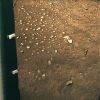
PHOE-SOL004-lg_955-956-958-2.jpgJust Small Rocks and Pebbles - Sol 4 (Superdefinition + MULTISPECTRUM; credits: Dr G. Barca & Lunexit)58 visitenessun commentoMareKromium
(6 voti)
|
|
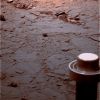
SOL1355-2P246653463EDNAVQWP2290L6M1-1.jpgAntenna Mast, Soil and "Sparkling Pebbles" - Sol 1355 (possible natural colors; elab. Lunexit)60 visiteInterpretazioni diverse, ma simili; entrambe razionali ed entrambe idonee a farci capire che "qualcosa" è successo, molto di recente, nei pressi di Spirit (quadrante in alto a Sx dell'Osservatore).
Le elaborazioni di Lunexit e del Dr Marco Faccin, come detto, sono MOLTO simili, a dispetto del fatto che sono state ottenute impiegando procedimenti sostanzialmente differenti.
Ora ci farebbe piacere vedere una elaborazione NASA del medesimo dettaglio ma...Forse è chiedere troppo.
Comunque sia, una cosa la si può dire senza timore di essere banali e/o scontati: se le logiche adottate per la trasformazione di un frame in b/n in un frame a colori sono simili (o, quanto meno, affini), lo strumento che permette la colorizzazione non è poi l'elemento decisivo ed i risultati finali restano comunque coerenti (pur nella loro - piccola - diversità).
Ora attendiamo i Vostri commenti e le Vostre valutazioni!MareKromium
(6 voti)
|
|
OPP-SOL1329-1P246170461ESF8754P2585L3M1.jpgThe "Inner Paving" and the "Red Sands" of Victoria - Sol 1329 (red-orange filter ON - possible natural colors - elab. Lunexit)58 visitenessun commentoMareKromium
(6 voti)
|
|

Japetus-N00091967.jpgMountains and Craters of Japetus (proximities of the Transition Zone - possible natural colors; elab. Lunexit)56 visiteCaption NASA:"N00091967.jpg was taken on September 10, 2007 and received on Earth September 11, 2007. The camera was pointing toward Japetus that, at the time, was approx. 2424 Km away, and the image was taken using the CL1 and CL2 filters. This image has not been validated or calibrated".MareKromium
(6 voti)
|
|

ZZ-ColorMars-09-KL-V01511013color.jpgMars from Orbit, as a "Human" would see it...by Keith Laney (3)59 visitenessun commentoMareKromium
(6 voti)
|
|
| 25332 immagini su 2111 pagina(e) |
 |
|
|
|
|
1986 | |
|
|
|
|





