| Piú votate |

OPP-SOL108-1NN108EFF23CYL00P1981L000M1-B110R1-00.jpgEarly morning on Mars (after a sand storm)57 visiteInterpretazione di fantasia sul come dovrebbe apparire Marte (Regione di Meridiani Planum, prossimità del Cratere Endurance) nelle prime luci dell'alba e subito dopo la fine di una tempesta di polveri.MareKromium
(7 voti)
|
|

QA-VikingLS-3.jpgViking One: the Landing Site - First Color Picture (now)117 visiteCaption originale:"Later printings of Mars surface images by various publications wandered widely in color, with garish versions like this frequently appearing".
Nota: con questi tre frames riallineati sequenzialmente, Don Davis ha compiuto - crediamo inconsciamente, dato che i suoi Lavori sono un quasi costante tributo alla NASA - un lavoro davvero egregio. Questa sequenza ha infatti dimostrato, diremmo in maniera davvero inequivocabile, che la NASA, sulla problematica dei colori di Marte (o, in generale, dei "colori dello e nello Spazio"), non è stata nè attenta, nè corretta.
La posizione NASA, in ordine a questa tematica, può oscillare solo fra due posizioni: incompetenza o mala fede.
E non sappiamo davvero quale preferire...
(7 voti)
|
|

SOL721.jpgMartian "salts" - Sol 72158 visite(...) Spirit discovered this material while driving toward Home Plate, along the floor of the basin south of Husband Hill in Gusev Crater.
These images from Spirit's Pan-Cam show some of the most colorful deposits yet photographed on the surface of Mars. Spirit uncovered several types of materials distinctive in their color, physical properties and chemistry as a result of accidentally digging a trench 30 cm (about 11,8") wide during a turn at the end of a drive. The white material in this image is brighter than any seen previously by the Rover. It has a powdery and cloddy texture and exhibits a high abundance of salts. The materials appear similar in some ways to bright soil deposits seen back at the Paso Robles site that Spirit encountered on the Sol 431 (March 20, 2005) while climbing the northern flank of Husband Hill.
Spirit analyzed the bright, yellowish exposures in the lower left part of the frame using instruments on the Rover's RA. Scientists hypothesized and then confirmed that these materials have a salty chemistry dominated by iron-bearing sulfates. These salts may record the past presence of water, as they are most easily mobilized and concentrated in liquid solution. Spirit also examined the unusual, pitted rock about 10 centimeters (4 inches) wide in the lower center of the frame. Scientists continue to study the origin of these rocks and soils and the role that water has played in their formation.
This view is an approximately true-color composite combining images taken with the Pancam's 600-nanometer, 530-nanometer and 480-nanometer filters on Jan. 12, 2006, the rover's 721st sol on Mars.
(7 voti)
|
|

Jupiter-PIA02865-4.jpgA "deep look" in the "deep clouds" of Jupiter62 visiteFinally, this is the combination of the 3 images taken from Cassini using the 3 different filters.
This picture reveals cloud structures and movements at different depths in the atmosphere around Jupiter's South Pole. Cassini's cameras come equipped with filters that sample 3 wavelengths where Methane gas absorbs light. These are in the RED (619 nnmts) and in the NEAR-INFRARED (at 727 and 890 nnmts). Absorption in the 619 nnmts filter is weak. It is stronger in the 727 nnmts band and very strong in the 890 nnmts band where 90% of the light is absorbed by Methane gas.
Light in the weakest band can penetrate the deepest into Jupiter's atmosphere. It is sensitive to the amount of cloud and haze down to the pressure of the water cloud (which lies at a depth where pressure is about 6 times the atmospheric pressure at sea level on the Earth).
Light in the strongest methane band is absorbed at high altitude and is sensitive only to Ammonia cloud level and higher (with pressures less than about one-half of Earth's atmospheric pressure) and the middle methane band is sensitive to the ammonia and ammonium hydrosulfide cloud layers as deep as two times Earth's atmospheric pressure.
(7 voti)
|
|

U-APOLLO 13 AS 13 59-8500 MR.jpgThe "Odyssey": what happened to it? (3)315 visiteIn questo caso, nonostante quanto il Dr Lovell racconti nel suo bel libro "Lost Moon" (in Italia:"Apollo 13", di Jim Lovell e Jeffrey Kluger - Sperling&Kupfer Editori), ciò che ci viene da dire, sulla base delle immagini che possediamo e dell'esperienza che ci siamo fatti, è solo questo: forse il CSM Odyssey non esplose del tutto quando il "problema" occorse, perchè il "problema" non era "interno".
Forse il CSM Odyssey, durante la sua crociera trans-lunare, "urtò contro qualcosa" o, se volete, "qualcosa urtò/colpì" il CSM Odyssey, ferendolo, ma in maniera non letale. Lo stesso "qualcosa" che poi ha, come tanti frames sembrano lasciar intendere, "seguito" l'Apollo 13 sino al ritorno a casa, quasi "vegliando" affinchè la situazione, da grave e drammatica che era, non diventasse FATALMENTE irrecuperabile.
Siamo alla fantascienza da "B-movie"? Forse si. Ma Voi, Amici Lettori, immagini alla mano (e dato che conoscete bene la "trasparenza" della NASA...), avete qualche teoria migliore da proporre?...
(7 voti)
|
|

ZM-The Moons of Pluto.jpgNew "moons" for Pluto? Early news60 visiteThe leading theory for the formation of Charon involves a large object striking Pluto. The debris from that collision could have formed the two smaller moons, Weaver speculates. It can't be ruled out that they might have been captured into the System, but that seems very unlikely, he said. The two new moons are between 30/40 and 100/125 miles (48/64 to 160/200 Km) in diameter. There is not enough data to pin their size down exactly, however. The moons were found using the HST.
The moons are catalogued as S/2005 P1 and S/2005 P2 for now.
Once they are confirmed, the discoverers will suggest names, to be approved by the IAU (International Astronomical Union).
(7 voti)
|
|
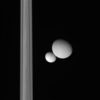
Tethys-N00039923.jpgTethys, Dione anf the Rings60 visiteN00039923.jpg was taken on September 22, 2005 and received on Earth September 23, 2005. The camera was pointing toward TETHYS and Dione at approximately 1.495.033 Km away and the image was taken using the CL1 and CL2 filters.
(7 voti)
|
|
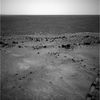
SOL574-2N177319704EFFADDVP1775L0M1.jpgPanorama and distant mountains (2) - Sol 57456 visiteQuesta immagine, al pari della precedente e della prossima, dimostra come la NavCam di Spirit - quando vuole... - funzioni benissimo e sia in grado di mostrarci splendide riprese in campo lungo spettacolarmente nitide e definite.
Ma come mai quando il Rover va a riprendere delle pietre poste a 15/20 metri di distanza dalle sue camere tutto diventa confuso ed annebbiato?
Nota: basta un mini-ingrandimento di questo frame per vedere quanto la qualità dell'immagine sia eccellente e poi fare un confronto, per esempio, con il frame che abbiamo intitolato "Leaning Boulder" per rendersi conto della ENORME (ed inspiegabile) differenza.
(7 voti)
|
|

Rhea-N00032541.jpgRhea, from approx. 242.000 Km (1)60 visiteTre frames sequenziali che ci mostrano la superficie di Rhea con grande chiarezza ed un eccellente livello di definizione.
Vi suggeriamo di focalizzare la Vostra attenzione sui crateri che si stagliano propria lungo la linea del terminatore: come noterete, solo uno di essi - piuttosto grande, "incrociato" con un altro più piccolo e (riteniamo) più antico, visibile all'altezza dell'equatore apparente di Rhea - ci mostra un picco centrale il quale, però, sembra diventare più piccolo e meno luminoso durante quei 429 Km di viaggio che accorciano la distanza Rhea/Cassini fra il primo ed il terzo frame della serie. Si tratta, naturalmente, di un effetto visivo che deriva dal movimento della luna Saturniana intorno al proprio asse - rotazione dalla quale deriva un leggerissimo spostamento della linea del terminatore e degli oggetti che si trovano su di essa - durante l'intervallo di tempo che separa il primo dal terzo frame.
Giudicate Voi stessi..
(7 voti)
|
|

North_Polar_Region-The_Erg-PIA07820-00.jpgFeatures of the North Polar Erg (Original NASA/JPL/ASU b/w Frame)58 visiteCaption NASA:"Sand Seas on Earth are often called "Ergs", an Arabic name for Dunefield, but a Sand Sea DIFFERS from a Dunefield in - at least - two ways:
1) a Sand Sea has a LARGE regional extent and
2) the individual Dunes forming the Sand Sea are LARGE in size and complex in form.
This VIS image was taken at 82° North Latitude during Northern Spring. The Dunes are still partially frost covered. This Region is part of the North Polar Sand Sea: so note the complexity and regional coverage of the Dunes".
Image information: VIS instrument;
Latitude: 81,2° North;
Longitude: 118,2° East (such as 241,8° West);
Resolution: 19 meter/pixel.
(7 voti)
|
|

Phobos-00-HR-117-051004-6xSRC-6-col-01-Phobos.jpgDifferent views of Phobos (Original NASA/MGS/MSSS b/w Frames)79 visiteUna serie di immagini ottenute dalla Sonda ESA "Mars Express" le quali ci fanno gradualmente "avvicinare" a Phobos ed alla sua affascinante (ed in parte assolutamente inspiegabile) superficie. Molto ben visibile, in tutti i sub-frames, la più grande e conosciuta caratteristica superficiale di Phobos: lo Stickney Crater.
(7 voti)
|
|

Japetus-A-W-Deathstar-Comp2.jpgIs this Japetus?!?70 visiteE Voi? E noi? Forse sposare il CICAP (tanto per citare una fonte di pensiero razionale e tralasciando le "simpatie" o le "antipatie" che i suoi membri possono suscitare) è un errore, così come può essere un errore sposare "The Enterprise Mission" del Prof. Hoagland. Perchè? Perchè non ricordiamo di aver MAI sentito dire, nè agli uni, nè all'altro, una frase del tipo "NON SO CHE COSA DIRE"! Mai un dubbio, mai un'indecisione: costoro hanno solo e sempre certezze. Beati loro! Noi, invece, di certezze ne abbiamo davvero poche. Forse solo una, ad oggi, ed è quella che rende Voi, Liberi Pensatori, e noi, Liberi Ricercatori, un genus a parte. E non si tratta neppure di una certezza, ma solo della consapevolezza che, nella Vita come nell'Universo, non c'è davvero nulla di certo...
"Nemo potest omnia scire" (Varrone)
(7 voti)
|
|
| 25332 immagini su 2111 pagina(e) |
 |
|
|
|
|
1980 | |
|
|
|
|





