| Piú votate |

RCW49 Nebula-SST-PIA05989_modest.jpgRCW 49 Nebula - SST70 visite"...Il Cielo muta, di continuo, e noi non ce ne accorgiamo: ma questo fa parte della sua magia e, in un certo senso, del suo "tempo". Il nostro "tempo" è scandito dalle ore, dai giorni e dagli anni: esso è scandito da tutto ciò che percepiamo e che cambia, visibilmente, davanti ai nostri occhi. Il "tempo" del Cielo, invece, è scandito dalla nascita e morte delle stelle e dalla rotazione delle galassie, intorno ai propri assi. Tutto pare immobile ed immutabile eppure tutto si muove e, muovendosi, cambia..."
P.C. Floegers - "In the Paradox"
(16 voti)
|
|

SOU-SOL016-PIA00784.jpgPre-Dawn Clouds on Mars - Sol 16 (True Colors; credits: NASA/JPL)179 visiteCaption NASA:"Pink Stratus Clouds are coming from the North/East at about 15 miles per hour (6,7 meters/second) at an approximate height of 10 miles (about 16 Km) above the Surface. The clouds consist of water ice condensed on reddish dust particles suspended in the Atmosphere. Clouds on Mars are sometimes localized and can sometimes cover entire Regions, but have not yet been observed to cover the entire Planet. The image was taken by the Imager for Mars Pathfinder (IMP) on Sol 16 about forty minutes before Sunrise showing areas of the Eastern Martian Local Horizon".
(16 voti)
|
|

Hyperion-PIA14583-PCF-LXTT.jpgHyperion (Absolute Natural Colors; credits for the additional process. and color.: Dr Paolo C. Fienga - Lunexit Team)216 visiteCaption NASA:The Cassini Spacecraft looks at Saturn's highly irregular moon Hyperion in this view taken from the Spacecraft's during the Fly-By that occurred on August, 25th, 2011. Hyperion (approx. 168 miles, or about 270 Km across) has an irregular shape, and it tumbles through its orbit: that is, it does not spin at a constant rate or in a constant orientation. (A standard reference latitude-longitude system has not yet been devised for this moon)
Images such as this one extend previous coverage and allow a better inventory of the Surface Features, the satellite's shape and changes in its spin.
The image was taken with the Cassini Spacecraft narrow-angle camera using a combination of spectral filters sensitive to wavelengths of Polarized Green Light centered at 617 and 568 nanometers. The view was obtained at a distance of approx. 36.000 miles (such as about 58.000 Km) from Hyperion and at a Phase Angle of 43° degrees. Image scale is 1145 feet (349 meters) per pixel".
MareKromium
(8 voti)
|
|

OPP-SOL346-2.jpgThe "Martian Meteorite" - Sol 346 (true-colors; credits: Dr G. Barca)57 visitenessun commentoMareKromium
(8 voti)
|
|

OPP-SOL1073-1P223439715EFF78W4P2360R2M1.jpgWhat if... - Sol 1073 (by Dr Paolo C. Fienga)124 visiteFantasia cromatica, con distese di muschi color lilla sulla pianura di Meridiani.
(8 voti)
|
|
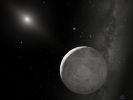
Xena.jpgXena: another "Tenth Planet"? (2003 UB313)61 visiteNASA's Hubble Space Telescope has resolved the Tenth Planet, now nicknamed Xena, for the first time and has found that it is only just a little larger than Pluto.
Though previous ground-based observations suggested that Xena was about 30% greater in diameter than Pluto, Hubble observations taken on Dec. 9 and 10, 2005, yield a diameter of 1.490 miles (with an uncertainty of 60 miles) for Xena. Pluto's diameter, as measured by Hubble, is 1.422 miles. Xena is the large object at the bottom of this artist's concept. A portion of its surface is lit by the Sun, located in the upper left corner of the image. Xena's companion, Gabrielle, is located just above and to the left of Xena.
(8 voti)
|
|

ZZ-ZZ-ZZ-ZZ-ZZ-ZZ-ZZ-MFAGONE006.jpgThe "True Colors" of Mars (6)517 visiteGrazie alle migliori tecnologie impiegate nella realizzazione delle telecamere di bordo, ora apparivano tonalità più vive. Il suolo era, sì, ancora sul rosso, ma un rosso diverso; ora si vedevano anche terreni bruno-giallastri, massi chiari e, in aggiunta naturalmente alle classiche foto dai colori rossicci, emergevano particolari nuovi, diversi forse dalle aspettative.
E poi il cielo: esso non era più soltanto rosso, ma rosa, giallastro, marroncino, rosato con parvenza di azzurro....Insomma la missione Pathfinder fu nel complesso un vero successo!
Un successo tale che Marte si trasformò quasi in un personaggio da carnevale, vestito di mille colori e dalle ambigue fattezze. Sarebbe interessante poter interrogare un chimico, un geologo e un meteorologo mostrandogli qualche frame a colori (e in b/n) e quindi domandargli "quale sommaria idea potrebbero offrire queste tipologie di immagini", "che valore scientifico racchiudono" e "in che modo questi variopinti paesaggi migliorano la comprensione del pianeta".
Probabilmente la risposta non è difficile da intuire.
(8 voti)
|
|

ORIGINAL NASA APOLLO 13 - AS13-61-8830.jpg edited.jpgAPOLLO 13 AS 13-61-8830 - A reflection or an Alien Spaceship?2204 visiteCi vuole qualcosa di più e quel di più è stato ed è, da un lato, il totale disinteresse dei maggiori mezzi di comunicazione di massa e, dall'altro, l'enorme (eccessiva!) attività di informazione/disinformazione che è stata posta in essere da Ricercatori Indipendenti e Gruppi di Studio e di Ricerca Pubblici e Privati.
Cosa intendiamo dire? Sulle Missioni Apollo, la Luna, le Anomalie etc. se ne sono dette talmente tante - e, fra le cose dette, ci sono anche delle stupidaggini a dir poco colossali! - che, alla fine, ogni Ricercatore onesto e competente che si trova a dover esprimere un'opinione (magari pure autorevole), non viene visto come elemento chiarificatore, bensì come elemento portatore di altro caos.
Il risultato? La sua opinione si perde nel nulla, fra le centinaia di migliaia di altre opinioni (alcune oneste e sensate, altre del tutto assurde e ridicole), e la Ricerca NON avanza. Se volete, su questo argomento, c'è un piccolo articolo riportato nella Sezione "TruePlanets" (Unreliable Teachers).
(117 voti)
|
|

Gliese 436-Extrasolar Planet.jpgA new planet orbiting "Gliese 436"163 visiteA 30 Anni Luce di distanza da noi, nella Costellazione del Leone, si trova questa piccola stella (di dimensioni pari a circa 4/10mi del nostro Sole) chiamata Gliese 436; a circa 4.100.000 Km da essa, orbita un pianeta di massa simile a quella di Nettuno. Non sappiamo ancora nulla di questo oggetto, ma una cosa l'abbiamo (probabilmente) capita: la Terra è tutt'altro che un fenomeno raro (o unico) dell'Universo. Siamo solo una particella di un organismo infinito. Che sia giunta la fine dell'antropocentrismo?
(23 voti)
|
|

HR 4796 a.jpgHR 4796a70 visite"...J'ai la chance d'avoir deux Pays,
Je suis un peu d'içi, un peu de là-bas...
Pourtant, j'ai toujours une valise prete
Dans mon ame...
Hésitante, entre les deux, son coeur balance...
Ballotté entre mes deux reves,
Je deviens le jouet fragile des flots...
J'ai de la chance. J'ai deux Pays...
Et une valise qui ne se posera, peut-etre, jamais..."
(Idir & Geoffrey Oryema - "Exil")
(15 voti)
|
|

Asteroids-Annefrank_Asteroid-PIA02885_modest.jpgAsteroid Annefrank from Stardust69 visiteAsteroid Annefrank is seen as irregularly shaped, cratered body in an image taken by NASA's Stardust spacecraft during a Nov. 2 flyby of the asteroid.
Stardust flew within about 3.300 Km (about 2.050 miles) of the asteroid as a rehearsal for the spacecraft's encounter with its primary target, comet Wild 2, in January 2004. The camera's resolution was sufficient to show that Annefrank is about 8 Km (5 miles) in length, twice the predicted size from Earth-based observations. The surface reflects about 0,1 to 0,2% of sunlight, slightly less than anticipated. A few craters that are hundreds of meters across can be seen. The straight edge in the right side of the image may be an artifact of processing.
(15 voti)
|
|

HD 100546_ctio.jpgStar HD 100546119 visiteQuando un oggetto è lanciato dalla Terra verso la Luna subisce, durante il suo percorso, un'attrazione decrescente da parte della Terra e crescente da parte della Luna. Conoscendo la massa di entrambi i Corpi (il cui rapporto è di circa 81 a 1) e dato che l'attrazione è inversamente proporzionale alla distanza, si deduce che in un punto situato 9 volte più vicino alla Luna che alla Terra i due Corpi esercitano sull'oggetto forze eguali e contrarie. A che distanza si trova questo punto (detto Punto Neutro)?
(15 voti)
|
|
| 25332 immagini su 2111 pagina(e) |
 |
|
|
|
|
1977 | |
|
|
|
|





