| Piú votate |

Hyperion-N00035398.jpgHyperion, from about 202.000 Km (3)58 visiteE' davvero semplice 'caos' quell'estrema complessità che caratterizza il moto di Iperione, così come la struttura di alcuni lontanissimi 'oggetti' di origine forse stellare (quali i Buchi Neri, i Quasar ed i Pulsar etc.), oppure anche questi 'movimenti' e queste 'strutture', così lontane dal nostro pensare e sapere, obbediscono a delle Logiche Maggiori che, oggi, non riusciamo neppure ad immaginare?
Questa piccola diversione filosofica non è, a nostro modo di vedere, un inutile esercizio dialettico: noi siamo sempre più convinti, infatti, che la disarmante 'semplicità' con cui la Scienza Consolidata cerca di spiegare alcuni fenomeni, unita all'estrema - ed inutile - complessità con cui Essa cerca di spiegarne altri, sìano entrambe espressioni di un notevole imbarazzo di fondo il quale si manifesta davanti ad una realtà piuttosto evidente.
Quale? La realtà che l'Universo è ancora molto lontano non solo dall'essere compreso nei suoi meccanismi quanto, addirittura, dall'essere anche solo immaginato...
(8 voti)
|
|

Claritas_Fossae-4-096-140904-0508-6-co-01-ClaritasFossae_hires.jpgClaritas Fossae (4 - ESA/ DLR/ FU Berlin - G. Neukum)60 visiteCaption ESA originale:"The lava blankets of the Solis Planum area cover the eastern parts of the older Claritas Fossae ridge and surround some of the higher ground. The geological history of this region can be reconstructed by analysing the layers of tectonic grabens, impact craters, volcanic features and even small valley networks. The complexity of Claritas Fossae Region suggests that some of the events took place at the same time. Furthermore, the detailed view of the large southern impact crater shows patches of dark material which are located near the central and marginal parts of the impact crater floor. This material may be of volcanic origin".
(8 voti)
|
|

Claritas_Fossae-3-096-140904-0508-6-co-01-ClaritasFossae_hires.jpgClaritas Fossae (3 - ESA/ DLR/ FU Berlin - G. Neukum)65 visiteCaption ESA originale:"The displayed region is the eastern part of Claritas Fossae and the western part of Solis Planum at longitude 260° East and latitude of about 28° South.
The diffuse blue-white streaks in the northern parts of the scene (Sx di chi guarda) are clouds or aerosols. The Claritas Fossae (‘fossa’ is Latin for trough----->canale) region is characterised by systems of ‘grabens’ running mainly north-west to south-east. These can be traced several hundred kilometres up to the northern Tharsis shield volcanoes.
A "graben" forms when a block of the planet’s crust drops down between 2 faults, due to extension, or pulling, of the crust. A ‘horst and graben’ system can occur where there are several parallel faults.
Geographically, the grabens separate the eastern volcanic plains of the Solis Planum region from the western Daedalia Planum lava plains.
(8 voti)
|
|

Image032-50-Plates3.jpgBlue Flares and the Invisible Crater: Panorama and Traverse Map184 visiteNella tavola ho sovrapposto il mosaico fotografico panoramico n. 12, la Tavola Esplicativa (T.E.) delle formazioni (rilievi) maggiori ed un dettaglio della Traverse Map.
Sorvolando sull’errore di nomenclatura che ha assegnato il n.741 a 2 crateri diversi (succede...), mi soffermerei sul Weird Crater e sul cratere secondario n. 1202.
Come si vede dalla T.E. il cratere 1202 apparirebbe in foto come una linea appena accennata, come si conviene per una buca di modesta entità. Il dubbio semmai viene sul perché l'astronauta del Terzo Frame (presumibilmente Mitchell) se ne stia bel bello sull’orlo della buca a guardare non si sa bene cosa, dato che di foto al riguardo non se ne sono mai viste, contrariamente a quanto verrà poi fatto col masso n.1204, battezzato “Weird Rock”. Ora, se ci basassimo solo su questa Tavola, tutto sarebbe coerente: Mitchell non ha fotografato nulla perché non c’era nulla da fotografare. Purtroppo ancora una volta dobbiamo invece assistere al gioco delle tre carte (di nome e di fatto).
(8 voti)
|
|

Tethys from Voyager2.jpgTethys, from Voyager 262 visiteCaption NASA originale:"Voyager 2 obtained this view of Saturn's moon Tethys on Aug.25 from a distance of 540.000 Km. It shows the numerous impact craters and fault valleys of a very ancient surface. Tethys itself is 1.090 km. (approx. 675 mi) in diameter and the great chasm seen at the top of this image extends about 1.700 Km (approx. 1.050 mi) halfway across the satellite. The largest impact crater visible here is 90 Km (approx. 55 mi) in diameter".
(8 voti)
|
|
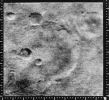
N-Mariner4-64-PIA02979.jpgMariner Crater from Mariner 4122 visiteCaption NASA originale:"Mariner 4 image of the crater named after it, the 151 Km diameter Mariner Crater at 35°S, 164°W. Running from the lower left corner of the frame through the bottom of the crater is a linear ridge which is part of Sirenum Fossae. The image was taken from 12.600 Km and covers 250 Km by 254 Km. North is up. (Mariner 4, frame 11E).
Mariner 4 was the first spacecraft to get a close look at Mars. Flying as close as 9.846 Km (6.118 miles), Mariner 4 revealed Mars to have a cratered, rust-colored surface, with signs on some parts of the planet that liquid water had once etched its way into the soil. Mariner 4 was launched on November 28, 1964 and arrived at Mars on July 14, 1965". Il commento NASA originale ed una semplice occhiata alle date della Missione dovrebbe esserci sufficiente per capire che la repentina interruzione dello "Human Space Program" deve aver avuto la sua reale ragione in motivi - a nostro avviso - diversi dai "budget cuts"...
(8 voti)
|
|

Europa-V1-PIA00016-0.jpgEuropa60 visite"TUTTI QUESTI MONDI VI APPARTENGONO, TRANNE EUROPA: NON TENTATE DI ATTERRARVI.
VIVETECI INSIEME.
VICETECI IN PACE".
Ricordate questa "famosissima" trasmissione (diretta alla Terra ed all'equipaggio dell'astronave Sovietica "Leonov") proveniente dall'astronave Americana "Discovery", in quel momento guidata dall'Elaboratore HAL 9000?
Naturalmente stiamo parlando di "2010 - Odissea 2", il prosieguo cinematografico dell'immortale capolavoro di Sir Stanley Kubrick "2001 - A Space Odyssey".
Europa: la culla di una Nuova Civiltà, da studiare "restando lontani", così da non contaminarla con la nostra arroganza e supponenza.
Due film da rivedere e, dopo aver visto queste immagini, su cui provare a meditare...
(8 voti)
|
|

Europa-fullcolor-PIA02590_modest.jpgEuropa in full colors68 visitenessun commento
(8 voti)
|
|

Copernicus Crater from HST.jpgCopernicus Crater - HST (detail mgnf)283 visiteE' evento raro che l'Hubble Space Telescope "guardi" verso la Luna: essa è un'oggetto troppo luminoso e una simile luminosità - si è detto - potrebbe danneggiare le delicatissime ottiche del telescopio spaziale.
Sarà anche vero, ma rimane il fatto che, di tanto in tanto, l'HST ci offre comunque qualche "visione" del nostro unico Satellite Naturale.
In questa, per esempio, viene ripreso il grande (e chiaramente visibile, anche ad occhio nudo, da Terra) Cratere Copernico.
(8 voti)
|
|
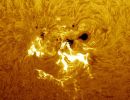
A-The Sun - sunspot_newton_big.jpgSunspots196 visitenessun commento
(8 voti)
|
|

NEPTUNE-Springtime.jpgSpring on Neptune from the Hubble Space Telescope89 visiteUna meravigliosa visione dell'Emisfero Sud di Nettuno e delle immense formazioni nuvolose bianche che sembrano essere la causa del suo notevole (e recente) aumento di luminosità.
L'Estate, anche per questo mondo lontano, si sta dunque avvicinando!
(8 voti)
|
|

Craters-Galle_Crater-Happy_Face_Crater-2003_05_15_M2300366.jpgGalle Crater (Natural Colors; credits: NASA/MGS/MSSS)90 visiteCaption NASA originale:"The 2 pictures shown here are taken from the same daily global image mosaic (the only difference is that each was processed slightly differently). The pictures show Galle Crater, informally known as "Happy Face," as it appeared in early Southern Winter. The white-ish gray surfaces are coated with wintertime carbon dioxide frost. The pattern of frost distribution gives the appearance that "Happy Face" has opened its mouth. Galle Crater is located on the east rim of Argyre Planitia at 51°S, 31°W. Sunlight illuminates the scene from the upper left. Galle Crater is about 230 Km (143 mi) across".
(16 voti)
|
|
| 25332 immagini su 2111 pagina(e) |
 |
|
|
|
|
1976 | |
|
|
|
|





