| Piú votate |

ORIGINAL NASA APOLLO 15 - AS15-98-13302.jpgAPOLLO 15 AS 15-98-13302 - The "LUN-EX-IT Cuspid"15232 visiteA proposito di questo splendido frame, ci siamo già lungamente intrattenuti nella Sezione dedicata all'Apollo 15 (prima) e poi allorchè Vi abbiamo raccontato per sommissimi capi la storia delle "Cuspidi di Blair", o "Lunar Spires". Che dire? Anche questo "picco" è, secondo noi, una "cuspide" e, sulla base delle informazioni raccolte (grazie anche alla collaborazione dell'Istituto di Scienze Planetarie), riteniamo che si tratti di un picco sensibilmente più alto della più alta delle Cuspidi di Blair. Nessuno, a quanto abbiamo visto, detto e scoperto, se ne è mai accorto prima di noi e quindi, così come ha fatto il Dr Blair con le sue "cime coniche", anche noi ci siamo sentiti autorizzati, in quanto "scopritori", a battezzarlo, dandogli il nome della nostra Associazione. Per Vostra curiosità, comunque, se guardate attentamente la base di questa asperità a forma di cono, potrete notare che c'è un'altra struttura, a forma di semicerchio, che sorge accanto ad essa e che fa coppia con la LUN-EX-IT Cuspid.
(146 voti)
|
|

ORIGINAL NASA APOLLO 12 - AS12-47-7020.jpg edited.jpgAPOLLO 12 AS 12-47-7020 - Star-like Objects all over the place1104 visite
(109 voti)
|
|
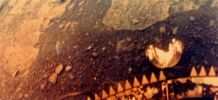
Venusian_Surface-Venera_13-04.jpgVenus from Venera 13 - March, 1, 1982 - color detail430 visiteAncora un'area vulcanica, dunque, dal colore giallastro.
Un probabile segnale della presenza di zolfo? Può darsi, ma può anche darsi che si tratti di un effetto di illuminazione causato dalla presenza, nei pressi della Sonda, di un'intensa sorgente luminosa di color giallo e rosso.
Come un camino vulcanico attivo, ad esempio, o un lago di lava. Entrambe le ipotesi, in difetto di elementi decisivi, sono valide ed accettabili.
(27 voti)
|
|

ZZ-ZZ-ZZ-ZZ-ZZ-ZZ-ZZ-ZZ-ZZ-ZZ-ZZ-ZZ-APOLLO 16 AS 16-116-18603 I-HR-1.jpgAS 16-116-18603 - The "Artifacts" (1)165 visitenessun (ulteriore) commento
(9 voti)
|
|

ZZ-SOL661.jpgEvolution of a Martian "Rock" (3) - Sol 661323 visiteIncredibile, non credete?!?
(9 voti)
|
|

SOL489-PIA07997.jpgSunset on Mars - Sol 48974 visiteOn May 19th, 2005, NASA's MER Spirit captured this stunning view as the Sun sank below the rim of Gusev Crater on Mars. This PanCam mosaic was taken around 18:07 MLT of the Rover's 489th Sol. Spirit was commanded to stay awake briefly after sending that Sol's data to the Mars Odyssey orbiter just before sunset. This small panorama of the western sky was obtained using PanCam's 750, 530 and 430-nnmts color filters. This filter combination allows false color images to be generated that are similar to what a human would see, but with the colors slightly exaggerated. In this image, the bluish glow in the sky above the Sun would be visible to us if we were there, but an artifact of the Pancam's infrared imaging capabilities is that with this filter combination the redness of the sky farther from the sunset is exaggerated compared to the daytime colors of the martian sky. Because Mars is farther from the Sun than the Earth is, the Sun appears only about two-thirds the size that it appears in a sunset seen from the Earth. The terrain in the foreground is the rock outcrop "Jibsheet", a feature that Spirit has been investigating for several weeks (rover tracks are dimly visible leading up to "Jibsheet"). The floor of Gusev crater is visible in the distance, and the Sun is setting behind the wall of Gusev some 80 km (50 miles) in the distance.
(9 voti)
|
|

M-042-94.jpgX-Ray Stars in the Orion Nebula88 visite"...La Fantascienza è l'archeologia del futuro..."
Clifton Fadiman - "Selected Writings" (1955)
(9 voti)
|
|

U-APOLLO 13 AS 13 59-8500 HR2.jpgAS 13-59-8500 - Farewell Odyssey! (HR)364 visiteIl CSM Odyssey, tremendamente danneggiato dall'esplosione che mise a repentaglio le vite dei tre Astronauti Americani si allontana dalla capsula che porterà Lowell & C. allo splash-down ed alla salvezza.
Un frame in b/n, leggermente sfuocato, ma che ci mostra con grande chiarezza i danni riportati dal Command Service Module Odyssey (e qualcuno alla NASA, guardando questa fotografia, ancora non riesce a capire come mai l'intero Apollo 13 non sia esploso...) e che entra, di diritto, nella "Storia per Immagini" degli Apollo Days.
(9 voti)
|
|

ZM-Viking2-Rocks.3jpg.jpgViking's unusual rocks (2)203 visiteAllora: stiamo guardando delle 'rovine' o dei 'ventifacts'? Voi che cosa ne pensate?
(9 voti)
|
|

ZE-I-Viking1-12h051-1.jpgFrom the "Viking Archive" - Viking 1: daylight171 visiteComposizione a colori dei Viking Lander 1 frames n. 12h051.red, 12h051.grn and 12h051.blu.
"Breve Storia della Conquista di Marte"
Era l'Estate del 1976 e, per i Planetologi (gli Esperti di Scienze Planetarie) si trattò, senza dubbi, di un'Estate indimenticabile: l'Estate del "soft landing" delle Sonde Viking 1 e 2, le prime 2 Sonde capaci di scendere dolcemente su Marte e quindi eseguire un grande numero di operazioni, trasmettendo i dati a Terra. Prima dei Viking (prodotti USA-NASA), però, anche l'Agenzia Spaziale Sovietica aveva tentato la discesa morbida sul Pianeta Rosso ma.... la Sonda Mars 2 si schiantò sulla superficie di Marte; Mars 3 riuscì a compiere l'atterraggio ma il segnale si interruppe dopo soli 20" di trasmissioni. Il Mars 6 Lander riuscì a trasmettere qualche dato sull'atmosfera Marziana, ma andò in crisi durante la discesa (non sappiamo cosa accadde, ma supponiamo che si schiantò anch'esso).
Il Mars 7 Lander, infine, 'scivolò' sull'atmosfera di Marte e si perse nello spazio.
(9 voti)
|
|

AB-Ariel-V2-PIA01351.jpgAriel, from 2,52 MKM67 visiteCaption NASA originale:"Distinct bright patches are visible on Ariel, the brightest of Uranus' 5 largest satellites. Voyager 2 obtained this image Jan. 22, 1986, from a distance of 2,52 MKM (1,56 MMs). The clear-filter image, obtained with the narrow-angle camera, shows a resolution of 47 Km (approx. 29 miles). This image shows several distinct bright areas that reflect nearly 45% of the incident sunlight; on average, the satellite displays a reflectivity of about 25-30%. The bright areas are probably fresh water ice, perhaps excavated by impacts. The South Pole of Ariel is slightly off center of the disk in this view. Voyager 2 obtained its best views of the satellite on Jan. 24, 1986 at a closest-approach distance of about 127.000 km (approx. 79.000 mi)".
(9 voti)
|
|

APOLLO 10 AS 10-29-4296.jpgAS 10-29-4296 - Maskelyne Crater and the "directional rockets"146 visiteUn cratere fra i più spettacolari (e meno conosciuti...) dal nome intrigante: Maskelyne. A proposito: il nome Maskelyne non è di fantasia, anzi. Il personaggio dal quale il cratere prende il nome è Sir Nevil Maskelyne, Quinto Astronomo di Sua Maestà Britannica, nato a Londra nel 1732 e morto a Greenwich nel 1811 (nota per evitare confusioni e gaffes: Sir Nevil Maskelyne è quasi omonimo dell'illusionista John Nevil Maskelyne, nato a Cheltenham nel 1839 e morto a Londra nel 1917!).
(9 voti)
|
|
| 25332 immagini su 2111 pagina(e) |
 |
|
|
|
|
1972 | |
|
|
|
|





