| Piú votate |

MERCURY SKY.jpgMercury from Earth153 visitenessun commento
(22 voti)
|
|

M-101-4.jpgM 101 - Spiral Galaxy141 visite"...Dominum mundi flectere vota valent..."
(Marziale)
"...Le preghiere degli uomini possono piegare gli Dei..."
(22 voti)
|
|

ORIGINAL NASA APOLLO 12 - AS12-49-7247.jpgAPOLLO 12 AS 12-49-7247 - Moon Panorama in b/w1377 visiteRipreso da una notevole distanza, il Modulo Lunare (e, accanto ad esso, l'antenna dedicata alle comunicazioni con la Terra) aveva assunto, nella versione compressa di questo frame, una forma davvero simile a quella di una "campana" rovesciata.
Ci è voluto il frame originale uncompressed per risolvere l'enigma, ma ci siamo riusciti: il LM è visibile proprio sul filo dell'orizzonte, leggermente spostato verso la Vostra Sn e, accanto ad esso, si vede bene l'antenna parabolica per le comunicazioni con la Terra.
Guardate Voi stessi...
(109 voti)
|
|

Earth___Mars.jpgEarth and Mars175 visiteDa "NASA - Picture of the Day" del 12 Aprile 2005:"Which image is Earth and which is Mars? One of the above images was taken by the robot Spirit Rover currently climbing Husband Hill on Mars. The other image was taken by a human across the desert south of Morocco on Earth. Both images show vast plains covered with rocks and sand. Neither shows water or obvious signs of life. Each Planet has a surface so complex that any one image does not do that planet justice. Understanding either one, it turns out, helps understand the other. Does the one on the left look like home? Possibly not, but it is Earth".
Una splendida immagine, un'intelligente comparazione, una ovvia domanda: siamo proprio certi che Marte sia un Pianeta "morto"?!?
(21 voti)
|
|

SUN___VENUS.jpgVenus and the Sun: the transit of June, 9, 2004 (1)185 visiteUn'immagine molto suggestiva che testimonia il recente transito (9 Giugno 2004) del Pianeta Venere davanti al Sole.
Le immagini che Vi mostriamo (questa e le due seguenti), forse a causa della "fama comune" che il Pianeta Venere possiede (anche in ragione del nome che porta), suggeriscono quiete, dolcezza e, comunque, calma.
Ma Venere non è affatto così, anzi...
(21 voti)
|
|

ORIGINAL NASA APOLLO 11 - AS11-39-5768.jpgAPOLLO 11 AS 11-39-5768 - Too "BIG" and too close to be a Star... (2)1202 visiteLa sfera bianca del frame AS 11-39-5753 è, innanzitutto, la stessa sfera bianca che si vede in questo nuovo frame, ossìa il AS 11-39-5768. Due frames separati, l'uno dall'altro, da qualche minuto di tempo (anche se non sapremmo dire quanto tempo con esattezza). Ciò premesso, se l'oggetto di AS 5753 è effettivamente il medesimo di AS 5768, allora è evidente che si tratta di un oggetto in movimento. Non è quindi - ovviamente - nè una stella, nè un pianeta. Non è neppure un "artifact". Gli "artifacts" si manifestano in maniera diversa e presentano, di regola, caratteristiche diverse. Non è un difetto della pellicola (i difetti tipici della pellicola fotografica che conosciamo e classifichiamo sono davvero tanti, ma questo non rientra nella casistica). L'unica certezza che abbiamo raggiunto (nei limiti in cui si può parlare di certezze in questa materia) è che la sfera bianca di questi 2 frames è la "versione in b/n" della sfera luminosa che si vede in AS 11-37-5456. La NASA, al riguardo, non dice una parola.
(107 voti)
|
|

hideaway_nielsen_big.jpgHideaway111 visite"...On the day I called, you answered me,
You increased my strength of soul..."
Psalm 138:3
(20 voti)
|
|
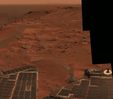
SOL582-2A_P2299_L456-A590R1_br2.jpgTennessee Valley: View from Husband's Summit (2)80 visiteMentre osserviamo affascinati questa immagine della "Tennessee Valley" desideriamo fare qualche puntualizzazione sulla scalata di Spirit verso il Summit di Husband Hill: una scalata che ha creato non pochi malintesi in noi Ricercatori.
In effetti, osservando le immagini in arrivo da Spirit - e relative ai Soles 585-589 -, la sensazione che il Summit fosse stato già raggiunto (o che si trovasse veramente 'ad un passo'...) era forte -, ma il silenzio del Centro Controllo Missione ci ha lasciati nell'incertezza e, come sempre, nel buio. La mancanza di note di commento ai raw frames, unita al cronico ritardo con cui vengono resi diponibili al Pubblico tutti gli updates sulla Missione, hanno completato l'opera.
Ad ogni modo il Summit di questa collinetta Marziana è stato raggiunto: lo spettacolo - effettivamente - è molto bello e suggestivo e, sebbene molti aspetti di questa nuova conquista debbano essere ancora chiariti, già in molti guardano oltre.
Adesso dove andrà Spirit?...
(20 voti)
|
|

APOLLO 15 AS 15-83-11218.jpgAS 15-83-11218 - Unexplainable (1)1094 visiteSe agitate un fiammifero acceso davanti ad una macchina fotografica e scattate con un tempo di esposizione di 4 o 5 secondi, otterrete lo stesso effetto che si vede in questa istantanea scattata sulla Navicella Endeavour - Missione Apollo 15. Sappiamo che l'immagine in questo frame è stata ripresa fotografando da un finestrino della Navicella, verso qualcosa di luminoso che si trovava all'esterno della stessa. Il titolo che abbiamo dato a questo fotogramma (Unexplainable) dice tutto.
(20 voti)
|
|

Mars-013.jpgMars: Yesterday and Today249 visiteDoes Mars have canals? A hot debate topic of the late 1800s, several prominent astronomers including Percival Lowell not only claimed to see an extensive system of long straight canals on Mars, but used them to indicate that intelligent life exists there. The relatively close opposition of 1894 was used to make drawings like the one digitally re-scaled on the above left. The above map was originally prepared by Eugene Antoniadi and redrawn by Lowell Hess for the book Exploring Mars, by Roy A. Gallant. In more modern times, the latest Mars opposition has allowed the Hubble Space Telescope to capture a picture of similar orientation. Comparison of the two images shows that large features were impressively recorded, but that an extensive system of long and straight canals just does not exist. Satellites orbiting Mars have now shown conclusively that the red planet does indeed have surface features similar to canals, but that these are usually smaller, curved, and less extensive than that previously claimed. Real canyon systems like Noctis Labyrinthus are most likely cracks caused by surface stress.
(19 voti)
|
|

Ganymede-PIA01610.jpgGanymede's surface detail: a comet fell over there?147 visiteView of a chain of craters named Enki Catena on Jupiter's moon, Ganymede. This chain of 13 craters probably formed by a comet which was pulled into pieces by Jupiter's gravity as it passed too close to the planet. Soon after this breakup, the 13 fragments crashed onto Ganymede in rapid succession. The Enki craters formed across the sharp boundary between areas of bright terrain and dark terrain, delimited by a thin trough running diagonally across the center of this image. The ejecta deposit surrounding the craters appears very bright on the bright terrain. Even though all the craters formed nearly simultaneously, it is difficult to discern any ejecta deposit on the dark terrain. This may be because the impacts excavated and mixed dark material into the ejecta and the resulting mix is not apparent against the dark background.
North is to the bottom of the picture and the sun illuminates the surface from the left. The image, centered at 39 degrees latitude and 13 degrees longitude, covers an area approximately 214 by 217 kilometers. The resolution is 545 meters per picture element. The image was taken on April 5, 1997 at 6 hours, 12 minutes, 22 seconds Universal Time at a range of 27282 kilometers by the Solid State Imaging (SSI) system on NASA's Galileo spacecraft.
(19 voti)
|
|
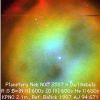
M-097-2.jpgM 97 - The "Owl Nebula" (in full color)69 visite"...Ut terrae variis mutatisque seminibus, ita ingenia nostra nunc hac nunc illa meditatione recoluntur..."
(Plinio)
"...Come le terre sono coltivate in vario modo (con semi di diversa specie), così le nostre menti sono di volta in volta stimolate da varie scienze..."
(19 voti)
|
|
| 25332 immagini su 2111 pagina(e) |
 |
|
|
|
|
1962 | |
|
|
|
|





