| Piú votate |

27-Zucchius Crater.jpgZucchius Crater87 visiteThis image of the central peaks of crater Zucchius was obtained by AMIE on 14 January 2006 from a distance of about 753 kilometres from the surface, with a ground resolution of 68 metres per pixel.
The imaged area is centred at a latitude of 61.3° South and longitude 50.8° West. Zucchius is a prominent lunar impact crater located near the southwest limb. It is 66 kilometres in diameter, but due to SMART-1's proximity to the surface, the AMIE field of view covers only the central 35 kilometres of the crater in this image.
Because of its location, the crater appears oblong-shaped due to foreshortening. It lies just to the south-southwest of the Segner crater, and northeast of the much larger Bailly walled-plain. To the southeast is the Bettinus crater, a formation only slightly larger than Zucchius.
Zucchius formed in the Copernican era, a period in the lunar planetary history that goes from 1200 million years ago to present times. Another example of craters from this period are Copernicus (about 800 milion years old) and Tycho (100 million years old). Craters from the Copernican era show characteristic ejecta ray patterns - as craters age, ejecta rays darken due to weathering by the flowing solar wind.
The hills near the centre of the image are the central peaks of the crater, features that form in large craters on the Moon. This type of feature is formed by the impact of a small asteroid onto the lunar surface. The surface is molten and, similarly to when a drop of water falls into a full cup of coffee, the hit surface bounces back and solidifies into the central peak.
The Zucchius crater is named after the Italian Mathematician and astronomer Niccolo Zucchi (1586-1670).

(1 voti)
|
|

26-Lunar Highlands.jpgLunar Highlands74 visiteThese two images, taken by the advanced Moon Imaging Experiment (AMIE) on board SMART-1, show the difference between lunar highlands and a mare area from close by.
The image on the left, showing highlands, was obtained by AMIE on 22 January 2006, from a distance of about 1112 kilometres from the surface, with a ground resolution of 100 metres per pixel. The imaged area is centred at 26° South and 157° West.
The image on the right, showing a mare, was taken on 10 January 2006, from a distance of about 1990 kilometres and with a ground resolution of 180 metres per pixel. The imaged area is centred at 27.4° North and 0.8° East.
Already when looking at the Moon with the naked eye, it can be seen that there are bright and dark areas on its surface. Centuries ago, the dark areas were called 'maria', presumably assuming that the observer would be seeing water oceans. Today we know that there is no liquid water on our satellite. However, telescopic observations showed that the maria are very flat, and are very different from the so-called highlands. The highlands are heavily cratered and mountainous.
We have learned that the maria are relatively young areas on the Moon which were generated after very large impacts penetrated the lunar crust and excavated basins. During later volcanic episodes, liquid magma came to the surface and filled these basins. When it cooled down and solidified, it formed the large flat areas we can still see today. As this happened in comparatively recent times, the number of impact craters is far less than in the highland areas.
From the two images it is possible to see how highlands present a very irregular topography and many craters, while the mare area is comparatively flat and shows a much smaller number of craters.
The images are raw data and no flat field or other corrections have been applied.
(1 voti)
|
|
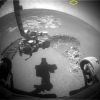
OPP-SOL840-1F202759817EFF71HQP1151R0M1.jpgPhotoartifact and UFO (2) - Sol 84058 visiteCerchiatura Gialla: sono passati oltre 8 minuti dal frame precedente.
Il photoartifact - ovviamente - non si è mosso, ma l'altro "oggetto luminoso" (e decisamente reale), si.
C'è davvero qualcosa o qualcuno che osserva - ma tenendosi sempre a debita distanza - la marcia di Opportunity?
Caption NASA originale:"Right Front HazCam Non-linearized Full frame EDR acquired on Sol 840 of Opportunity's mission to Meridiani Planum at approximately 13:43:57 MLT".
(1 voti)
|
|
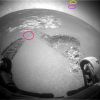
OPP-SOL840-1F202759290EFF71HQP1204R0M1.jpgPhotoartifact and UFO (1) - Sol 84060 visiteCaption NASA originale:"Right Front HazCam Non-linearized Full frame EDR acquired on Sol 840 of Opportunity's mission to Meridiani Planum at approximately 13:35:24 MLT".
Dal sempre ottimo "occhio" del Dr Gianluigi Barca:
Cerchiatura Gialla: photoartifact ricorrente
Cerchiatura Fucsia (in cielo): oggetto reale
Cerchiatura Fucsia (nei pressi del Rover): pebble (ciottolo luccicante, forse perchè piatto e liscio - e quindi capace di riflettere bene la luce del Sole - o forse perchè ricco di micro-cristalli).
(1 voti)
|
|
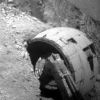
OPP-SOL838-1F202580410ESF71GXP1244R0M1-BR.jpgLook at my wheels!!! - Sol 83865 visiteCaption originale:"Right Front HazCam Non-linearized Sub-frame EDR acquired on Sol 838 of Opportunity's mission to Meridiani Planum at approximately 13:13:18 MLT".
(1 voti)
|
|
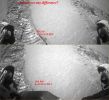
OPP-SOL837-1F202491816EFF71GQP1214L0M1.jpgMoving out... - Sol 836/83760 visiteCaption NASA originale del Sol 836:"Left Front HazCam Non-linearized Full frame EDR acquired on Sol 836 of Opportunity's mission to Meridiani Planum at approximately 12:33:15 MLT".
Caption NASA originale del Sol 837:"Left Front HazCam Non-linearized Full frame EDR acquired on Sol 837 of Opportunity's mission to Meridiani Planum at approximately 13:15:59 MLT".
(1 voti)
|
|

Saturn-PIA08190.jpgThrough the Rings...58 visiteCaption NASA originale:"The dark shadows that drape Saturn's Northern Latitudes are split by 3 familiar bright gaps. From bottom to top, Sunlight passes through the broad Cassini Division (4.800 Km - or about 2.980 miles - wide), the Encke Gap (325 Km - or about 200 miles - wide) and (barely visible) the Keeler Gap (42 Km - or about 26 miles - wide).
It is unlikely that the shadows cast by Saturn's Rings have much of an effect on the large-scale movements of the atmosphere. The dynamic clouds of this Gas Giant are driven by processes going on much deeper inside the Planet, where Sunlight does not penetrate.
The image was taken using a spectral filter sensitive to wavelengths of infrared light centered at 752 nanometers. The image was acquired with the Cassini spacecraft wide-angle camera on April 28, 2006 at a distance of approximately 377.000 Km (about 234.000 miles) from Saturn. Image scale is roughly 19 Km (such as about 12 miles) per pixel".
(1 voti)
|
|
OPP-SOL835-1P202311478EFF71GBP2599R2M1.jpgSoft, maybe too soft sands... (4) - Sol 83557 visitenessun commento
(1 voti)
|
|
OPP-SOL835-1P202311230EFF71GBP2599L5M1.jpgSoft, maybe too soft sands... (3) - Sol 835133 visitenessun commento
(1 voti)
|
|

OPP-SOL836-1R202404062EFF71GGP1314L0M1.jpgUnder "strict" observation! (4) - Sol 83656 visiteCaption NASA:"Left Rear HazCam Non-linearized Full frame EDR acquired on Sol 836 of Opportunity's mission to Meridiani Planum at approximately 13:32:17 MLT".
(1 voti)
|
|
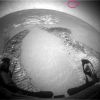
OPP-SOL836-1F202404009EFF71GGP1214R0M1.jpgUnder "strict" observation! (1) - Sol 836133 visite"Presenze di Luce", come dice il Dr Barca, sempre più...presenti! Si tratta di dettagli davvero minimi ma, almeno a nostro parere, quanto cerchiato in questi frames non sembra proprio essere il risultato di errori nella trasmissione (e ricezione) delle immagini.
Insomma: i "punti luminosi" che vediamo in questa serie di 4 frames (e, guarda caso, sono TUTTI frames HazCam...), a nostro parere NON sono dei photoartifacts (guardate bene l'ultimo!).
(1 voti)
|
|
OPP-SOL833-1F202133985EFF71GBP1211R0M1.jpgDeep Tracks near Martian Paving (1) - Sol 83358 visiteCaption originale:"Right Front HazCam Non-linearized Full frame EDR acquired on Sol 833 of Opportunity's mission to Meridiani Planum at approximately 12:30:37 MLT".
(1 voti)
|
|
| 25332 immagini su 2111 pagina(e) |
 |
|
|
|
|
1926 | |
|
|
|
|





