| Piú votate |
OPP-SOL912-1N209150156EFF7500P0695R0M1.jpgPanorama (3) - Sol 912121 visitenessun commento
(1 voti)
|
|

98-SMART-1-Impact-Graphic-hq.jpgThe "Impact Site" of SMART-1 (detailed)61 visiteCaption ESA originale:"Map of the Lacus Excellentiae Region, showing the nominal SMART-1 impact orbit (central red line: orbit 2890) and possible impact location at perilune on the Lunar Surface.
The two adjecent orbits, 2889 and 2891, and their perilune locations are also indicated.
Note that 1° of Latitude corresponds to 30 km on the Moon, and that one arcsec from Earth subtends 1,8 km on the Moon centre".
(1 voti)
|
|

90-August Moon.jpgThe "Impact Site" of SMART-158 visiteCaption ESA originale:"Reconnaissance view of the Moon on 20 August 2006 at 00:00 UT.
The Lunar North Pole is up.
The SMART-1 impact is expected on 3 September 2006 in the Lacus Excellentiae Region, at the top of the U-shape feature situated North of the crater Clausius "B". The nominal impact position is marked by the red circle".
(1 voti)
|
|

APOLLO 15 AS 15-9254.jpgAS 15-9524 - Bright and Big "Streaks"60 visiteThis elliptical crater is 1 Km long with an unusual, winglike pattern of rays.
This ejecta pattern is similar to those around some small experimental impact craters produced by missiles traveling along low-angle trajectories at White Sands Missile Range, N. Mex.
From the shape of the crater and the distribution of the rays, it is difficult to tell whether the meteoroid was traveling from North to South or South to North.
The higher albedo (brightness) of the North wall and the concentration of high albedo ejecta on the North-West and North-East flanks suggest that it traveled from South to North.
(1 voti)
|
|

APOLLO 15 AS 15-1541.jpgAS 15-1541 - Archimedes and Aristillus59 visiteThe ejecta blanket and secondary impact craters of the mare-filled crater Archimedes (80 Km in diameter) are visible on the terrain toward the viewer (South) but not on the mare surface to the crater's left and right. Yet at one time ejecta like that to the south must have completely surrounded Archimedes because similar ejecta surrounds craters such as Aristillus (upper right). Thus, the mare lavas, in addition to filling the interior of Archimedes, obviously have covered the eastern and western parts of the ejecta. In turn, ejecta from Archimedes has covered materials of the Imbrium Basin like the rugged hills in the lower left of the picture. These stratigraphic relations prove that time elapsed between formation of the Imbrium basin and its filling by mare-time enough for impacts to create Archimedes, the deeply flooded crater to its right (arrow), and similar "Imbrian-age" craters elsewhere, as was pointed out by Eugene Shoemaker in 1962.
Archimedes has no visible central peak complex. Presumably the complex exists but has been completely inundated by the mare.
(1 voti)
|
|
OPP-SOL907-1N208706254EFF746AP1962R0M1.jpgSurface features - Sol 90772 visitenessun commento
(1 voti)
|
|
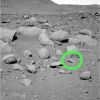
SOL391-C-2P161076449EFFA300P2367L7M1.jpg3D or not 3D? That is the question... (3) - Sol 39173 visiteEbbene, per qualche ora ci abbiamo creduto disperatamente ma poi, recuperando 12 frames bidimensionali della stessa zona (relativi ai Soles 390, 391 e 392), abbiamo individuato con certezza il rilievo controverso (cerchiato in verde in questo quadro) ed abbiamo potuto accertare che, purtroppo, la Scoperta del Secolo è rinviata: la roccia in questione non fluttua nel vuoto, anzi...E' bene infossata.
E allora? Come spiegare l'illusione ottica dei due frames precedenti? Semplice: è solo un effetto distorsivo del 3D il quale mantiene ed esalta il dettaglio più scuro del frame in 2D (e cioè l'ombra) e sbiadisce (sino quasi a cancellare) il dettaglio più chiaro del 2D (e cioè il profilo della pietra che proietta l'ombra).
Risultato: una pietra comunissima del frame bidimensionale, diventa una inquietante e spettacolare (ma falsa) Anomalìa in 3D.
(1 voti)
|
|
OPP-SOL905-1P208524704ESF74ZTP2566L2M1.jpgBeagle Crater's landforms (5) - Sol 90465 visitenessun commento
(1 voti)
|
|
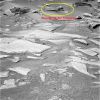
OPP-SOL904-1P208440642EFF74ZTP2293L7M1.jpgBeagle Crater's landforms (2) - Sol 90459 visitenessun commento
(1 voti)
|
|
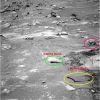
OPP-SOL904-1P208438078EFF74ZTP2293L7M1.jpgBeagle Crater's landforms (1) - Sol 90463 visiteAncora una serie di immagini molto curiose ed accattivanti - che fanno sempre parte dei più affascinanti "Martian Misteries" di Meridiani Planum - selezionate dal Dr Gianluigi Barca.
(1 voti)
|
|
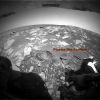
OPP-SOL896-1R207727763EFF74YKP1311R0M1.jpgLook at that stuff... - Sol 89662 visite"Plaster-like surface", ovvero "l'intonaco di Marte" che, non appena viene disturbato, si stacca in pezzi medio-grandi.
Un nuovo, eccellente (ed intrigante) dettaglio che va a fare compagnia alle innumerevoli curiosità e stranezze Marziane selezionate dal nostro grande Amico e Socio, Gianluigi Barca.
(1 voti)
|
|

OPP-SOL321-1R156683426EFF4000P1311R0M1-B.jpgA new (small) "Silver Anomaly"? (extra detail mgnf) - Sol 32184 visiteA nostro parere, anche se vorremmo essere "immaginifici" e pensare al manufatto alieno - o, perchè no?, ad un frammento di quarzo di discrete dimensioni - in questo caso specifico riteniamo di essere davanti ad un semplice frammento di metallo (un rottame, insomma) il quale dovrebbe appartenere all'Heat-Shield di Opportunity, non molto distante rispetto al punto attualmente occupato dal Rover.
Siamo giunti a questa conclusione basandoci sulla particolare brillantezza del rilievo la quale ci induce a concludere che, al 99%, si tratta di lamiera e quindi abbiamo effettuato una sommaria analisi dell'area circostante l'Heat-Shield. Un'area che, come dimostra un elevato numero di frames, è cosparsa di frammenti metallici di medio-piccole dimensioni.
Questo "oggetto", quindi - e con ogni probabilità -, dovrebbe essere solo una scheggia dell'Heat-Shield il quale, dopo l'impatto con il suolo Marziano, si è - in larga parte - frantumato.
Complimenti come sempre al Dr Barca ed una domanda per Voi: che ne pensate di questa nostra conclusione? Siete d'accordo?...
(1 voti)
|
|
| 25332 immagini su 2111 pagina(e) |
 |
|
|
|
|
1922 | |
|
|
|
|





