| Piú votate |

OPP-SOL281-b_sol281_L_flows.jpgHematite's dust flows over Endurance - Sol 281 (false colors; credits: Dr Jill England)65 visitenessun commento
(1 voti)
|
|
OPP-SOL951-site_B76_264_navcam_CYP_A-B952R1-1.jpgFirst look inside Victoria Crater (3D-1) - Sol 95155 visitenessun commento
(1 voti)
|
|
OPP-SOL950-1P212524184EFF76CNP2386L7M1.jpgVictoria Crater (6) - Sol 95054 visitenessun commento
(1 voti)
|
|

OPP-SOL948-1N212349063EFF76ACP0665L0M1.jpgVictoria Crater (1) - Sol 94856 visiteCaption NASA:"Left NavCam Non-linearized Full frame EDR acquired on Sol 948 of Opportunity's mission to Meridiani Planum at approximately 14:27:07 MLT".
(1 voti)
|
|

OPP-SOL947-1P212253277ESF7600P2585R2M1.jpgMartian Paving near Victoria (2) - Sol 94758 visitenessun commento
(1 voti)
|
|

Z-099-Lunar Impact-SMART-1.jpgThe Impact Sequence59 visiteCaption ESA originale:"Analysis of images obtained at the CFHT by Christian Veillet have revealed a plume of debris thrown up when SMART-1 impacted the Lunar Surface.
The observations were made with the WIRCam wide-field infrared camera with 10s exposure time through an H2 narrow-band filter at 2122 nanometers with a 32 nanometers bandwidth.
Each image is approximately 2'x 2', equating to 200x200 Km".
(1 voti)
|
|

Earth-PIA08324-1.jpgEarth, from Saturn's Space (1)85 visiteCaption NASA originale:"Not since NASA's Voyager 1 spacecraft saw our home as a pale blue dot from beyond the orbit of Neptune has Earth been imaged in color from the Outer Solar System. Now, Cassini casts powerful eyes on our home Planet, and captures Earth, a pale blue orb - and a faint suggestion of our Moon - among the glories of the Saturn System.
Earth is captured here in a natural color portrait made possible by the passing of Saturn directly in front of the Sun from Cassini's point of view. At the distance of Saturn's orbit, Earth is too narrowly separated from the Sun for the spacecraft to safely point its cameras and other instruments toward its birthplace without protection from the Sun's glare.
The Earth-and-Moon System is visible as a bright blue point on the right side of the image above center. Here, Cassini is looking down on the Atlantic Ocean and the Western Coast of North Africa. The phase angle of Earth, seen from Cassini is about 30°".
(1 voti)
|
|
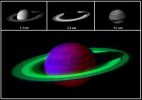
Saturn-PIA08735.jpgThree, for one and the same: Saturn, in infrared light60 visiteCaption NASA:"This false-color image of Saturn was constructed by combining 3 images at 3 different infrared wavelengths.
The image at the upper left was taken at 1,3 microns, where both Saturn and its Rings strongly reflect light. The center image in the top panel was taken at 2,4 microns, where the Rings strongly reflect light, but Saturn, because of the methane in its atmosphere, absorbs most of the light. The third image on the right in the panel was taken at a wavelength of 5 microns where, because they are composed of almost pure water ice, the Rings absorb almost all the light, and Saturn, because its interior is warm, glows. Assigning each of the three images to blue, green and red, respectively, results in the beautiful, false-color, composite image shown here.
These images were taken on June 21, 2004, with Cassini's VIMS (Visual and Infrared Mapping Spectrometer) from a distance of approx. 6,35 MKM (about 3,94 MMs) from Saturn".
(1 voti)
|
|
OPP-SOL901-PIA08753-007.jpgBeagle Crater and 360° Panorama from Sol 901 through 904 (7)83 visitenessun commento
(1 voti)
|
|
OPP-SOL901-PIA08753-005.jpgBeagle Crater and 360° Panorama from Sol 901 through 904 (5)59 visiteCaption NASA originale:"Beagle Crater takes its unofficial name from a great ship of exploration, the HMS Beagle, whose most famous passenger was British naturalist Charles Darwin. During the Beagle expedition around the world, Darwin conducted many of the observations that led to his theory of natural selection. Scientists have unofficially named many rocks and features in the area of Beagle Crater after the Galapagos Islands and the varieties of finches Darwin observed there. The name Beagle Crater also commemorates the ill-fated British lander, Beagle 2, reminding us how difficult space exploration can be".
(1 voti)
|
|

Titan-Craters-Unnamed_Crater-PIA08737.jpgTitanian Crater62 visiteCaption NASA originale:"This image from Cassini's radar instrument shows an impact crater with a diameter of about 30 Km (19 miles) on the surface of Saturn's moon Titan. Cassini data have only revealed 3 definite impact craters on Titan so far, so each new discovery adds significantly to our body of knowledge. Impact craters are particularly important, as their shapes give scientists insight into the structure of the crust beneath Titan's surface. The difference in overall appearance between this crater, which has a central peak, and those without, such as Sinlap, indicates variations in the conditions of impact, thickness of the crust, or properties of the meteorite that made the crater. The dark floor indicates smooth or highly absorbing materials.
This image was acquired by the Cassini radar instrument in synthetic aperture mode during a Sept. 7, 2006, flyby of Titan.
This image is centered at 70° West Long.; 10° North Lat. and measures about 145 Km high by 180 Km wide (such as approx. 93 by 118 miles). The smallest details in this image are about 500 mt (approx. 550 yards) across".
(1 voti)
|
|

Mimas-PIA08264.jpgMimas56 visiteCaption NASA originale:"Mimas plows along in its orbit, its pockmarked surface in crisp relief. The bright, steep walls of the enormous crater, Herschel (130 Km, or 80 miles wide), gleam in the Sunlight.
The lit terrain seen here is on the Leading Hemisphere of Mimas (about 397 Km, or 247 miles across). North is up.
The image was taken in visible light with the Cassini spacecraft narrow-angle camera on Aug. 16, 2006 at a distance of approx. 221.000 Km (about 137.000 miles) from Mimas and at a Sun-Mimas-spacecraft, or phase, angle of 80°.
The image scale is roughly 1 Km (about 0,6 mile) per pixel".
(1 voti)
|
|
| 25332 immagini su 2111 pagina(e) |
 |
|
|
|
|
1920 | |
|
|
|
|





