| Piú votate |

as08-13-2267.jpgAS 08-13-2267 - Beautiful Vision (2 - MULTISPECTRUM; credits: Lunexit)59 visiteLatitude: approx. 13,5° South
Longitude: approx: 78,5° EastMareKromium
(1 voti)
|
|

as16-107-17473.JPGAS 16-107-17473 - The "Sample Container"59 visiteThis picture is showing the Rover in the background, while the SCB that John Young brought to hold individual sample bags is in the foreground. Charlie is at the back of the Rover. Note the footprints that John made as he made his way up to the Station 4 Crater.
MareKromium
(1 voti)
|
|
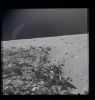
as16-107-17483.JPGAS 16-107-17483 - Station 4 Crater (ejecta crater)59 visiteStation 4 crater. Note that there is very little debris on the Western (right) side of the Crater. As John Young recognized in the field, this crater was almost certainly formed by a large piece of highly-shocked ejecta from South Ray Crater which plowed into the side of Stone Mountain at relatively low velocity and came apart.
Hence, this is a Secondary Crater.
Notes (from "Glossary of Geology", 2nd Edition, American Geological Inst., Falls Church (VA) - 1980)
Ejecta — The material thrown out of an impact crater by the shock pressures generated during the impact event. Ejecta generally covers the surface around an impact crater to a distance of at least one crater diameter, with individual streamers of material extending well beyond this distance ("rays"). The ejecta blanket of a crater becomes less visible with increasing age of the crater.
Secondary craters — Craters produced by the impact of debris thrown out by a large impact event. Many secondary craters occur in clusters or lines where groups of ejecta blocks impacted almost simultaneously.MareKromium
(1 voti)
|
|
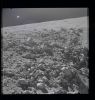
as16-107-17477.JPGAS 16-107-17477 - Station 4 Crater (ejecta crater)59 visitenessun commentoMareKromium
(1 voti)
|
|

ZZ-Z-N-JC1-MERB_Traverse_Sol1365.jpg414 Soles around Victoria...66 visiteCaption NASA:"Victoria Crater, about 800 meters (one-half mile) in diameter, has been home ground for NASA's MER Opportunity for more than 14 of the Rover's first 46 months on Mars. This view shows the Rover's path overlaid on an image of the crater taken by the High Resolution Imaging Science Experiment on NASA's Mars Reconnaissance Orbiter.
Opportunity first reached the crater's rim on Sept. 27, 2006, during the 951st Martian Day, or Sol, of the Rover's work in the Meridian Planum Region of Mars.
The Rover then explored clockwise about 1/4th of the way around the rim before returning to a point close to its first overlook.
On the mission's 1293rd Sol (Sept. 13, 2007), Opportunity began a sustained exploration of the interior of the Crater, entering at an alcove called "Duck Bay" on the Western Side of Victoria.
This traverse map includes Opportunity's route through Sol 1365 (such as Nov. 26, 2007). The scale bar is 300 meters (984 feet) long.MareKromium
(1 voti)
|
|

as16-107-17446.JPGAS 16-107-17446 - The LR at Station 459 visiteCaption NASA:"144:16:27 MT - "Locator" to the Rover from John's first Station 4 sample site. Charlie Duke is still at the Rover.
Note the spray of dirt propelled toward us by backward motion of Charlie's left heel. Note, also, the large rock at the lower right that John drove over just before stopping the Rover.
The Rover chassis clearance is about 14" (35 cm)".
MareKromium
(1 voti)
|
|

as16-107-17451.JPGAS 16-107-17451 - Angular Rock59 visitenessun commentoMareKromium
(1 voti)
|
|

as16-107-17462.JPGAS 16-107-17462 - Station 4 Trench60 visiteCaption NASA:"Post-sampling up-Sun of John Young's Station 4 trench".MareKromium
(1 voti)
|
|

as16-107-17420.JPGAS 16-107-17420 - Beautiful Desolation (1)60 visiteCaption NASA:"Charlie Duke begins a pan taken North of the LM with this frame showing part of the U.S. Flag on the left and the Solar Wind Collector (SWC) at center".MareKromium
(1 voti)
|
|
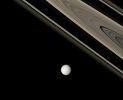
Tethys-PIA09788.jpgTrue Colors?57 visiteCaption NASA:"As seen from the side not illuminated by the Sun, Saturn's thinner Rings are highlighted in shades of brown and gold, contrasting with the more neutral appearance of the icy moon Tethys. The A-Ring and Cassini Division are separated by the optically thick B-Ring, which does not permit sunlight to penetrate and appears as the broad, dark lane between them in this view.
This view looks toward the anti-Saturn side of Tethys.
North is up and rotated 35° to the right.
The view looks toward the unilluminated side of the rings from about 2° above the Ring-Plane.
Images taken using red, green and blue spectral filters were combined to create this natural color view. The view was acquired with the Cassini spacecraft narrow-angle camera on Oct. 29, 2007, at a distance of approx. 2,1 MKM (about 1,3 MMs) from Tethys and at a Sun-Tethys-spacecraft, or phase, angle of 21°.
Image scale is roughly 12 kilometers (8 miles) per pixel".MareKromium
(1 voti)
|
|

Kaguya-010-20071113.gifRelative locations of the KAGUYA Probe, the Moon, and the Earth73 visitenessun commentoMareKromium
(1 voti)
|
|
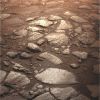
OPP-SOL1339-1P247059974EFF8788P2393R1M1-1.jpgThe "Inner Paving" and the "Red Sands" of Victoria - Sol 1339 (red-orange filter ON - possible natural colors - elab. Lunexit)65 visitenessun commentoMareKromium
(1 voti)
|
|
| 25332 immagini su 2111 pagina(e) |
 |
|
|
|
|
1913 | |
|
|
|
|





