| Piú votate |
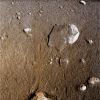
PHOE-SOL005-233919main_SS005EFF896647257_11708RBM1-2-3.jpgSmall Rocks in a Greenish/Reddish Soil - Sol 5 (Superdefinition; credits: Dr G. Barca)57 visitenessun commentoMareKromium
(1 voti)
|
|

as15-96-13098~0.jpgAS 15-96-13098 - Floating in Space... (Special Processing by Lunexit)57 visiteWorden's EVAMareKromium
(1 voti)
|
|
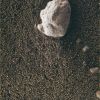
SOL1008-1.jpgMartian "Pumice Stone" and "wet" Sands - Sol 1008 (Superdefinition; credits: Dr G. Barca)69 visitenessun commentoMareKromium
(1 voti)
|
|

OPP-SOL652-1.jpgSol 652 (True Colors + MULTISPECTRUM; credits: Dr G. Barca & Lunexit)56 visitenessun commentoMareKromium
(1 voti)
|
|

Luna21-Photomosaic-001b.jpgLunar Panorama: disturbed soil and Rover Tracks73 visitenessun commentoMareKromium
(1 voti)
|
|

ZZ-ZZ-ZZ-ZZ-ZZ-ZZ-ZZ-ZZ-ZZ-ZZ-ZZ-ZZ-ZZ-ZZ-ZZ-ZZ-ZZ-ZZ-ZZ-ZZ-Spirit-2P257305763EFFAY00P2578R7M1.jpgExtremely Unusual Rocks and Landforms (context frame - credits: Enzo Lojacono)145 visiteUn dettaglio apparentemente "innocuo" ecco che diventa un nuovo "puzzle" per Ricercatori Immaginifici: dall'occhio e dall'attenzione del nostro Amico Enzo Lojacono, un rilievo superficiale inusuale il quale accede ad una "forma del suolo" decisamente curiosa (come potrete meglio vedere ed apprezzare nei due detail mgnf che seguono).
Come dice il bravo Enzo:"...Lo strano gioco di luce o il sovrapporsi casuale di materiali, dopo che Spirit ci è passato sopra, danno un immagine che sembra mostrare i contorni di un volto con fattezze umanoidi e con orbite incavate e naso sporgente...".
Un'OTTIMA DESCRIZIONE e, come sempre, un OTTIMO SPUNTO per riflettere e precisare che, volendo, ogni rilievo superficiale (Marziano, Lunare, Terrestre etc.) può "trasformarsi" in una Singolarità o - addirittura - in un'Anomalìa di Superficie. Basta avere "occhi aperti" ed un pizzico di predisposizione.
Ed è questa circostanza che rende il nostro Lavoro affascinante e sempre nuovo (da un lato) ed ingrato - se non "letale"... - dall'altro.
Un abbraccio e Complimenti per la visione e lo spunto al bravissimo Enzo Lojacono!
MareKromium
(1 voti)
|
|

ZZ-ZZ-ZZ-ZZ-ZZ-ZZ-ZZ-ZZ-ZZ-ZZ-ZZ-ZZ-ZZ-ZZ-ZZ-ZZ-ZZ-ZZ-ZZ-ZZ-Spirit-MGNF02.jpgExtremely Unusual Rocks and Landforms (extra-detail mgnf; credits: Enzo Lojacono)148 visitenessun commentoMareKromium
(1 voti)
|
|
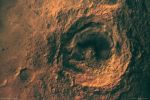
MaunderCrater.jpgMaunder Crater (Natural Colors + MULTISPECTRUM; credits: ESA & Lunexit)75 visiteThe above image shows the striking Maunder crater lying at approx. 50° South Lat. and 2° East Long., in the Noachis Terra Region on Mars.
The High Resolution Stereo Camera (HRSC) on ESA’s Mars Express orbiter took pictures of the Noachis Terra Region during orbits 2412 and 2467 on 29 November and 14 December 2005, respectively, with a ground resolution of approx. 15 mt/pixel.
The Sun illuminates the scene from the North-East (top left in the image).
Maunder crater, named after the British Astronomer Edward W. Maunder, is located halfway between Argyre Planitia and Hellas Planitia on the Southern Highlands of Mars.
With a diameter of 90 Km and a depth of barely 900 mt, the Crater is not one of the largest impact craters on Mars at present, but it used to be much deeper. It has since been filled partially with large amounts of material.MareKromium
(1 voti)
|
|

Enceladus-PIA10361-1.jpgJet Spots in Tiger Stripes62 visiteCaption NASA:"Heat radiating from the entire length of 150 Km (about 95 mile)-long fractures is seen in this best-yet heat map of the active South Polar Region of Saturn's ice moon Enceladus. The warmest parts of the fractures tend to lie on locations of the plume jets identified in earlier images, shown in the annotated version with yellow stars. The measurements were obtained by the Cassini Spacecraft's Composite Infrared Spectrometer from the spacecraft's close flyby of the moon on March 12, 2008.
Remarkably high temperatures, at least 180 Kelvin (such as -135 degrees Fahrenheit) were registered along the brightest fracture, named Damascus Sulcus, in the lower left portion of the image. For comparison, surface temperatures elsewhere in the South Polar Region of Enceladus are below 72 Kelvin (such as -330 degrees Fahrenheit).
Heat is escaping from Enceladus' interior along these warm fractures, dubbed "Tiger Stripes", which are also the source of the geysers that erupt from the Polar Region.
The infrared radiation was mapped at wavelengths between 12 and 16 microns. The infrared data, shown in false color, are superimposed on a grayscale image mosaic of the South Pole obtained by Cassini's cameras on July 14, 2005, during the previous close Enceladus flyby. Numbers on the map indicate Latitude and Longitude.
This new view shows that at least 3 of the South Polar fractures are active along almost their full lengths - the 4th one, on the right, was only partially covered by this scan. The level of activity varies greatly along the fractures. The warmest parts of the fractures tend to lie on locations of the plume jets identified in earlier images. The main "Tiger Stripe" fractures are not the only sources of heat, however; additional warm spots are seen in the upper right part of the scan.
The warm regions are probably concentrated within less than a few hundred meters (a few hundred yards) of the fractures, and their apparent width in this image results from the relatively low resolution of the infrared data.
This map was made by scanning the South Pole during the period from 16' to 37' (minutes) after closest approach to Enceladus, at a distance between 14.000 and 32.000 Km (about 8.700 and 20.000 miles) as Cassini rapidly receded from its close (50-Km or about 32-miles) flyby".MareKromium
(1 voti)
|
|
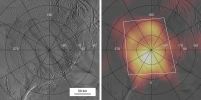
Enceladus-PIA10360.jpgStripes and Heat Map Side-by-Side73 visiteCaption NASA:"Cassini's March 12, 2008, flyby of Enceladus provided the best view yet of the heat radiation from the active South Pole of the satellite. These images summarize what was learned about the South Polar landscapes and heat radiation during the previous close flyby on July 15, 2005.
The left panel shows a map of the South Pole constructed from images taken by the Spacecraft's Imaging System. Four prominent fractures, informally called "Tiger Stripes", cut diagonally across the South Polar Region. In the right-hand panel, a July 2005 map of the south polar heat radiation, obtained by Cassini's Composite Infrared Spectrometer, is superimposed in false color on the visible images.
The observations revealed a prominent warm region centered on the South Pole, appearing yellow and orange in this view, which coincides with the locations of the tiger stripes. However, these data were taken from too far away from Enceladus (about 80.000 Km) to distinguish the fine details of the heat radiation.
The July 2005 flyby also included some scattered close-up snapshots by the Composite Infrared Spectrometer; these showed that the heat radiation was concentrated along the Tiger Stripe fractures, but those snapshots covered only a small fraction of the South Polar Region.
The white lines enclose the area covered by the much more detailed view of the South Pole obtained by the spectrometer during the March 12, 2008, flyby.
Numbers on the map show Latitude and Longitude".MareKromium
(1 voti)
|
|
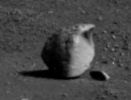
SOL524-2P172890954EFFAC00P2438L7M1-2.jpgExtremely unusual "Boulder" - Sol 524 (extra-detail mgnf - EDM; credits: Dr Gianluigi Barca)101 visiteEd ecco un eccellente e ben definito extra-detail mgnf del macigno individuato dal Dr Barca e che sembra essere una via di mezzo tra un "uovo con becco" ed una sorta di "mega-conchiglia bivalve" ancora chiusa e con una curiosa deformazione sul suo lato Sx (Dx dell'Osservatore).
Una piccola osservazione (che non vuole essere nè sarcastica, nè polemica): ma i nostri Amici Scienziati e Studiosi si sono - giustamente, per carità - concentrati su tanti aspetti della morfologia di Marte i quali sono, se ci permettete di usare una espressione un pò desueta, "canonicamente scientifici". Esempi di analisi di rilievi Marziani ne trovate a decine - taluni anche interessanti - nelle note di commento ai frames orbitali MRO. Qualche commentino sui rilievi superficiali visti "dal suolo" - anche se si tratta di commenti piuttosto "blandi"... - lo potete leggere nelle Gallerie dedicate alle Press Releases MER (http://marsrovers.jpl.nasa.gov/gallery/press/).
Ma di "accenni" - anche MINIMI - alla assoluta UNICITA' e (spesso) INSPIEGABILITA' (per forma, equilibrio, texture, colore etc.) di alcuni "Sassi di Marte" (come questo e come le centinaia di altri che abbiamo isolato e che Vi abbiamo proposto e Vi proporremo negli anni), NULLA. MAI UN SINGOLO ACCENNO.
E questo, abbiate pazienza, è strano. E' strano perchè se riduciamo l'investigazione dello Spazio (Pianeti inclusi) al suo solo aspetto scientificamente "canonico" (ed ultra-razionale), a nostro parere rischiamo FORTEMENTE di farci SFUGGIRE QUALCOSA.
Ed a Buoni Intenditori...MareKromium
(1 voti)
|
|

AS15-88-12002HR-3.jpgAS 15-88-12002 - The "Bridge" (extra-detail mgnf n. 2; credits: Dr G. Barca)59 visitenessun commentoMareKromium
(1 voti)
|
|
| 25332 immagini su 2111 pagina(e) |
 |
|
|
|
|
1910 | |
|
|
|
|





