| Piú votate |

OPP-SOL237-3.jpgThe "Mark", again - Sol 237 (possible True Colors; credits: Dr G. Barca & Lunexit)55 visitenessun commentoMareKromium
(1 voti)
|
|

SOL758-9-0.jpgRocky Landscape - Sol 758 (possible True Colors; credits: Dr G. Barca & Lunexit)57 visitenessun commentoMareKromium
(1 voti)
|
|

Psp_009480_2265_red.jpgLayers and Scallops (True Colors; credits: Lunar Explorer Italia)68 visiteMars Local Time: 15:10 (early afternoon)
Coord. (centered): 45,9° North Lat. and 91,1° East Long.
Spacecraft altitude: 306,6 Km (such as about 191,6 miles)
Original image scale range: 30,7 cm/pixel (with 1 x 1 binning) so objects ~92 cm across are resolved
Map projected scale: 25 cm/pixel
Map projection: EQUIRECTANGULAR
Emission Angle: 11,8°
Phase Angle: 55,8°
Solar Incidence Angle: 44° (meaning that the Sun is about 46° above the Local Horizon)
Solar Longitude: 107,9° (Northern Summer)
Credits: NASA/JPL/University of Arizona
Additional process. and coloring: Lunar Explorer ItaliaMareKromium
(1 voti)
|
|

Enceladus-PIA11133.jpgCrescent Enceladus (possible True Colors; credits: Lunar Explorer Italia)60 visiteCaption NASA:"On Oct. 5, 2008, just after coming within 25 kilometers (15.6 miles) of the surface of Enceladus, NASA's Cassini captured this stunning mosaic as the Spacecraft sped away from this geologically active moon of Saturn.
Craters and cratered terrains are rare in this view of the Southern Region of the moon's Saturn-facing Hemisphere. Instead, the surface is replete with fractures, folds, and ridges — all hallmarks of remarkable tectonic activity for a relatively small world. In this True Colors view, regions that appear blueish are thought to be coated with larger grains than those that appear white or gray.
Portions of the Tiger Stripe Fractures, or Sulci, are visible along the Terminator at lower right, surrounded by a circumpolar belt of mountains. The icy moon's famed jets emanate from at least 8 distinct Source Regions, which lie on or near the Tiger Stripes. However, in this view, the most prominent feature is Labtayt Sulci, the approximately one-kilometer (such as 0,6 miles) deep Northward-trending chasm located just above the center of the mosaic.
Near the top, the conspicuous ridges are Ebony and Cufa Dorsae. This mosaic was created from 28 images obtained at seven footprints, or pointing positions, by Cassini's narrow-angle camera. At each footprint, 4 images using filters sensitive to UltraViolet (UV), Visible (V) and InfraRed light (IR) - spanning wavelengths from 338 to 930 nanometers) were combined to create the individual frames. The mosaic is an orthographic projection centered at 64,49° South Lat. and 283,87° West Long., and it has an image scale of 196 Km (about 122,5 miles) per pixel. The original images ranged in resolution from 180 meters (594 feet) to 288 meters (950 feet) per pixel and were acquired at distances ranging from 30.000 to 48.000 Km (such as from about 18.750 to 30.000 miles) as the Spacecraft receded from Enceladus.
The view was acquired at a Sun-Enceladus-spacecraft, or phase, angle of 73°".MareKromium
(1 voti)
|
|
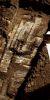
PHOE-SOL053-lg14261-14267-14268-2_copia.jpgIn the Trench - Sol 53 (True Colors; credits: Dr G. Barca & Lunexit)76 visitenessun commentoMareKromium
(1 voti)
|
|
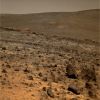
SOL758-3.jpgRocky Landscape - Sol 758 (possible True Colors; credits: Dr G. Barca & Lunexit)83 visitenessun commentoMareKromium
(1 voti)
|
|

SOL489-MF-LXT.jpgHearts of Stone... - Sol 489 (possible True Colors; credits: Dr M. Faccin & Lunar Explorer Italia)172 visitenessun commentoMareKromium
(1 voti)
|
|
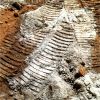
SOL404-MF.jpgSalts and Sulphates - Sol 404 (possible True Colors; credits: Dr M. Faccin & Lunar Explorer Italia)59 visitenessun commentoMareKromium
(1 voti)
|
|
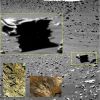
SOL765-2P194275970EFFAOG2P2277L7M1-1~0.jpgMars and Earth: a comparison - Sol 765 (insets by Dr Gualtiero La Fratta)57 visiteRocce "bizzarre" su Marte? Si, quasi una regola! Ma anche la Terra non scherza (come il bravissimo Dr La Fratta ci mostra e ci ricorda)...MareKromium
(1 voti)
|
|
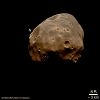
PHOBOS-Image031-420-20081008-6042-6-src-02-PhobosSeries_H1.jpgApproaching Phobos (natural colors; credits: Lunexit)59 visiteThis image of Phobos was obtained by the Super Resolution Channel (or SRC, a part of the High Resolution Stereo Camera experiment) on board ESA’s Mars Express on 15 September 2008 (orbit 6042).
The distance from the moon’s centre was 3718 km, and the image resolution is 34 m/pixel.
The original image has been corrected for mirror distortion.
MareKromium
(1 voti)
|
|

Enceladus-PIA11108.jpgBaghdad Sulcus86 visiteCaption NASA:"This Cassini image was the 4th 'skeet shoot' narrow-angle image captured during the Oct. 31, 2008, flyby of Saturn's moon Enceladus.
The source region for jet VI (see PIA08385) has been identified. The image was taken with the Cassini Spacecraft narrow-angle camera on Oct. 31, 2008, at a distance of approximately 3417 Km (about 2135 miles) from Enceladus and at a Sun-Enceladus-Spacecraft, or Phase, Angle of 75°.
Image scale is roughly 38 meters (125 feet) per pixel".MareKromium
(1 voti)
|
|

Enceladus-PIA11124.jpgThe Enceladus' "Tiger Stripes"60 visiteCaption NASA:"This Cassini image was the first and highest resolution 'skeet shoot' narrow-angle image captured during the Oct. 31, 2008, flyby of Saturn's moon Enceladus.
The image was taken with the Cassini Spacecraft narrow-angle camera on Oct. 31, 2008, at a distance of approximately 1691 Km (about 1056 miles) from Enceladus and at a Sun-Enceladus-Spacecraft, or Phase, Angle of 78°.
Image scale is roghly 9 meters (29 feet) per pixel.MareKromium
(1 voti)
|
|
| 25332 immagini su 2111 pagina(e) |
 |
|
|
|
|
1905 | |
|
|
|
|





