| Piú votate |

Janus-PIA11694.gifObscuring Janus (GIF-Movie; credits: NASA/JPL/Space Science Institute)64 visiteCaption NASA:"Sunlight passing through the Cassini Division between Saturn's "A" and "B" Rings sweeps across and illuminates the surface of the moon Janus in this movie captured shortly after Saturn's August 2009 Equinox.
The novel illumination geometry that accompanied Equinox lowered the Sun's Angle to the Ring-Plane, significantly darkened the Rings, caused out-of-plane structures to look anomalously bright and threw shadows across the Rings. As this movie shows, the Equinox period also allowed the Rings to cast shadows on the moons. These scenes were possible only during the few months before and after Saturn's Equinox, which occurs only once in about 15 Earth years. Before and after Equinox, cameras on NASA's Cassini Spacecraft spotted not only the predictable shadows of some of Saturn's moons, but also the shadows of newly revealed Vertical Structures in the Rings themselves (see PIA11665).
This view looks toward the Trailing Hemisphere of Janus (approx. 179 Km, or about 111 miles across). North on Janus is up and rotated 8° to the right.
The movie is a concatenation of 12 still images. The images were obtained in Visible Light with Cassini's narrow-angle camera on Aug. 27, 2009. The view was acquired at a distance of approx. 268.000 Km (about 67.000 miles) from Janus and at a Sun-Janus-Spacecraft, or Phase, Angle of 25°.
Image scale is roughly 2 Km (5271 feet) per pixel".MareKromium
(1 voti)
|
|

SOL568-2N176788619ESFADAEP1560L0M1.jpgRunning Pillars of Dust - Sol 568 (Enhanced Natural Colors; credits: Dr Paolo C. Fienga - Lunexit Team)85 visitenessun commentoMareKromium
(1 voti)
|
|

OPP-SOL553-1P177276798EFF58D4P2353R2M1.jpgThe Sandy Waves of Meridiani - Sol 533 (Natural Color View - credits: Dr Paolo C. Fienga - Lunexit Team)63 visitenessun commentoMareKromium
(1 voti)
|
|

OPP-SOL553-1P177276831EFF58D4P2353L2M1.jpgThe Sandy Waves of Meridiani - Sol 533 (Natural Color View - credits: Dr Paolo C. Fienga - Lunexit Team)70 visitenessun commentoMareKromium
(1 voti)
|
|

OPP-SOL553-1P177276906EFF58D4P2353R2M1.jpgThe Sandy Waves of Meridiani - Sol 533 (Natural Color View - credits: Dr Paolo C. Fienga - Lunexit Team)66 visitenessun commentoMareKromium
(1 voti)
|
|
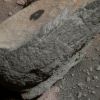
OPP-SOL2089-GB.jpgErratic Boulder and debris - Sol 2089 (possible True Colors - credits: Dr G. Barca - Lunexit Team)108 visitenessun commentoMareKromium
(1 voti)
|
|
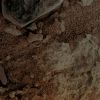
SOL533-2M173683780EFFACAQP2957M2M1_rgb_3d-MF3.jpgCristal-like Substance near semi-transparent Rock and Pebbles - Sol 533 (EDM - Superdefinition and possible Natural Colors; credits: Dr Paolo C. Fienga - Lunexit Team)59 visitenessun commentoMareKromium
(1 voti)
|
|
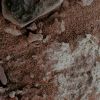
SOL533-2M173683780EFFACAQP2957M2M1_rgb_3d-MF2.jpgCristal-like Substance near semi-transparent Rock and Pebbles - Sol 533 (EDM - Superdefinition and possible True Colors; credits: Dr M. Faccin - Lunexit Team)145 visitenessun commentoMareKromium
(1 voti)
|
|
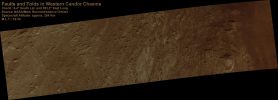
PSP_003540_1735_RED_browse~0.jpgFaults and Folds in West Candor Chasma (Natural Colors; credits: Lunexit)65 visiteThis image shows various interesting structures along the Floor of Candor Chasma, a major canyon of Valles Marineris.
The rocks along the floor of the chasma consist of multiple layers of light-toned material, possibly windblown or water-lain sediment. These layers have been shifted along faults and also folded, giving the layers an apparent wavy appearance as they are exposed at the Surface through erosion.
Some waviness in the Layers may also have formed as these sediments were laid down (for example, in Dunes or large Ripples. Detailed mapping of these Faults and Folds may help reveal the origin of these Layered Deposits and if water played any role in their formation.MareKromium
(1 voti)
|
|
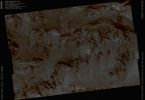
PSP_001415_1875_RED_abrowse.jpgAlluvial Fans in Mojave Crater (Natural Colors; credits: Lunexit)85 visiteAptly-named Mojave Crater in the Xanthe Terra Region has Alluvial Fans that look remarkably similar to landforms in the Mojave Desert of South-Eastern California and portions of Nevada and Arizona.
Alluvial Fans are "fan-shaped deposits of water-transported material" (---> Lat.: alluvium). They typically form at the base of hills or mountains where there is a marked break, or flattening of slope.
They typically deposit big rocks near their Mouths (close to the mountains) and smaller rocks at greater distances. Alluvial Fans form as a result of heavy desert Downpours, typically "Thundershowers" (Nota Lunexit: piogge torrenziali che occorrono durante violenti temporali, per lo più di tipo tropicale).
Because deserts are poorly vegetated, heavy and short-lived Downpours create a great deal of erosion and nearby deposition.
There are Fans inside and around the outsides of Mojave Crater on Mars that perfectly match the morphology of Alluvial Fans on Earth, with the exception of a few small impact craters dotting this Martian Landscape.
Channels begin at the apex of topographic Ridges, consistent with precipitation as the source of water, rather than groundwater. This remarkable landscape was first discovered from Mars Orbital Camera images. Mars researchers have suggested that impact-induced Atmospheric Precipitation may have created these unique landscapes.
This HiRISE image at up to 29 cm/pixel scale supports the Alluvial Fan interpretation, in particular by showing that the sizes of the largest rocks decrease away from the Mouths of the Fans.MareKromium
(1 voti)
|
|
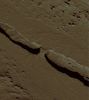
PSP_001420_2045_RED_browse-01~0.jpgSmall Channel in Tartarus Colles (EDM - Natural Colors; credits: Lunexit)71 visiteThe Channel between the Knobs has a variable depth as seen by the varying shadow lengths. The origin of the Channel is unknown, but it is probably NOT a Fluvial Channel because there are no obvious source or Deposit Regions; the Channel, therefore, is probably a Collapse Feature.
One portion of it, (see this EDM, approx. 375 meters across), contains a Bridge, and is probably a remnant of the original surface.
A depression that extends from the Channel Northwards — but which is not as deep as the majority of the Channel — might be in the process of collapsing and enlarging the Channel. MareKromium
(1 voti)
|
|
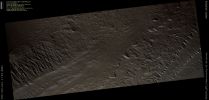
PSP_001422_1750_RED_abrowse.jpgLayers in Gale Crater Central Mound (Natural Colors; credits: Lunexit)59 visiteThis image shows a portion of the Central Mound in the Gale Crater (Central Mound that is of interest to scientists because of the light-toned Layered Deposits that can be found inside it).
The Layered Deposits could have formed in a water environment if, for instance, a lake - once - filled the Crater. Alternatively, particles suspended in the Atmosphere, such as Dust or Volcanic Ashes, could have built up the Layers over time.
By using HiRISE images to see details in the Layers, such as how their thicknesses vary horizontally and vertically, scientists can narrow down the potential origins.
The paucity of Impact Craters on the Layered Deposits indicates that either the Deposits are very young, or more likely that they are being eroded up to the point where such (alleged) Impact Craters were erased.
Wind Erosion modified the Layers after they formed, creating both sharp corners and rounded depressions along the Surface.
A few meter-size Boulders are visible at the base of some steep Cliffs, but the really poor amount of visible Boulders elsewhere suggests that most of the erosion occurred (and it is still occurring) because of eolic processes (such as wind action) rather than downslope movement of material.MareKromium
(1 voti)
|
|
| 25332 immagini su 2111 pagina(e) |
 |
|
|
|
|
1897 | |
|
|
|
|





