| Piú votate |

PSP_004052_2045_RED_abrowse-02-PIA13726.jpgUnnamed Crater with Layers near Mawrth Vallis (Enhanced Natural Colors; credits: NASA/JPL-Caltech/University of Arizona)114 visiteThis image covers part of an Unnamed Impact Crater roughly 4 Km (approx. 2,5 miles) in diameter; the upper portion of the picture shows a one Km segment of the Crater's Inner Wall and Rim.
The Surface outside the Crater is relatively dark, while the Inner Wall of the Crater exposes lighter, Layered Bedrock of diverse colors. A few dark patches on the Crater Wall have small Dunes or Ripples on their surfaces, and are likely Pits filled with Dark Sand. This Crater provides a window into the Sub-Surface of Mars, revealing Layered Sedimentary Deposits.
Just about 30 Km (approx. 18,6 miles) to the East of this Crater lies Mawrth Vallis, an ancient Channel that may have been carved by catastrophic Floods.
In Layered Deposits surrounding Mawrth Vallis, the orbiting spectrometers OMEGA (on Mars Express) and CRISM (on MRO) have detected Phyllosilicate (such as Clay) minerals, which must have formed in the presence of water.
In this Region on Mars, the colors of the Layers seen by HiRISE often correlate with distinct water-bearing minerals observed by CRISM, so the color diversity seen here may reflect a dynamic environment at this location on early Mars.
Note: the color in these images is enhanced; it is not as it would normally appear to the human eye.MareKromium
(1 voti)
|
|
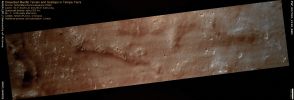
PSP_007930_2310_RED_abrowse-PCF-LXTT.jpgFeatures of Tempe Terra (Absolute Natural Colors; credits for the additional process. and color.: Dr Paolo C. Fienga - Lunexit Team)79 visitenessun commentoMareKromium
(1 voti)
|
|

Just_Like_Old_Mars-APOLLO_09_-_AS_09-22-3439.jpgAS 09-22-3439 - Just like the "Old Mars"... (credits for the additional process. and color.: Dr Paolo C. Fienga - Lunexit Team)132 visitenessun commentoMareKromium
(1 voti)
|
|

ESP_020061_1720_RED_abrowse-PCF-LXTT.jpgBright and Dark Plains (Absolute Natural Colors; additional process. and color.: Dr Paolo C. Fienga - Lunexit Team)126 visiteThis HiRISE image shows a mixture of bright and dark Terrain along the plains just West of Ganges Chasma.
The concentration of these bright patches adjacent to an old Impact Crater suggests that the bright patches could represent Ejecta from when the crater formed.
This would be an interesting discovery because it would mean that a different unit underlies the Surface we now see. Alternatively, much of the Plains in this Region seem to have a dark surficial cover (probably aeolian debris). Where this darker debris has been removed by the wind, the underlying brighter substrate would be exposed.
Mineralogic information from the CRISM instrument would be very useful for determining if the bright patches contain minerals indicative of water - such as Clays - or if they are Basalts (produced from Volcanic Eruptions).MareKromium
(1 voti)
|
|
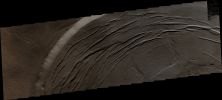
Volcanoes-Olympus_Mons_Caldera-PIA13747.jpgOlympus Mons' Summit Caldera (Absolute Natural Colors; credits for the additional process. and color.: Dr Paolo C. Fienga - Lunexit Team)123 visitenessun commentoMareKromium
(1 voti)
|
|
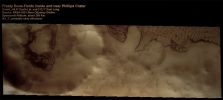
Craters-Phillips_Crater.jpgFrosty Dunefields inside and near Phillips Crater (Absolute Natural Colors; credits for the additional process. and color.: Dr Paolo C. Fienga - Lunexit Team) 128 visitenessun commentoMareKromium
(1 voti)
|
|
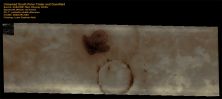
Crater-Unnamed_Buried_South_Polar_Crater.jpgUnnamed (and Buried) South Polar Crater (Absolute Natural Colors; credits for the additional process. and color.: Dr Paolo C. Fienga - Lunexit Team)118 visitenessun commentoMareKromium
(1 voti)
|
|
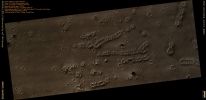
PSP_003494_2075_RED_abrowse.jpgCrater Cluster with Cones and Ridges in Utopia Planitia (Natural Colors; credits for the additional process. and color.: Dr Paolo C. Fienga - Lunexit Team)120 visiteThis image shows Cratered Cones in Utopia Planitia. Cones with Summit Craters join together in places to form Ridges up to several kilometers long, with Troughs running along the Summit.
In many of these cases it is evident that the Ridge Systems formed by merging of multiple Cones, since the arcs of individual Cones can be distinguished.
These features are probably formed by eruption of Subsurface material-Mud or Lava. Lava can form Cinder or Spatter Cones, and eruptions from localized sources along a single Fissure could produce the Ridges.
The absence of obvious (---> evidenti) Lava Flows near the Cones may argue against this mechanism, but ascending Lava could have interacted with Subsurface Water or Ice, leading to a more explosive eruption.
An alternative is eruptions of pressurized Mud from depth ("Mud Volcanism"), a process which occurs in certain environments on Earth.
This observation has a few minor gaps where transmission errors caused data to be lost. These appear as narrow black bars.MareKromium
(1 voti)
|
|

PSP_004052_2045_RED_abrowse-01.jpgUnnamed Crater with Layers near Mawrth Vallis (EDM - Absolute Natural Colors; credits for the additional process. and color.: Dr Paolo C. Fienga - Lunexit Team)106 visitenessun commentoMareKromium
(1 voti)
|
|
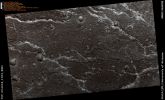
PSP_004018_1505_RED_abrowse.jpgLayers in Columbus Crater (Natural Colors; credits for the additional process. and color.: Dr Paolo C. Fienga - Lunexit Team)87 visiteThis HiRISE image shows bright Layers on the Floor of Columbus Crater, a large Impact Basin in the Southern Highlands of Mars.
The Crater is very old and has gone through much modification. Its Rim is relatively low and the Floor is flat, and it is likely that material has been eroded from the Rim and deposited on the Crater Floor.
The bright stripes that appear in this image at low resolution are likely Sedimentary Deposits. This bright material also includes dark patches which may be embedded within it, or the dark material could be covering the light one. The small-scale topography is rugged, likely an erosional characteristic of the dark material which covers much of the Surface.
Bright materials like those visible here are found in many places on Mars. In this case, it is likely that they are part of the Sediments that have filled the Basin, but it is not certain how they were deposited.
In many places, bright Sediments exhibit fine horizontal banding, suggesting that they were once part of more extensive, flat-lying Layers of rock. In the bright materials here, Layering is rare and the original geometry somewhat more obscure. Impact Craters in the scene have excavated the Dark Surface, but in several cases this has neither exposed layering nor bright material.MareKromium
(1 voti)
|
|

ESP_019589_2340-03.jpgSmall and Shallow (Secondary?) Craters in the Northern Plains (credits for the additional process.: Dr Gianluigi Barca - Lunexit Team)120 visitenessun commentoMareKromium
(1 voti)
|
|

ESP_019589_2340-04.jpgSmall and Shallow (Secondary?) Craters in the Northern Plains (credits for the additional process.: Dr Gianluigi Barca - Lunexit Team)107 visitenessun commentoMareKromium
(1 voti)
|
|
| 25332 immagini su 2111 pagina(e) |
 |
|
|
|
|
1885 | |
|
|
|
|





