| Piú votate |

PHOE-SOL151-lg_42523.jpgLast Frame from Phoenix: End of Transmissions... - Sol 151 (possible True Colors; credits: Lunexit)61 visiteNovember 10, 2008 -- NASA's Phoenix Mars Lander has ceased communications after operating for more than 5 months. As anticipated, seasonal decline in sunshine at the robot's Arctic Landing Site is not providing enough sunlight for the solar arrays to collect the power necessary to charge batteries that operate the lander's instruments.
Mission engineers last received a signal from the lander on Nov. 2. Phoenix, in addition to shorter daylight, has encountered a dustier sky, more clouds and colder temperatures as the Northern Mars Summer approaches Autumn. The mission exceeded its planned operational life of 3 months to conduct and return science data.
The Project Team will be listening carefully during the next few weeks to hear if Phoenix revives and phones home. However, engineers now believe that is unlikely because of the worsening weather conditions on Mars.
While the Spacecraft's work has ended, the analysis of data from the instruments is in its earliest stages.
Nell'immagine: il cielo cupo e sempre più scuro che sovrasta Phoenix, come ripreso intorno alle ore 15:30, M.L.T. e colorizzato da Lunexit in possibli Colori Veri (e nel rispetto della Regola Aurea che vuole il Cielo prossimo all'Orizzonte Marziano più chiaro e poi sempre più scuro a mano a mano che si alza lo sguardo).MareKromium
(8 voti)
|
|

ARP-147.jpgARP 14760 visiteJust a couple of days after the orbiting observatory was brought back online, Hubble aimed its prime working camera, the Wide Field Planetary Camera 2 (WFPC2), at a particularly intriguing target, a pair of Gravitationally Interacting Galaxies called Arp 147.
The image demonstrated that the camera is working exactly as it was before going offline, thereby scoring a "perfect 10" both for performance and beauty.
The two galaxies happen to be oriented so that they appear to mark the number 10. The left-most galaxy, or the "one" in this image, is relatively undisturbed apart from a smooth ring of starlight. It appears nearly on edge to our line of sight. The right-most galaxy, resembling a zero, exhibits a clumpy, blue ring of intense star formation.
The blue ring was most probably formed after the galaxy on the left passed through the galaxy on the right. Just as a pebble thrown into a pond creates an outwardly moving circular wave, a propagating density wave was generated at the point of impact and spread outward. As this density wave collided with material in the target galaxy that was moving inward due to the gravitational pull of the two galaxies, shocks and dense gas were produced, stimulating star formation.
The dusty reddish knot at the lower left of the blue ring probably marks the location of the original nucleus of the galaxy that was hit.
Arp 147 appears in the Arp Atlas of Peculiar Galaxies, compiled by Halton Arp in the 1960s and published in 1966.
This picture was assembled from WFPC2 images taken with three separate filters. The blue, visible-light, and infrared filters are represented by the colors blue, green, and red, respectively.
The galaxy pair was photographed on October 27-28, 2008. Arp 147 lies in the constellation Cetus, and it is more than 400 MLY away from Earth.MareKromium
(8 voti)
|
|

EpsilonEridani-PIA11375.jpgEpsilon Eridani62 visiteThis artist's conception shows the closest known Planetary System to our own, called Epsilon Eridani. Observations from NASA's Spitzer Space Telescope show that the system hosts two Asteroid Belts, in addition to previously identified candidate planets and an outer Comet Ring.
Epsilon Eridani is located about 10 LY away in the constellation Eridanus. It is visible in the night skies with the naked eye.
The System's Inner Asteroid Belt appears as the yellowish ring around the star, while the Outer Asteroid Belt is in the foreground. The outermost Comet Ring is too far out to be seen in this view, but comets originating from it are shown in the upper right corner.
Astronomers think that each of Epsilon Eridani's Asteroid Belts could have a planet orbiting just outside it, shepherding its rocky debris into a ring in the same way that Jupiter helps keep our asteroid belt confined.
The planet near the inner belt was previously identified in 2000 via the radial velocity, or "star wobble", technique, while the planet near the outer belt was inferred when Spitzer discovered the belt.
The inner belt orbits at a distance of about 3 AU from its star — or about the same position as the Asteroid Belt in our own Solar System (an astronomical unit is the distance between Earth and the Sun). The second Asteroid Belt lies at about 20 AU from the star, or a position comparable to Uranus in our Solar System.
The outer Comet Ring orbits from 35 to 90 AU from the star; our Solar System's analogous Kuiper Belt extends from about 30 to 50 AU from the sun.MareKromium
(8 voti)
|
|

Comets-Comet_Holmes-UZ_PIA11228-2.jpgComet 17-P Holmes now in the Outer Solar System60 visiteSpitzer's infrared picture at left hand side of this frame reveals fine dust particles that make up the Outer Shell, or "Coma", of the Comet. The Nucleus of the Comet is within the bright whitish spot in the center, while the yellow area shows solid particles that were blown from the Comet in the explosion.
The Comet is headed away from the Sun, which lies beyond the right-hand side of these pictures.
The contrast-enhanced picture on the right shows the Comet's Outer Shell, and strange "filaments", or "Streamers", of dust. The Streamers and shell are a yet another mystery surrounding Comet Holmes. Scientists had initially suspected that the Streamers were small dust particles ejected from fragments of the Nucleus, or from hyerpactive jets on the Nucleus, during the October 2007 explosion.
If so, both the Streamers and the Shell should have shifted their orientation as the Comet followed its orbit around the Sun.
Radiation pressure from the Sun should have swept the material back and away from it. But pictures of Comet Holmes taken by Spitzer over time show the Streamers and Shell in the same configuration, and not pointing away from the Sun. The observations have left astronomers stumped.
The horizontal line seen in the contrast-enhanced picture is a trail of debris that travels along with the Comet in its orbit.
The Spitzer picture was taken with the Spacecraft's multiband imaging photometer at an infrared wavelength of 24 microns.MareKromium
(8 voti)
|
|
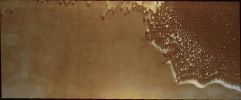
North_Polar_Features-The_Erg-PCF-LXTT-5.jpgVastitas Borealis and the North Polar Erg (Absolute Natural Colors; credits for the additional process. and color.: Dr Paolo C. Fienga - Lunexit Team)60 visiteCoord.: 76,5° North Lat. and 295,6° East Long.MareKromium
(8 voti)
|
|

Titan-N00121492.jpgTitan (natural colors; credits: Lunexit)61 visitenessun commentoMareKromium
(8 voti)
|
|

POLARIS-RT.jpgPolar Hills (by Roberto Tremolada)67 visitenessun commentoMareKromium
(8 voti)
|
|

SOU-SOL027-Yogi_super_res2.jpgYogi on Mars! - Sol 27 (Superdefinition and possible True Colors; credits: Dr G. Barca & Lunexit)72 visitenessun commentoMareKromium
(8 voti)
|
|
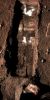
PHOE-SOL121-lg35670-35671-35672-2.jpgIcy Trench... - Sol 121 (Superdefinition and natural colors; credits: Dr G. Barca)58 visitenessun commentoMareKromium
(8 voti)
|
|
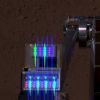
PHOE-SOL116-PIA11225.jpgLights ON - Sol 116 (extra-saturated colors; credits: NASA)59 visiteCaption NASA:"This image is a composite view of NASA's Phoenix Mars Lander's Robotic Arm Camera (RAC) with its lights on, as seen by the Lander's Surface Stereo Imager (SSI). This image combines images taken on the afternoon of Phoenix's 116th Martian day, or Sol (such as September 22, 2008). The RAC is about 8 cm (3" - inches) tall.
The SSI took images of the RAC to test both the light-emitting diodes (LEDs) and cover function. Individual images were taken in three SSI filters that correspond to the red, green, and blue LEDs one at a time. When combined, it appears that all three sets of LEDs are on at the same time.
This composite image is not true color. The streaks of color extending from the LEDs are an artifact from saturated exposure".MareKromium
(8 voti)
|
|
OPP-SOL1651-1.jpgThe Sky over Meridiani Planum - Sol 1651 (True Colors; credits: Dr G. Barca)61 visitenessun commentoMareKromium
(8 voti)
|
|
OPP-SOL1638-1_copia2.jpgDistant Horizon... - Sol 1638 (natural colors; credits: Dr G. Barca)59 visitenessun commentoMareKromium
(8 voti)
|
|
| 25332 immagini su 2111 pagina(e) |
 |
|
|
|
|
188 | |
|
|
|
|





