| Piú votate |

Comets-Garrad-PIA12985.jpgComet Garradd61 visiteThis image from the WISE mission was taken on January 2nd, 2010, during the check-out phase, before the start of the WISE survey. It is a mosaic of 3 individual WISE frames spanning an area on the sky about 7 times the size of the full Moon in portions of the constellations Bootes and Canes Venatici.
In the lower right portion of the image there is a streak of orange light. This is most likely a human-made satellite, orbiting Earth at a higher altitude than the WISE telescope, which is at 523 km above the surface. WISE sees many of these as it scans the sky.
Just above the satellite in the image is Comet C/2008 Q3 (Garradd). Comets are balls of dust and ice left over from the formation of the Solar System. As a comet approaches the Sun it is heated and releases gas and dust from its surface that is blown back by the solar wind into a long, spectacular tail. This comet was discovered in August 2008 by Gordon Garradd of the Siding Spring Observatory in Australia. This comet probably comes from the Oort Cloud, a vast collection of remnants from the formation of the Solar System thought to surround it. At the time the comet was observed by WISE, in the constellation Bootes, it was a distance of 419 million kilometers (2.789 Astronomical Units, AU) from Earth. But we are just catching it while it is near the Sun. The orbit calculated for Comet C/2008 Q3 (Garradd) is inclined to the plane of the Solar System by nearly 140 degrees and takes it very far from the Sun (trillions of kilometers). It made its closest approach to the Sun in June of 2009 at a distance of 1.8 AU (270 million km), just outside the orbit of Mars. If it comes back near the Sun at all, it won't be for hundreds of thousands of years.
In the upper left of the image is the impressive globular cluster Messier 3 (M3). M3 was discovered in the constellation Canes Venatici by famous French Astronomer, Charles Messier in 1764, and first seen to be made of stars around 1784 by the British astronomer who discovered infrared light, William Herschel. Globular clusters are huge globs of stars (hence the name) that are found orbiting in the outer reaches of most galaxies. They are thought to form around the same time that a galaxy forms. The Milky Way has over 200 known globular clusters. M3 is one of the largest and brightest globular clusters around the Milky Way. It is just barely visible to the naked eye from a dark location. M3 is made of about half a million stars, thought to be about 8 billion years old. It is about 150 light-years across (1 light-year is equal to 9.46 trillion km) and located some 34,000 light-years from Earth.
WISE sees invisible infrared light, and the colors here are mapped to 3 of the 4 wavelength bands observed by WISE. Blue represents light with a wavelength of 3.4 microns, cyan maps to 4.6 microns and red is lightat 12 microns (a micron is 1 millionth of a meter, and visible light runs from 0.4-0.7 microns). The light from relatively hot objects, like stars in M3, is seen in blue and cyan. Red color represents cooler things, like dust from the comet and its tail. When this image was taken the WISE team was still calibrating the rate of the scan mirror with the motion of the WISE telescope. The rate was not yet perfected and careful examination of this image reveals some stars that are a little smeared and not exactly aligned in the blue/cyan with the red.
MareKromium
(8 voti)
|
|

Comets-Comet_Siding_Spring-PIA12836.jpgComet Siding Spring64 visiteCaption NASA:"Is it a bird, or a plane? It's comet Siding Spring streaking across the sky, as seen by NASA's Wide-field Infrared Survey Explorer, or WISE.
The comet, also known as C/2007 Q3, was discovered in 2007 by observers in Australia. The snowball-like mass of ice and dust spent billions of years orbiting in the deep freeze of the Oort Cloud, a spherical cloud of comets surrounding our Solar System. At some point, it got knocked out of this orbit and onto a course that brings it closer to the Sun. Sunlight has warmed the Comet, causing it to shed ices and dust in a long tail that trails behind it.
On October 7, 2009, comet Siding Spring passed as close as 1,2 Astronomical Units from Earth and 2,25 Astronomical Units from the Sun (an Astronomical Unit - AU - is the distance between the Sun and Earth). Now, the comet is leaving the warmer, more hospitable neighborhood of the Solar System and heading back out to chillier parts. In this view, longer wavelengths of InfraRed Light are red and shorter wavelengths are blue.
The comet appears red because it is more than ten times colder than the surrounding stars. Colder objects give off more of their light at longer wavelengths.
An ice cube, for example, pours out a larger fraction of its light at longer InfraRed wavelengths than a cup of hot tea emits".MareKromium
(8 voti)
|
|

Titan_and_Dione-EB-LXTT-1.jpgFading in the Background... (Natural Colors; credits: Elisabetta Bonora - Lunexit Team)60 visitenessun commentoMareKromium
(8 voti)
|
|
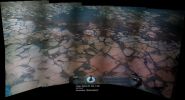
OPP-SOL1390-MF-LXTT.jpgThe Beautiful Martian Paving - Sol 1390 (an Image-Mosaic in False Colors by Dr Marco Faccin - Lunexit Team)89 visitenessun commentoMareKromium
(8 voti)
|
|

Saturnian_Ghost.jpgA Ghost, in the Space of Saturn (by Elisabetta Bonora - Lunexit Team)62 visitenessun commentoMareKromium
(8 voti)
|
|
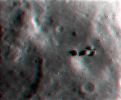
N-M0137673879F4-3d-2.jpgRocky Outcrop on 433-Eros (3D - credits: Dr G. Barca - Lunexit Team)61 visitenessun commentoMareKromium
(8 voti)
|
|

N-M0132559028F4-3d-2.jpgRocky Outcrop on 433-Eros (3D - credits: Dr G. Barca - Lunexit Team)59 visitenessun commentoMareKromium
(8 voti)
|
|

EonsMark-GB-LXTT.jpgThe Eons' Mark (Natural Colors; credits: Dr G. Barca - Lunexit Team)69 visitenessun commentoMareKromium
(8 voti)
|
|
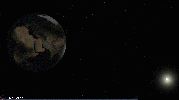
Sun_Storm-2012.gifSun-Storm (by Dr M. Faccin)64 visitenessun commentoMareKromium
(8 voti)
|
|

Volcanic_Features-Lava_Flows-PIA00471.jpgLava Flows (possible Natural Colors; credits: Dr Paolo C. Fienga - Lunexit Team)60 visiteThis is a full resolution mosaic centered at 25° North Latitude and 351° East Longitude.
The Region is approximately 160 Km (100 miles) across. It shows a series of complex Lava Flows which emerge from the Northern Flank of Sif Mons, a large Southern Venusian Volcano.
Several of the Flows occupy narrow troughs formed by long fractures. A sequence of events that can be inferred from this image is the formation of the dark background Plains by eruptions of extremely fluid volcanic material, and the formation of the small Shield Volcanoes on the Plains' Surface that can be seen in the upper left part of the image.
Next, the Region was domed upward probably by heat from the interior of Venus that ultimately caused magmas to break out from the Surface near the Summit Regions forming the Sif volcanic structure and its associated flank eruptions which can be seen in this image.MareKromium
(8 voti)
|
|

Solar_Eclipse~1.jpgEclipse over the Temple of Poseidon59 visitenessun commentoMareKromium
(8 voti)
|
|
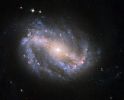
NGC-6217-HST.jpgNGC 6217 - Barred Spiral Galaxy60 visite"...As Servants of God, live as free people..."
- 1 Peter; 2:16MareKromium
(8 voti)
|
|
| 25332 immagini su 2111 pagina(e) |
 |
|
|
|
|
181 | |
|
|
|
|





