| Piú votate |

Supernova1987_A.jpgSupernova SN-1987 A96 visite"...Dalle mie parti i furbi sono cugini dei morti..."
(dal film:"My Name is Nobody")MareKromium
(8 voti)
|
|
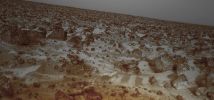
vl2_p21841-1.jpgUtopian Landscape (Absolute Natural Colors; credits for the additional process. and color.: Dr Paolo C. Fienga - Lunexit Team)98 visitenessun commentoMareKromium
(8 voti)
|
|

Asteroids.jpgAsteroids (an Image-Mosaic by Emily Lakdawalla - Planetary Society - & Ted Stryk)105 visiteDalla Rubrica "NASA - Picture of the Day" del giorno 26 Luglio 2010:"As humans explore the Universe, the record for largest Asteroid visited by a Spacecraft has increased yet again. Earlier this month, ESA's robotic Rosetta Spacecraft zipped past the asteroid 21 Lutetia taking data and snapping images in an effort to better determine the history of the Asteroid and the origin of its unusual colors.
Although of unknown composition, Lutetia is not massive enough for gravity to pull it into a sphere.
Pictured above on the upper right, the 100-Km across Lutetia is shown in comparison with the other nine Asteroids and four Comets that have been visited, so far, by human-launched spacecraft. Orbiting in the Main Asteroid Belt, Lutetia shows itself to be a heavily cratered remnant of the early Solar System.
The Rosetta Spacecraft is now continuing onto comet Churyumov-Gerasimenko where a landing is planned for the AD 2014".MareKromium
(8 voti)
|
|

SOL213-2P145272478EFF8500P2273R2M1-IT-LXTT2.jpgIs Anybody Out There??? - Sol 213 (EDM - credits: Ivana Tognoloni - Lunexit Team)118 visitenessun commentoMareKromium
(8 voti)
|
|

OPP-SOL2239-PCF-LXTT.jpgLate Sun over Endeavour (by Dr Paolo C. Fienga - Lunexit Team)85 visitenessun commentoMareKromium
(8 voti)
|
|
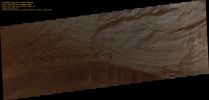
Landslides-Ophir_Chasma-PIA13184.jpgLandslide Deposit in Ophir Chasma (Natural Colors; credits: Dr Paolo C. Fienga - Lunexit Team)57 visitenessun commentoMareKromium
(8 voti)
|
|

Titan-Regions-Fensal_and_Senkyo_Regions-PIA12655-PCF-LXTT.jpgAztlan, Fensal and Senkyo Region (Absolute Natural Colors; credits: Dr Paolo C. Fienga - Lunexit Team)60 visiteCaption NASA:"The Cassini Spacecraft looks toward the dark Senkyo Region on Saturn's moon Titan.
Senkyo is the Dark Region towards the right. Two other Dark Regions, Aztlan (to the left, slanting down below the Equator) and Fensal (left, North of Aztlan), are also shown here.
The bright area below Aztlan is called Tsegihi. This view looks toward the Saturn-facing Side of Titan. North on Titan is up and rotated 9° to the left.
The image was taken with the Cassini Spacecraft narrow-angle camera on April 8, 2010 using a spectral filter sensitive to wavelengths of Near-InfraRed Light centered at 938 nanometers. The view was obtained at a distance of approx. 2,1 MKM (about 1,3 MMs) from Titan and at a Sun-Titan-Spacecraft, or Phase, Angle of 33°.
Image scale is roughly 12 Km (a little more than 7 miles) per pixel".MareKromium
(8 voti)
|
|

ZZ-Mercury-Craters-Copland_Crater-PIA13068.jpgCopland on Mercury (Natural Colors; credits for the additional process. and color.: Dr Paolo C. Fienga - Lunexit Team)127 visiteVisible in the center of this image is the Crater Copland, recently named in honor of the American composer and pianist Aaron Copland.
Aaron Copland and this Crater are both unquestionably worthy candidates for named features on Mercury, but how this specific crater came to be known as Copland has an interesting back-story.
Amateur astronomer Ronald Dantowitz and his colleagues Scott Teare and Marek Kozubal used the Mt. Wilson 60-inch telescope in 1998 to observe a very bright feature on this portion of Mercury's surface, and they assumed that the bright feature was an impact crater.
Mr. Dantowitz expressed his wish that the crater be named "Copland" once better images of the area were obtained from spacecraft. Surprisingly, MESSENGER images from Mercury flyby 3 revealed that the small bright feature, seen at the left edge of this image, is not an impact crater but more closely resembles a Volcanic Vent.
No convention for naming Volcanic Vents on Mercury has yet been adopted, because none were identified prior to MESSENGER's first Mercury flyby. However, even if a convention for naming volcanic features on Mercury is adopted in the future, the naming rules will likely differ from those for impact craters, and thus "Copland" would probably not be an acceptable name for the bright volcanic feature.
A MESSENGER team member corresponded with Mr. Dantowitz and suggested that the name Copland be proposed instead for a large crater nearby.
He agreed, and the International Astronomical Union (IAU) approved the name Copland on March 3, 2010. Copland crater is flooded with volcanic smooth plains material that could be related to the activity that formed the bright vent.
Date Acquired: September 29, 2009
Instrument: Narrow Angle Camera (WAC) of the Mercury Dual Imaging System (MDIS)
Scale: Copland crater has a diameter of about 208 Km (approx. 129 miles)
Projection: This image is a portion of the NAC approach mosaic from Mercury flyby 3. It is shown in a simple cylindrical map projection with a resolution of roughly 500 meters/pixel (approx. 0,31 miles/pixel).MareKromium
(8 voti)
|
|

SOL067-PCF-LXTT2.jpgShining in the Sunshine...154 visitenessun commentoMareKromium
(8 voti)
|
|

OPP-SOL2055-1P310618128EFFA9G7P2444L6M1-3.jpgCold Sunshine over Meridiani n. 2 (by Paolo C. Fienga)245 visitenessun commentoMareKromium
(8 voti)
|
|

Craters-Proctor_Crater-PIA13076.jpgProctor's Dunes (Possible Natural Colors; credits for the additional process. and color.: Dr Paolo C. Fienga - Lunexit Team)92 visiteThis observation shows the edge of a dark Dunefield on the Floor of Proctor Crater, an about 150 Km (approx. 93 miles) diameter crater in the Southern Highlands of Mars.
This subimage is a close-up view of the dark dunes. These dunes are most likely composed of basaltic sand that has collected on the bottom of the crater. Superimposed on their surface are smaller secondary dunes which are commonly seen on terrestrial dunes of this size. Near the crests of the dark dunes are bright patches of frost. Dark spots within the frost patches are areas where defrosting is occurring.
Many smaller and brighter bed forms, most likely small dunes or granule ripples, cover the substrate between the larger dark dunes as well as most of the Floor of Proctor Crater. In many locations, large boulders are seen on the same surfaces as the bright bed forms.
The dark dunes stratigraphically overlie the small bright bed forms indicating that the darker dunes formed more recently.
However in several areas, the dark dunes appear to influence the orientation of the small bright dunes, possibly by wind flowing around the larger dunes, suggesting that both dark and bright bed forms are coeval.MareKromium
(8 voti)
|
|
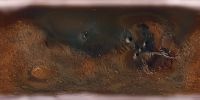
028-Mars_Colors-MF-LXTT2.jpgFull Map of Mars (Approximate Natural Colors; credits: Dr Marco Faccin - Lunexit Team)75 visite...E anche questa è ARTE...MareKromium
(8 voti)
|
|
| 25332 immagini su 2111 pagina(e) |
 |
|
|
|
|
180 | |
|
|
|
|





